




Japan's Abe closes trip with Malaysia talks
Japanese Prime Minister Shinzo Abe closed a three-nation tour in Malaysia yesterday, where maritime security in the piracy-hit Malacca Straits and economic ties topped the agenda, officials said.
Japanese Prime Minister Shinzo Abe closed a three-nation tour in Malaysia yesterday, where maritime security in the piracy-hit Malacca Straits and economic ties topped the agenda, officials said.
Abe brought his wife Akie, business delegates and government officials for his first official visit to Malaysia, a nation his grandfather, former premier Nobusuke Kishi, visited on its independence 50 years ago.
The Japanese leader was on the last leg of a tour which has taken him to India and Indonesia. Analysts say the trip was aimed at countering China's rising regional influence.
But the Japanese leader insisted that Beijing was not a threat.
"Asean is the growth centre of Asia and indeed the world," Abe told reporters, referring to the 10-nation Southeast Asian group.
 "China that grows economically is not regarded as a threat, it represents an opportunity. Asean and China are not juxtaposed concepts and we have no intention to juxtapose the two against each other."
Growing cooperation
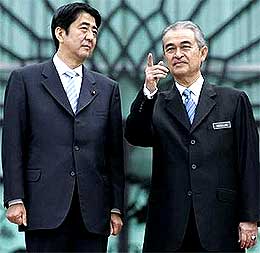
After talks between Abe and Malaysian Prime Minister Abdullah Ahmad Badawi, they issued a joint statement pledging to promote closer economic ties.
"I hope Japan-Malaysia economic cooperation will grow further and further," Abe also told a business forum in Kuala Lumpur.
A Japanese foreign ministry official said earlier the leaders would discuss "the fight against terrorism" including unrest in the southern Philippines.
The leaders also raised security in the vital Malacca Straits sea lane, the statement said. Sporadic pirate attacks in the waterway have sparked concern that it could be a target for terrorism, with Malaysian police in June warning of a "real and possible" threat.
"Prime Minister Abdullah reaffirmed Malaysia's commitment in continuing with its efforts to ensure the safety and security of maritime navigation within its maritime areas as well as the Straits of Malacca and Singapore," it read.
Half of the world's oil shipments pass through the Malacca Straits, which is shared by Malaysia, Indonesia and Singapore.
Hiro Katsumata, a research fellow at the S Rajaratnam School of International Studies in Singapore, said Tokyo was keen to establish strong maritime security ties with Indonesia and Malaysia, as China and Japan used the same sea lane to import much of their oil from the Middle East.
"For both of them it is a lifeline," he said. "He chose (to visit) these two countries for the same reason he chose India - it's all based on his concern about the rise of China."
Malaysia, he also said, would be keen to further the economic and technical assistance that Japan provides, particularly in the automobile industry.
Viable business partner
Abdullah hailed a free trade pact signed by Japan and Malaysia in 2006, and said that trade between the two nations had risen more than 15 percent since 1997 to 31.3 billion dollars in 2006.
"The Japanese business community should look at Malaysia as a viable business partner within the framework of Asean," he said.
"Malaysia can be used as a spring board to penetrate other markets in the Asian region," he told about 300 Japanese and Malaysian business leaders.
Malaysia is facing competition for foreign investment from nearby emerging destinations like China, Thailand and Vietnam.
About 240 business delegates - including top officials from Toyota, Canon, Honda and Mitsubishi - travelled to Malaysia with Abe.
Abdullah and his counterpart also pledged to work together to battle climate change, sharing knowledge on the energy and environment.
On North Korea, they urged the communist state to continue towards denuclearisation, while Malaysia "expressed support" for Japan's bid to seek a permanent seat on the UN Security Council.
Abe returned to Tokyo today.


Are you sure you want to delete this comment?
This action cannot be undone.