


/file/publisher-c1a3f893382d2b2f8a9aa22a654d9c97/2021/10/817dd182433d41d9c95a94a93c69e605.jpg)

Sense of discrimination rises in Chinese, Indian youths - survey
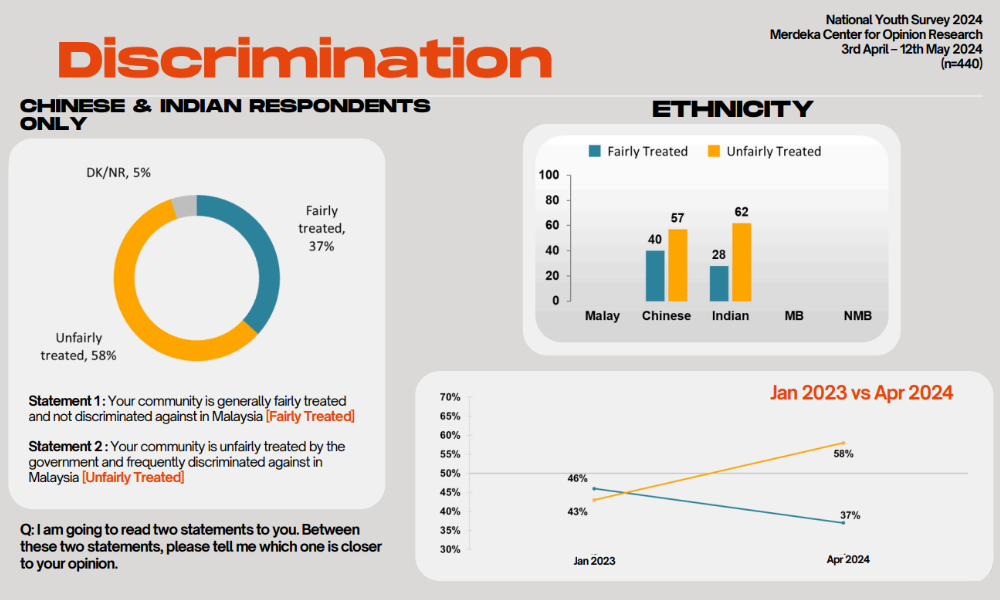
According to the Merdeka Center Youth Survey 2024, 58 percent of Chinese and Indian respondents felt their communities were unfairly treated, up from 43 percent last year.
The perceived discrimination was also said to have stemmed from...
There has been a rising sense of discrimination among Chinese and Indian youth in the country.
According to the Merdeka Center Youth Survey 2024, 58 percent of Chinese and Indian respondents felt their communities were unfairly treated, up from 43 percent last year.
The perceived discrimination was also said to have stemmed from unfair treatment by the government.
Bumi privileges
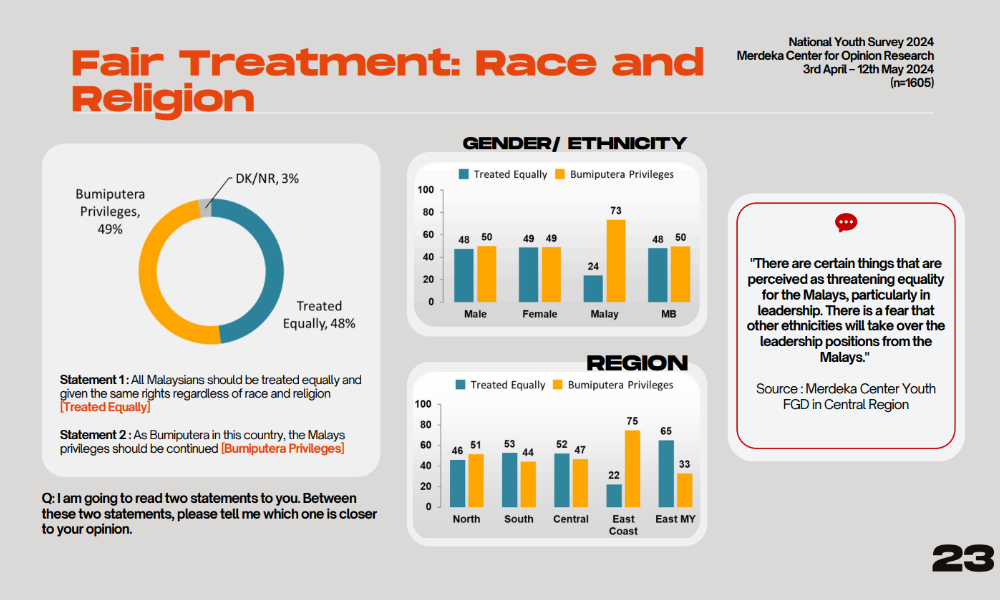
Support for Bumiputera privileges among Malay youths polled at 74 percent, versus 24 percent who favoured equal treatment.
Support for maintaining these privileges was strongest among voters from the peninsula’s east coast (75 percent) compared to other regions (33 percent to 51 percent).
“There are certain things that are perceived as threatening equality for the Malays, particularly in leadership. There is a fear that other ethnicities will take over the leadership positions from the Malays,” the report read, quoting a participant at one of Merdeka Center’s focus group discussions.
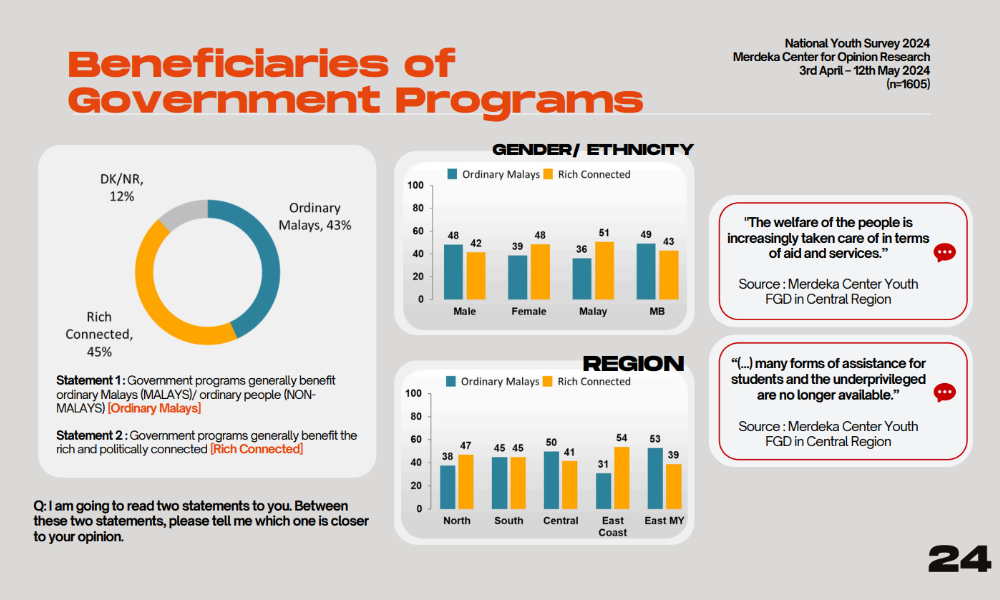
Despite this, the survey found that opinions are divided on whether the government’s programmes generally benefit ordinary people (45 percent) or the rich and politically connected (43 percent).
For context, the survey asked respondents which of two statements align more closely with their opinions, but the wording of the first statement is changed based on the respondent’s race.
Malay respondents were asked whether “Government programmes generally benefit ordinary Malays”, whereas for non-Malay respondents, the phrase “ordinary Malays” were changed to “ordinary people”.
The second statement for the question is whether they agree that “Government programmes generally benefit the rich and politically connected”.
Trust between ethnicities
The survey also revealed insights into trust levels between ethnicities.
Chinese respondents reported high trust in the Malay community (92 percent), while Indians showed strong trust in the Chinese (83 percent).
However, Malays reported lower trust levels toward both Chinese (57 percent) and Indian (53 percent) groups.
Trust within same ethnicity
Regarding trust levels within the same community, the Chinese exhibited the highest level (95 percent), followed by Indians (85 percent), and Malays (75 percent).
Additionally, 73 percent, or about 1,171 respondents, reported having friends from different ethnic backgrounds, though the Malays made up the lowest percentage (66 percent) in this regard.
Choosing friends based on race
Some participants also expressed that ethnicity played little to no role in their choice of friends.
“I do not care about their friend’s background as long as they are good and friendly,” the report highlighted in one focus group discussion participant’s comments.
Genders mingling
In a related finding, the survey revealed that 52 percent of respondents were comfortable with Muslims attending concerts, even in a mixed-gender crowd.
However, the survey also recorded a higher percentage of men (45 percent) who disagreed with the idea, compared to only 36 percent of women expressing the same view.
Some respondents suggested incorporating the concept of mahram, noting concerns about men and women potentially mingling in crowded spaces.
A mahram is a close relative whom one is prohibited from marrying, such as a father, brother, son, or uncle. In Islam, a woman is not required to adhere to strict modesty rules in the presence of her mahram.
Those surveyed
The survey included 1,605 respondents aged 18 to 30 who were polled via telephone between April 3 and May 12. They were selected randomly along the lines of ethnicity, gender, age, and state to help ensure a nationally representative sample.
In addition, Merdeka Center conducted a series of eight focus group discussions involving 46 Malay youths, and five workshops involving 185 youths.
/file/publisher-c1a3f893382d2b2f8a9aa22a654d9c97/2024/09/8812128d697dcf238973ddbf33c4febb.jpg)
/file/1333/94c1365c168bcccf0fd2a977c2f22af7.jpeg)
/file/publisher-c1a3f893382d2b2f8a9aa22a654d9c97/2024/04/87737f53aa942afce9ce0dfc7404a95e.jpg)
/file/publisher-c1a3f893382d2b2f8a9aa22a654d9c97/2024/01/46cd2d6256d8adca2ccbf21a7fc25ff6.jpg)


Report this comment
Are you sure you want to delete this comment?
This action cannot be undone.