




Musa plays matchmaker to Johor and Xinjiang
Boxes upon boxes of grapes and Hami melons, Xinjiang's famed produce, cluttered the check-in queue at Urumqi airport.
Stacked high, too, was luggage from a group of Johor state and private sector officials, waiting to go home after a three-day weekend visit to this north western China provincial capital that has the reputation as the world's most land-locked city.
Boxes upon boxes of grapes and Hami melons, Xinjiang's famed produce, cluttered the check-in queue at Urumqi airport.
Stacked high, too, was luggage from a group of Johor state and private sector officials, waiting to go home after a three-day weekend visit to this north western China provincial capital that has the reputation as the world's most land-locked city.
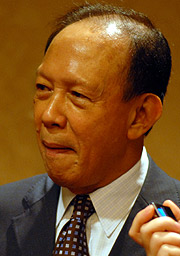
Leading the first-time delegation were Johor Menteri Besar Abdul Ghani Othman and Tun Musa Hitam, who is joint chairman of the Malaysia-China Business Council and a special adviser to the Iskandar Development Region (IDR).
"Tun Musa has been so persistent and persuasive in selling Xinjiang that we could not help but come and see the beauty of this region ourselves," Abdul Ghani said.
Mutual economic good
 Despite the vast distance that separates Johor and Xinjiang, Abdul Ghani sees synergy in the similar multi-ethnic, Islamic and
halal
background that they can harness for mutual economic good.
Despite the vast distance that separates Johor and Xinjiang, Abdul Ghani sees synergy in the similar multi-ethnic, Islamic and
halal
background that they can harness for mutual economic good.
Both Johor and Xinjiang are strong agriculture producers and can collaborate in textile and furniture making to sell to the world market, he said, pointing to Johor's Batu Pahat and Muar districts which are Malaysia's biggest textile and furniture producers.
"There is ample opportunity for both sides to forge business alliances or networks and work together on design and product development to increase our global market share," he said.
"Xinjiang is the biggest producer of lavender oil, sweet grapes and fruits. We in Johor are also Malaysia's top producer of fresh vegetables, poultry, poultry eggs and fruits. We cannot let these similarities go to waste."
 He pointed out that tropical Malaysia with its long coastlines and islands offers a refreshing change for visitors from the desert landscapes of Xinjiang.
Musa sees the Muslim-dominated autonomous region as the stepping stone for Bumiputera businessmen to venture into China.
Ski resort planned
"Xinjiang borders eight countries, including the Commonwealth of Independent States (CIS), and it can be a source of tourists to Malaysia and Johor and vice versa. People here can visit our islands and enjoy the sunny weather and Malaysians can come here for holidays even in winter," he said.
He was briefed by the provincial tourism bureau that a ski resort is being planned with an American partner because Xinjiang is covered with a thick blanket of snow during winter which already draws tourists from Hong Kong.
Musa also visited the Xinjiang Medical University (XMU) and Xinjiang University to explore the possibility of establishing education links with Johor.
"As the medical university teaches foreign students in English, I will follow up on this in Malaysia. Education and tourism are important sectors for the IDR as well," he added.
Once a key stopover along the ancient Silk Road, Xinjiang borders Russia, Kazakhstan, Kyrgyzstan, Tajikistan (which are three of the 11 CIS members), Pakistan, Mongolia, India and Afghanistan, and has a population of 20 million.
-Reproduced with permission from Bernama


