




Subashini's husband 'abused' legal process
T Saravanan had abused the legal process in his attempt to gain tactical advantage over his wife by seeking relief from the syariah courts, lawyer Malik Imtiaz Sarwar told the Federal Court today.
T Saravanan had abused the legal process in his attempt to gain tactical advantage over his wife by seeking relief from the syariah courts, lawyer Malik Imtiaz Sarwar told the Federal Court today.
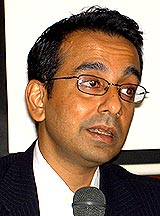 Malik, who was appearing for secretary R Subashini, told the three-man bench led by Justice Nik Hashim Nik Ab Rahman that Saravanan had acted in "defiance of logic and reason" by filing divorce and custody claims with the syariah courts after his conversion to Islam.
"This approach would result, if permitted to crystalize, in the unlawful and unconscionable deprivation of constitutional rights accorded to the wife.
"It would in all probability result in the wife being deprived of her right to custody of her children," the lawyer argued.
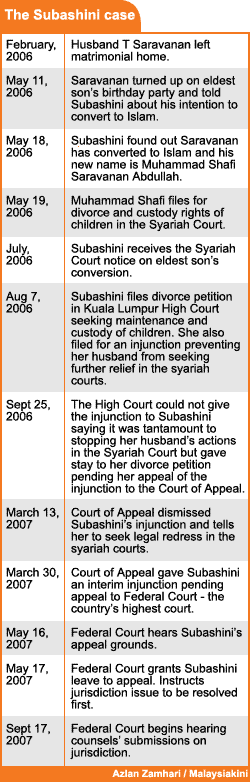
Subashini, 28, a Hindu, is trying to stop her 31-year-old husband, who has assumed the name Muhammad Shafi Saravanan Abdullah, from taking matrimonial proceedings to the syariah courts.
Her battle began when her husband converted to Islam in May 2006, along with their eldest son, Dharvin Joshua, 4.
The husband then launched proceedings in the syariah courts for divorce and custody of their second son, Sharvin, 2.
Evading obligation
Malik told the bench that the jurisdiction should be at the civil court because Saravanan's right to embrace Islam should not extend to evading his obligation under the civil law to his wife and children.
 "Syariah courts have no power to adjudicate over marriages under Law Reform (Marriage and Divorce) Act 1976 nor can they decide on issues flowing from a civil marriage.
"By contracting a marriage under LRA, both parties had agreed to be bound by the provisions of LRA in respect of matters pertaining to the marriage including divorce and custody," he said.
Malik also argued that the country's highest court had recently ruled unanimously in the case of Latifah Mat Zin that jurisdiction over a non-Muslim fell under the civil court because the syariah court is only for individuals professing Islam.
He stressed that Article 121 (1A) of the Federal Constitution - which states that the civil court has no jurisdiction on matters under the purview of the syariah court - is not applicable based on the facts.
"There is no question of the syariah courts having 'subject matter' jurisdiction as syariah courts only have jurisdiction over persons who profess Islam. The wife is not such a person," he said.
On the conversion of Dharvin, Malik argued that Saravanan had no right to convert either child of the marriage to Islam without Subashini's consent based on the constitution, Section 5 of the Guardianship of Infants Act 1961 and Section 117 of the Selangor Administration of Islamic Law Enactment 2003.
"(These legislation) expressly provides that the consent of both parents is needed. (Subashini) was denied her constitutional right to determine the religious instruction of her child," he said.
Special position
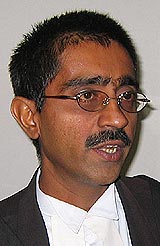 Meanwhile, Saravanan's lawyer Mohamed Haniff Khatri Abdullah said the syariah court has jurisdiction because religious rulings allow for a marriage between a Muslim and a non-Muslim to be dissolved after three months.
"The dissolution need not be conferred by the civil courts. It has to do with the special position of the religious rulings (in Islamic law)," he said.
Haniff also argued that the subject-matter fell under Article 121(1A) and it does not matter whether Subashini has remedy in the syariah courts or not.
"It is not about whether a person has remedy or not in syariah courts. This is a non-issue.
"Both parties need not be Muslim to go to the syariah courts. As long as the subject matter falls under the purview of syariah law, syariah court jurisdiction suffices," he said.
Haniff did not finish his submission as the court adjourned around 2.30pm. The trial will resume tomorrow.
The other two judges presiding over this case were Abdul Aziz Mohamad and Azmel Ma'amor.


Are you sure you want to delete this comment?
This action cannot be undone.