


/file/publisher-c1a3f893382d2b2f8a9aa22a654d9c97/2024/11/2b3cc6405801e670fbd33831b55962ef.jpg)

Carved stone on Gunung Ledang has no historical value - official
The authenticity of the supposed inscription stone at the peak of Gunung Ledang in Johor has been clarified, with authorities confirming it to be merely a carved stone with no historical value.
Johor National Parks Corporation director Taufik Bahar said that the stone, discovered by members of the public at the mountain’s summit, cannot be classified as an inscription stone.
The authenticity of the supposed inscription stone at the peak of Gunung Ledang in Johor has been clarified, with authorities confirming it to be merely a carved stone with no historical value.
Johor National Parks Corporation director Taufik Bahar said that the stone, discovered by members of the public at the mountain’s summit, cannot be classified as an inscription stone.
Taufik said checks conducted by the corporation with the Johor Archives Department revealed that the stone did not contain formal text or significant documents.
“The Johor National Parks Corporation director is aware of the existence of a carved stone at Gunung Ledang.
“However, this stone does not qualify as an inscription stone, which historically contains formal texts or important documents.
“Through verification with relevant authorities such as the Johor Archives Department, the carved stone has been identified as lacking historical value or official documentation,” he said in a statement to Malaysiakini.
“The text or carvings on the stone are more like notes or graffiti left by hikers who reached the mountain’s summit.
“These carvings often take the form of names, dates, or personal messages as a mark of their presence.
“Nevertheless, the Johor National Parks Corporation welcomes historians or any interested parties to conduct research on the carved stone,” he added.
Mysterious stone
The National Heritage Department had previously been urged to investigate the mysterious stone at the summit of Gunung Ledang.
This came after disputes over whether the stone was a genuine historical artefact or merely modern-day etchings.
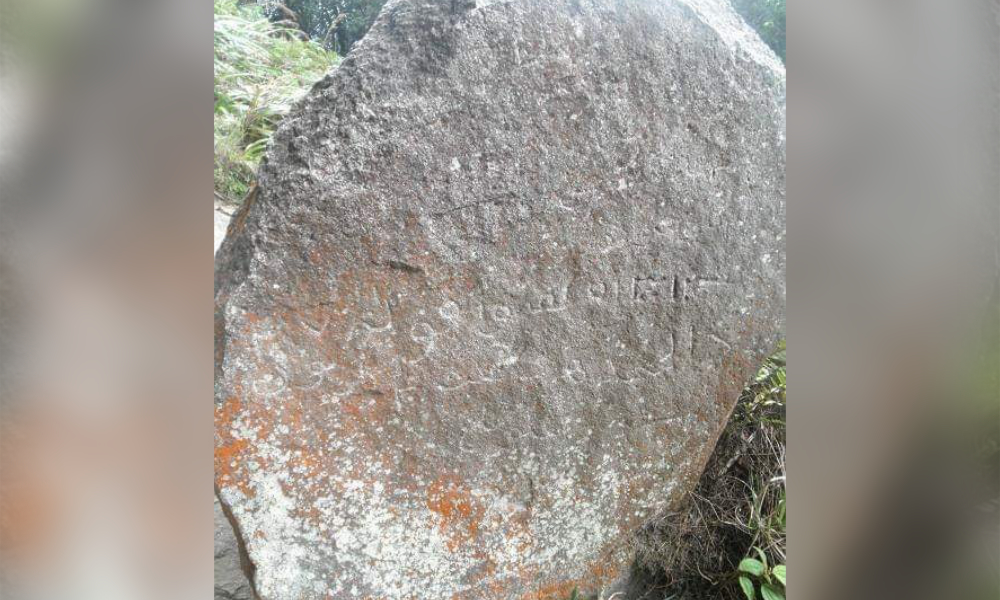
Various myths link the stone to legendary figures such as Puteri Gunung Ledang, Hang Tuah, and a Javanese ruler from the Demak kingdom.
Some social media users have claimed that the inscriptions are an old Jawi script, while others speculated they are ancient Kawi characters.
Kawi is a Brahmic writing system used around the Maritime Southeast Asia region since around the eighth century until it was supplanted by the Arabic-based Jawi script following the spread of Islam.
However, the exact words carved on the stone remain unclear.
/file/publisher-c1a3f893382d2b2f8a9aa22a654d9c97/2023/12/c75495eecc76fa41202ef33803282302.jpg)
/file/publisher-c1a3f893382d2b2f8a9aa22a654d9c97/2021/04/6b0e4c802ceaeb687f252b494a054524.jpg)
/file/publisher-c1a3f893382d2b2f8a9aa22a654d9c97/2020/05/565b5f383344288bc5f312044c6ff3a1.jpg)
/file/publisher-c1a3f893382d2b2f8a9aa22a654d9c97/2024/11/21849bf39113891b7f533b8edddf770a.jpg)
/file/publisher-c1a3f893382d2b2f8a9aa22a654d9c97/2024/11/2dc61544ba97269e905ee75400858362.jpg)


Are you sure you want to delete this comment?
This action cannot be undone.