




Campus polls: Pro-gov't students still rule
'Pro-government' or Aspirasi groups wrested control over most of the public universities in campus polls held yesterday, but not without a fight from their arch-rivals - the 'pro-students' faction.
'Pro-government' or Aspirasi groups wrested control over most of the public universities in campus polls held yesterday, but not without a fight from their arch-rivals - the 'pro-students' faction.
 Pro-student groups, generally considered as anti-establishment - retained their dominance in the International Islamic University of Malaysia - the sole campus among the 17 public universities which has bucked the trend.
However, results are still pending at Universiti Malaya (UM) and Universiti Malaysia Sabah.
The UM election committee has delayed announcing election results after a protest by the 'anti-establishment' faction during vote-counting last night, allegedly due to irregularities.
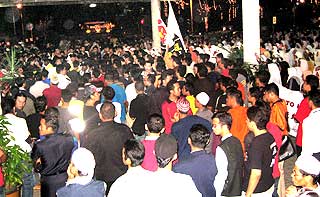 The faction claimed that phantom voters were spotted at UM's 12th Residential College and demanded that students be made to vote again.
The authorities agreed to this being done tomorrow, after which the count will be added to the campus-wide results.
Nevertheless, it is expected that the pro-government forces will win in the two remaining campuses.
Round-up of results
The pro-government students continue ruled the day in top campuses such as UM, USM and UKM where only two years ago anti-establishment sentiments were pronounced.
Previously, pro-government students were stronger in the newer universities, where they easily retained control.
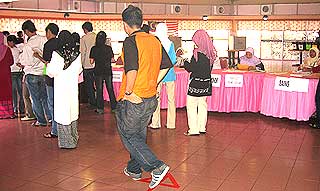 In Universiti Putra Malaysia, the situation was similar to last year's results with
Aspirasi
crushing its opponents by taking 42 seats against 6 seats by its rivals.
In Universiti Putra Malaysia, the situation was similar to last year's results with
Aspirasi
crushing its opponents by taking 42 seats against 6 seats by its rivals.
It won 28 seats against 8 in Universiti Sains Malaysia; and 31 seats against 9 in Universiti Teknologi Malaysia.
 Aspirasi
also swept all the seats in Universiti Malaysia Pahang, University Darul Iman Malaysia, Universiti Pendidikan Sultan Idris, Universiti Teknikal Melaka Malaysia, Universiti Malaysia Terengganu, Universiti Malaysia Perlis, Universiti Teknologi Mara, Universiti Sains Islam Malaysia and Universiti Utara Malaysia.
Aspirasi
also swept all the seats in Universiti Malaysia Pahang, University Darul Iman Malaysia, Universiti Pendidikan Sultan Idris, Universiti Teknikal Melaka Malaysia, Universiti Malaysia Terengganu, Universiti Malaysia Perlis, Universiti Teknologi Mara, Universiti Sains Islam Malaysia and Universiti Utara Malaysia.
In recent years, pro-government students - with active assistance from campus authorities - have made remarkable inroads.
For example, the universities have implemented a slew of new rules, including electronic voting, which some have alleged to be skewed to favour Aspirasi candidates.
The pro-students group boycotted elections in 2005 after complaining about unfair rules and dirty tactics by rivals. Last year, it suffered its worst defeat in student politics.
The pro-student faction has long demanded that the annual polls be monitored by the Human Rights Commission, but university authorities have rejected the proposal.


