




Candlelight vigil for victims of Burmese crackdown
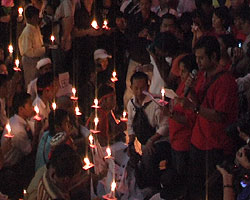
About 300 men, women and children were somberly silent last night, holding lit candles that easily brightened their symbolically red outfit.
About 300 men, women and children were somberly silent last night, holding lit candles that easily brightened their symbolically red outfit.
"Free Burma! Stop the bloodshed!" - this was the purpose of the vigil, a tribute to the presumably hundreds murdered, arrested and assaulted in the recent brutal crackdown on pro-democracy protesters on the streets of Rangoon by the military junta.
The candlelight vigil was organised by local human rights NGOs - Suara Rakyat Malaysia, Amnesty International Malaysia (AI), Youth for Change and the Civil Rights Committee of Kuala Lumpur and Selangor Chinese Assembly Hall.
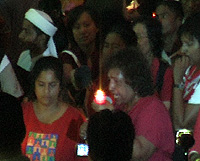 Alhough such an event often attracts only political and social activists, last night's vigil at the Petronas Twin Towers in Kuala Lumpur also saw the presence of Burmese women and children, all neatly dressed up in their national outfit.
'Stop the bloodshed!' and 'Free Burma!' banners were held up by those present, as if to signal to passing motorists that all is not well in Burma. The location was also significant - it is to inform the public that Petronas' hands are patting the back of the Burmese junta.
The vigil started with speeches from the organisers with poem recitals in between, accompanied by soft, background music.
In his speech, Shannon Shah, Executive Director of AI Malaysia said that Malaysia, as an influential Asean member, must pressure the junta to restore democracy to Burma.
"As council member of the United Nations Human Rights Council, Malaysia must step up and push for a full arms embargo on the junta," he added.
Malaysian interests
Tenaganita director Irene Fernandez also stressed on the important role the Malaysian government can play to stop the junta's brutal exertion of power on the Burmese people.
 "I think what Malaysia can do is to withdraw all its economic interests on Burmese soil. Having economic interests there directly supports the junta. Only if Malaysia withdraws all its businesses and impose an all-out economic sanction will there be hope to restore democracy in the country, " she added.
Petronas, according to Human Rights Watch, has contributed significantly to human rights abuses via a pipeline construction project in collaboration with Thailand's PTT Exploration, Production Co Ltd (PTTEP) and the junta in the natural gas-rich district of Yetagun in Burma.
Such projects often involve forced evictions, forced labour and other abuses on the locations of these investments.
According to Times Asia magazine, two existing operations, one managed by France's Total and the other by Petronas, provided Burma with about US$1 billion in revenues in 2005.
Burma's gas business, through the junta's State Peace and Development Council's helps sustain military rule in the country and currently comprise at least 30 percent of the country's exports.
Political refugees?
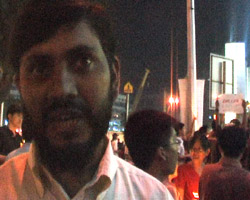 On another matter, Mohammad Sadek (
left
), a Rohingya and vice-chairperson of local Burmese group All Burma Democratic Force (ABDF) asked the Malaysian government to stop being blind to the plight of Burmese refugees in Malaysia.
On another matter, Mohammad Sadek (
left
), a Rohingya and vice-chairperson of local Burmese group All Burma Democratic Force (ABDF) asked the Malaysian government to stop being blind to the plight of Burmese refugees in Malaysia.
"What the government can do is to recognise Burmese asylum seekers in this country as political refugees so that human rights abuses by authorities like the police and the Voluntary Corps (Rela) can stop."
Burmese and other migrants here have experienced degradation and humiliation in a form of extortion, unlawful arrests and even rape, often perpetrated by the police and Rela members due to their 'illegal' immigrant status.
After news of the brutal military crackdown reached this country, about 2,000 people flooded the Burmese embassy in Kuala Lumpur on Sept 28 to protest.
Watch the three-minute video here.


