


/file/publisher-c1a3f893382d2b2f8a9aa22a654d9c97/2020/10/2bda679309c88e264ef963588bbe46d2.jpg)

Govt must reform all protest laws after court ruling on PAA - Amnesty
The government should take heed of the Federal Court’s ruling today striking down the five-day notice requirement for rally organisers by overhauling all laws that suppress dissent, said Amnesty International Malaysia.
The group’s interim executive director, Vilasini Vijandran, stressed that even as the rule enshrined under Section 9(5) of the Peaceful Assembly Act (PAA) 2012 is declared null and void...
Summary
Amnesty International Malaysia urges the government to reform all repressive laws that curb dissent, following the Federal Court's decision striking down Section 9(5) of the Peaceful Assembly Act.
Its interim executive director Vilasini Vijandran warns that authorities may still use laws like the Sedition Act and Penal Code to harass protesters.
Suaram says the ruling affirms that peaceful assembly is a right and not a privilege granted at the discretion of authorities.
The government should take heed of the Federal Court’s ruling today striking down the five-day notice requirement for rally organisers by overhauling all laws that suppress dissent, said Amnesty International Malaysia.
The group’s interim executive director, Vilasini Vijandran, stressed that even as the rule enshrined under Section 9(5) of the Peaceful Assembly Act (PAA) 2012 is declared null and void by the Federal Court, the government must stop relying on other repressive laws to fill the gap.
“We remain acutely aware that authorities can continue weaponising the Sedition Act, Penal Code, and other repressive laws to investigate and harass protesters.
“If the Madani government is truly committed to protecting peaceful assembly, it must dismantle the wider legal framework used to silence dissent and bring all laws in line with constitutional protections and international human rights standards,” she said in a statement today.
Earlier, a five-member bench led by Chief Justice Tengku Maimun Tuan Mat delivered a unanimous ruling deeming Section 9(5) of the PAA unconstitutional, in relation to a challenge brought by former Muda secretary-general Amir Hariri Abdul Hadi.
Tengku Maimun said Section 9(5) of the PAA imposes a punishment that exceeds the limits permitted under Article 10(1)(b) of the Federal Constitution, which guarantees the freedom of speech, assembly, and association.
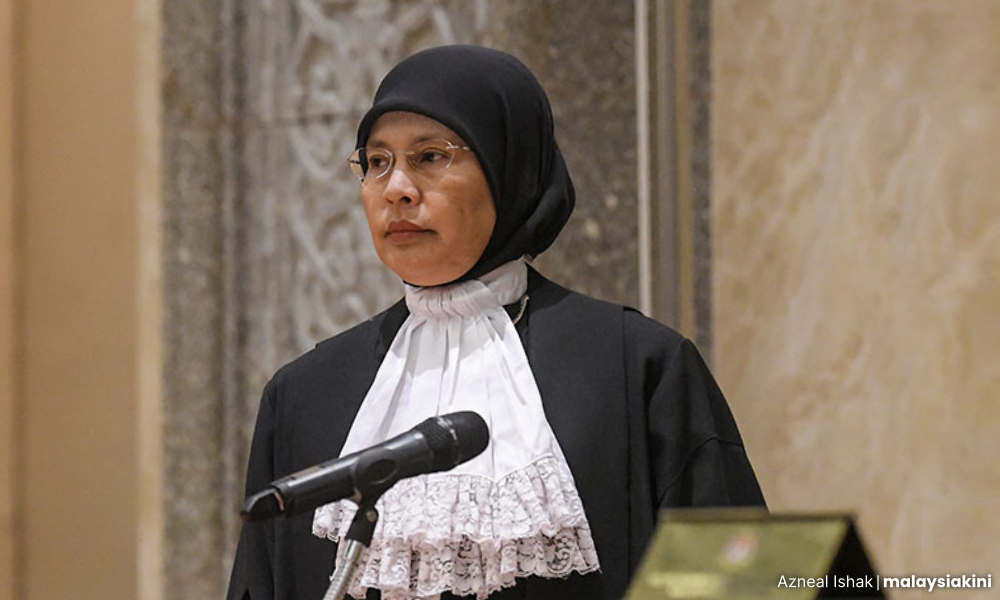
She also described the section as “a disproportionate intervention” that amounted to a prohibition rather than a restriction on the guaranteed rights.
She also directed that Amir’s ongoing criminal proceedings, related to a 2022 protest over the littoral combat ship issue, be remitted to the High Court and disposed of in line with the apex court’s judgment.
Powerful precedent
In welcoming the landmark ruling as a significant step in the right direction, Vilasini said the apex court’s decision sets a powerful precedent for the protection of the constitutionally guaranteed right to peaceful assembly.
She highlighted that punishing individuals who wish to exercise their right to peaceful protest, simply for failing to give police a five-day notice, has always been a “disproportionate and punitive restriction on civic freedom”.
“For too long, Malaysian authorities have approached peaceful gatherings as threats, reinforced by harmful policies, narratives and policing practices that depict protests as a crime rather than a democratic right.
“Today’s decision marks a shift away from that legacy. This ruling must now spark a broader change in how peaceful assemblies are treated in Malaysia,” she added.
Right, not privilege
Separately, rights group Suaram said the judgment affirms that peaceful assembly is a right and not a privilege granted at the discretion of authorities.

Suaram executive director Azura Nasron said the judgment also reiterates the state's positive duty to facilitate and create enabling environmental conditions for assemblies, including those that are urgent and spontaneous.
"This ruling also presents the government with a renewed opportunity to better uphold its democratic mandate by ensuring that the right to peaceful assembly is fully protected - both in law and in practice - as a foundation of participatory governance and rule of law," she said.
As such, Suaram urged the government to honour the decision and immediately impose a moratorium on the use of Section 9(5) and ensure its full repeal in the upcoming PAA amendments.
/file/publisher-c1a3f893382d2b2f8a9aa22a654d9c97/2024/01/5f30339bbc397e585836c6c69685ad10.png)
/file/publisher-c1a3f893382d2b2f8a9aa22a654d9c97/2025/06/b48a7a6c3b2dd3c4c3b7ac5339557b2a.jpg)
/file/publisher-c1a3f893382d2b2f8a9aa22a654d9c97/2025/06/3ec4d090a164fb0fa1e478a90fb90f3b.jpg)
/file/publisher-c1a3f893382d2b2f8a9aa22a654d9c97/2024/09/77ee9fd135ddbdcc693169e2d29407fa.jpg)


Report this comment
Are you sure you want to delete this comment?
This action cannot be undone.