
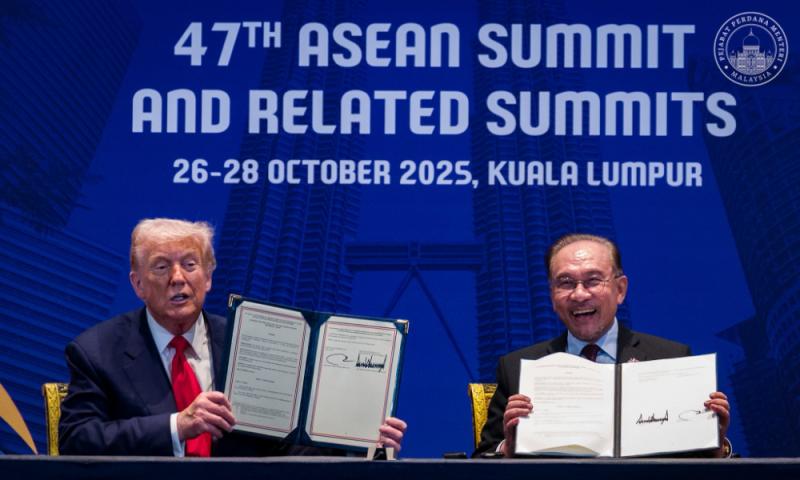
Hulu Terengganu MP Rosol Wahid has initiated legal action against Prime Minister Anwar Ibrahim over the Malaysia-US agreement on reciprocal trade (ART), demanding clarity on the constitutional basis for the deal.

Through the firm Tetuan Karthig Shan, the Bersatu supreme council member issued a letter of demand (LOD) urging Anwar to explain the powers that enabled him to sign the ART.

Rosol said that as an MP, he has a responsibility to seek further explanation after his questions in the Dewan Rakyat were not fully answered.

In the LOD, he questioned the legal authority Anwar relied on to execute the agreement and whether the executive branch of the government can bind the federation without complying with the Federal Constitution.

He also queried whether the cabinet had thoroughly reviewed the ART before it was signed and if the attorney-general’s advice was sought.

He further raised whether advice and consent from the Conference of Rulers had been obtained.

Hulu Terengganu MP Rosol Wahid (middle)

Rosol also asked whether Parliament had passed any enforcement or ratification laws related to the agreement and if constitutional requirements involving the Yang di-Pertuan Agong under Articles 39, 40, 41, 44, and 66 were followed.

“Has the prime minister personally, or on behalf of the Malaysian government, exchanged written notifications with the US government confirming that Malaysia has completed the ‘applicable legal procedures’ under Article 7.2 of the ART?” he asked at a press conference in Kuala Lumpur today.

Also present were lawyer P Waytha Moorthy and Putra president Ibrahim Ali.

‘Anwar didn’t have constitutional capacity’

Rosol reiterated his view that Article 69 of the Federal Constitution confers contractual capacity to the “federation”, not the prime minister, cabinet, or any individual officeholder.

He said that for Part IV of the Constitution, the “federation” includes the Yang di-Pertuan Agong, the Conference of Rulers, the executive, and Parliament.

Conference of Rulers meeting, July 2025

“Any agreement intended to bind the federation must be executed with the participation, authority, or consent of the relevant constitutional organs, and cannot be entered into unilaterally by the executive.

“In that regard, a prime minister acting unilaterally has no power or mandate to sign the ART on behalf of the federation without Parliament’s prior approval.

“Anwar, as prime minister, did not have the constitutional capacity to bind the federation at the material time,” he said.

Rosol added that as a result, no valid notification under Article 7.2 of the ART confirming Malaysia had completed the “applicable legal procedures” can be issued by the prime minister or the government, as the agreement is void ab initio due to non-compliance with Article 69.

Waytha said that if Anwar fails to respond within 14 days, they will proceed to file the case in the High Court.

“After that, we will request that it be referred directly to the Federal Court, without going through the High Court, Court of Appeal, and so on, because this is a very serious constitutional matter.

“Such an issue has never been decided by Malaysian courts, and it requires an immediate and final judgment,” he said.