




Q&A: 'Race-based tactics will fail in polls'
Parti Sosialis Malaysia (PSM) pro-tem secretary-general S Arutchelvan looks at the bigger picture of opposition politics and election preparations.
Parti Sosialis Malaysia (PSM) pro-tem secretary-general S Arutchelvan looks at the bigger picture of opposition politics and election preparations.
Malaysiakini: What is your opinion of the opposition’s preparations for the general elections?
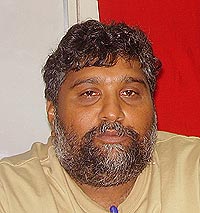
S Arutchelvan: The problem is, opposition parties often field candidates according to race. If a particular constituency is dominated by a particular race, the party will field a candidate (of that race), thinking that this is a good strategy.
PSM believes that this is wrong and that the criteria in fielding candidates should be based on (the) groundwork (done and) track-record in that (constituency).
In the case of Ijok , PKR placed its treasurer Khalid Ibrahim as a candidate (On the basis that) Ijok is a Malay-dominated constituency but an Indian BN candidate won. This shows that the race game does not work any more.
Are you saying that the opposition has a bad track-record?
The struggle is not purely about elections. What we see is that (political parties) only do groundwork once elections are near. (Only) six months before the elections (can) we see them getting active, (doing) a lot of leafleting and then there’s a lot of hassle over seats.
Every election, we see that the parties think the voters are stupid. Most parties degrade the people by promising them goodies when elections are near, and we find this extremely insulting. The work of empowering the communities in their constituencies does not exist.
We (PSM) believe that candidates must be those of unquestionable commitment when it comes to helping out the communities.
What alternatives does your party provide?
In our manifesto, you can see that we want a People’s Council to be set up in constituencies. If we win, (such a) council would help the state assembly person by raising issues relevant to the (local) communities.
As you can see, this is not the usual top-down approach but a bottom-up one. It’s a matter of how you get the people to be involved in the process. (If there are) Bills to be introduced in the state assembly, we intend to bring (these) to the council so that the people can debate (them) and come up with the best solutions.
We are also introducing the ‘Representative’s Pledge’, so that candidates can be held accountable once they are elected.
How does this work?
Well, the pledge must be signed by the elected person. It will be a formal document guaranteeing the fact our elected member will fulfil his or her duties as an elected representative. (The person) is also duty-bound to fulfil our 10-point election manifesto.
It covers the declaration of assets, establishment of a consultative body with NGOs and people’s organisations and the setting-up of a service centre so that members of the constituency can see the elected representative and discuss community issues.
The point is to fight for the welfare and well being of the people, together with the people. We have to change how things work. Currently, the elected representatives are only present among the people in time of elections, only when they need the people for their votes.
Why is PSM contesting under the PKR banner?
One of the biggest problems we face is that we can’t stand under our own banner. It is a big blow. Unlike the new Indian-based Malaysian Indian United Party which is a race-based party and which was quickly approved by the Registrar of Societies (ROS) , we have been denied the right to contest because we are not (registered) by the ROS. Because of that, we will stand under the PKR banner.
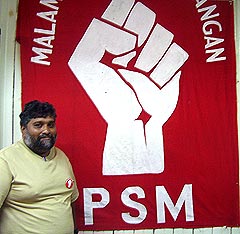 In the 1999 elections, we stood under the DAP banner, for example, in the Sungai Siput (parliamentary) constituency, as we have done a lot of groundwork there. You see, in PSM, if (someone) wants to contest in a particular constituency, he or she must have done at least five years of work there.
But in the 2004 elections, DAP did not want to let us contest in Sungai Siput although we had done a lot of work there. So, it became a three-corner fight. This is why we had to look for another party banner this time around.
What happened in Sungai Siput?
Or candidate was second and DAP candidate was third. It’s sad that we had to go through a three-corner fight. If that hadn’t happened, we would have won the seat.
Once again, in the next elections, a number of parties have offered us the opportunity to contest under their banner. I think they think PSM have quality candidates. It’s not exactly a situation where we have to beg for a place. It’s more of a win-win situation for the other parties.
But the problem is (that they are also negotiating the allocation of seats between themselves). We just want them to give us the seats and let us decide which banner to use. But opposition parties are getting more confident because of recent events like the Bersih rally and Hindraf rally. The current climate has created a tendency for opposition parties to fight among themselves for seats.
So how do you propose to solve this?
That is why we told them to go back to looking at the main criteria when choosing candidates. Look at the person’s track-record, how much work he or she has done in that area.
Where will PSM contest?
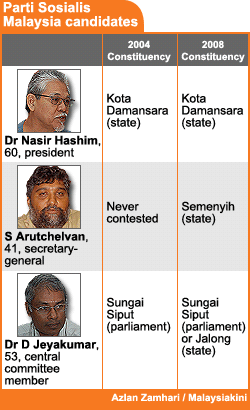 We only want four seats - the same seats that we asked for in the previous elections. (These are the) Sungai Siput parliamentary seat and Jalong state seat in Perak; the Kota Damansara state seat which PSM
(pro-tem)
president Dr Nasir Hashim will contest; and the Semenyih state seat which I will contest.
We only want four seats - the same seats that we asked for in the previous elections. (These are the) Sungai Siput parliamentary seat and Jalong state seat in Perak; the Kota Damansara state seat which PSM
(pro-tem)
president Dr Nasir Hashim will contest; and the Semenyih state seat which I will contest.
We read in a Tamil newspaper that DAP wants to field in a Hindraf candidate in the Sungai Siput constituency. We are okay about this but I feel that it would be fair that DAP replaces it with some other seat.
As for the Jalong seat, we are confident about winning there. ( Pro-tem central committee member) Dr Jeyakumar will stand there.. It has been a while since a socialist candidate has won a seat, the last time being 1969. Although we are not contesting under our banner, I still think we can win there.
Why are you so confident about winning Jalong?
Because we have done tremendous (amount of) work there. If you must know, Jalong has been a stronghold of the Socialist Front since (early) days.
When you field a candidate as credible as Jeyakumar, people are confident that he will deliver and the chances of winning will be high. If we are to win any seats, I believe Jalong would be our best bet.
What about you? Do you think you will do well in Semenyih?
This constituency is not new for us. We have been working in this area for more than 20 years now. All of our groups are based in Semenyih (in Selangor). There are so many plantations there and we have worked closely with workers, including industrial workers in that area.
The problem is, PKR wants to field (its) Selangor chief Zainal Abidin (Ahmad). Their argument is that the area is a Malay-dominated constituency, (which means that) we are going back to race-based politics.
 I believe that PKR should let us contest there. We cannot go with race tactics any more. (Barisan Nasional’s) K Parthiban would have not won in the Ijok by-election (last April) if such logic still holds true - (instead, PKR treasurer) Khalid Ibrahim (
photo
) should have won, but that was not the case. I think that this formula should change.
I believe that PKR should let us contest there. We cannot go with race tactics any more. (Barisan Nasional’s) K Parthiban would have not won in the Ijok by-election (last April) if such logic still holds true - (instead, PKR treasurer) Khalid Ibrahim (
photo
) should have won, but that was not the case. I think that this formula should change.
Is PSM ready for the elections?
We have been campaigning for quite a while now. We are focusing more on the ceramah kelompok (cluster-group discussions) right now. This method allows (greater participation in discussions). The campaigning has been good - in Semenyih, the mood has been positive.
Because of the recent developments, people are leaning towards the opposition. Our bulletins have been well received in areas where we are campaigning [..]. So yes, PSM is ready.


Are you sure you want to delete this comment?
This action cannot be undone.