




Kelantan a critical battleground for PAS
Food vendor Tan Mong See is doing brisk business openly selling roasted pork in Kelantan - the last bastion of Islamic fundamentalism in multicultural Malaysia.
"I've been selling pork and rice here for the last 10 years," Tan says as he serves ethnic Chinese and Indian patrons lining up for plates of the fragrant meat, which is forbidden under Islam.
Food vendor Tan Mong See is doing brisk business openly selling roasted pork in Kelantan - the last bastion of Islamic fundamentalism in multicultural Malaysia.
"I've been selling pork and rice here for the last 10 years," Tan says as he serves ethnic Chinese and Indian patrons lining up for plates of the fragrant meat, which is forbidden under Islam.
"The authorities know what I am doing and understand," says the Chinese trader whose grandparents migrated to Malaysia, which is dominated by Muslim Malays, in the early 1900s.
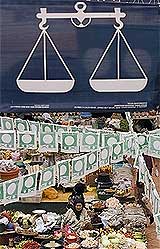 On March 8, the nation votes to decide who governs the country and its 14 states and territories, and as the only state left in the hands of Islamic party PAS, Kelantan is a critical battleground.
In the rest of the country, ethnic Indians are in revolt over allegations of marginalisation and the Chinese community is upset by economic discrimination, but in Kelantan racial harmony appears to prevail.
A walk down the dusty streets of the capital Kota Bharu sees mosques located next to Buddhist temples, and headscarf-clad Muslim girls chatting with their short-skirted non-Muslim friends.
"I think the present PAS government is actually okay," says 23-year-old Samantha Chong as she heads for a coffee shop.
"They allow us non-Muslims to do what we want," she says in the town where green-and-white PAS flags face off against the blue banners of the ruling coalition which is determined to re-take the state.
A Kelantanese blueprint
PAS has struggled to convince voters that their brand of Islam is what voters need.
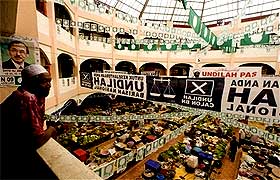 "If we are in charge nationally, what you see in Kelantan will be a blueprint for the nation," says PAS state councillor Takiyuddin Hassan.
"Of course, we will have non-Muslims in the government and in key positions as the minorities must be represented and are a big part of our multiracial make-up," he says.
Political analyst Fazil Mohammad Som says that life is peaceful in Kelantan because "the minorities know where they stand and what the boundaries are."
"This is not the case for the rest of the country where many communities don't feel their rights are protected and many want to renegotiate the present power-sharing structure among the races," he says.
When PAS took over 18 years ago, the party of religious scholars closed down nightclubs, pool halls and cinemas, and severely restricted the sale of alcohol.
Party leaders have also caused consternation with comments such as recommending civil service jobs not be given to pretty women, on the grounds they can snare a rich husband and that only plain women need the work.
Lure of the federal money
At the height of its power, PAS controlled Kelantan and neighbouring Terengganu which it won in 1999 elections, but its goal of turning Malaysia into an Islamic state is credited with losing Terengganu in 2004.
It has now adopted a more moderate stance, but the government's main weapon in the battle for Kelantan is the billions of dollars it promises to pump into the state which is currently one of the nation's most impoverished.
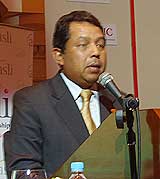 "The majority of projects you see in the state are federal BN government projects," says Awang Adek Hussin (left), who is leading the coalition's electoral charge.
Trader Ahmad Bakri, 65, says development is crucial.
"We want to see more investments coming into Kelantan and a growing economy," he says.
But many others, like headman Nik Man Nik Mat from the village of Luboh Tapak just outside the capital, say the government's sweeteners will not change anything.
"If you give sugar we will use it and if you give us cloth we will wear it and if you give us money we will take it but when it comes to voting, we won't," he says.


