




Migrant woes: New state govts can help
While the larger legal and policy context of refugees and other undocumented migrants can be holistically addressed only by the federal government, state governments are not completely helpless in resolving - or at least alleviating - the problems faced by such vulnerable groups.
While the larger legal and policy context of refugees and other undocumented migrants can be holistically addressed only by the federal government, state governments are not completely helpless in resolving - or at least alleviating - the problems faced by such vulnerable groups.
In saying this, two human rights groups reminded the five state governments ruled by opposition parties that there are several areas where concrete steps can already be taken.
Among the immediate steps, said International Federation for Human Rights’ (FIDH) vice-president (Asia-Pacific) Cynthia Gabriel, is to allay the fears of undocumented migrants such as refugees and asylum-seekers that prevent them from accessing basic facilities.
The fear of being arrested, extorted from or otherwise harassed by police personnel, members of the civilian auxiliary force Rela, or the enforcement officers of the immigration department and local councils prevent many from seeing a doctor even in the event of a serious health or medical problem, said Gabriel.
"The fear of being arrested can be addressed by the state governments (by) giving them the necessary assurance and protection that they wouldn’t be hunted down and that the harassments would not continue," she said.
 Gabriel said this at a press conference held at the Selangor Chinese Assembly Hall in Kuala Lumpur today after launching a report on the problems faced by undocumented migrants and refugees in Malaysia.
The report is the result of a fact-finding mission jointly carried out by FIDH, a Paris-based organisation, and local human rights group Suaram.
While there are about two million registered migrant workers in the country, some estimates place the number of undocumented migrants as high as five million. They are said to make up between 30 percent to 50 percent of the total Malaysian labour force.
Municpal and city councils
Echoing Gabriel’s comments, Suaram executive director Yap Swee Seng said state governments may not be calling all the shots as far as the police, immigration and Rela are concerned.
They do, however, when it comes to the municipal and city councils, he noted.
The present Selangor state government can retract, for example, the ‘zero squatters’ policy of the previous Barisan Nasional-led state administration and which was carried out by the state local councils, said Yap.
While many citizens have lost their homes, a sizeable number of undocumented migrants have also lost the roofs over their heads as a result of the policy.
"A lot of undocumented migrants and refugees are denied proper adequate housing, and I think this is one of the areas that the state governments can look into and formulate some assistance on humanitarian grounds," he said.
State governments can also take the lead in "sensitising" the enforcement personnel of local councils on the need to protect and promote the human rights of everyone, including non-citizens, Yap added.
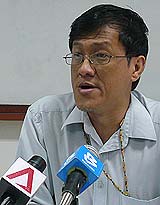 Yap acknowledged the "legal obstacle" faced by state governments in that giving shelter to undocumented migrants can be viewed as violating the country’s harsh laws on the harbouring of illegal immigrants.
Malaysia is not a party to either the 1951 Convention relating to the Status of Refugees or the 1967 Protocol relating to the Status of Refugees.
Yap noted, however, that such humanitarian assistance to undocumented migrants - especially to women and child refugees - are part of the federal government’s legal obligations to abide by international treaties that Malaysia has ratified.
These include the 1989 Convention on the Rights of the Child and the 1981 Convention on the Elimination of All Forms of Discrimination Against Women, he said.
"I think the state governments can take the lead in implementing both these conventions," said Yap.
Financial assistance
When met later, Gabriel said state governments can also extend much needed financial assistance to non-governmental organisations that are already providing social services to undocumented migrant communities.
Taking the example of Burmese refugee children - who, by virtue of their ‘illegal’ status’. are deprived of any education - state funds can go a long way in helping NGOs to reach out to more child refugees and their families.
"In addition to the issue of schooling, there’s also the issue of these children’s security and safety that state governments can already address," she said.
There are an estimated 13,000 Burmese refugees who have fled their military-ruled country and sought asylum in Malaysia.
Gabriel had earlier said in the press conference that the state governments can take the steps needed to educate the public and set the record straight regarding the involvement of migrants such as refugees in the rising crime rate.
She was referring to recent statistics that - contrary to the widely-held blame placed on 'foreigners'- showed that 98 percent of crimes are committed by Malaysians.
"We’d like to call on state governments to develop that space for engagement so that civil society groups can engage with them on issues like public safety, crime, health issues, and so on.
"They have to ensure that the problem is addressed, (to ensure) that migrant communities are not necessarily blamed for everything that goes wrong in our society, and that state governments can take steps to ensure that basic rights are protected," she said.
Abolish whipping
FIDH and Suaram in their reports urged the government to amend the Immigration Act 1959/1963 so as to legally recognise refugees.
Many quarters have argued that immigration offences should not be ‘criminalised’ as done currently by the Act but viewed as an ‘administrative’ issue.
FIDH and Suaram also urged for whipping to be abolished as a form of punishment and that the maximum term of imprisonment for immigration violations to be reduced.
"I think on this part, we are calling on the parliamentarians to adhere to the international norm and principle that corporal punishment is a form of torture and should not be allowed in Malaysia, especially when we are talking about being a developed country by 2020.
"A developed country should be a civilised country, as well, and we think this (whipping) is a barbaric act," said Yap.


