




Judicial appointments commission ready by June
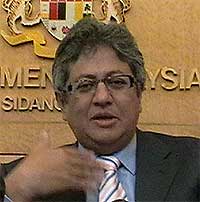
The proposed judicial appointments commission is expected to comprise between 12 to 14 members when its details are finalised in three weeks' time, de facto law minister Zaid Ibrahim said today.
The proposed judicial appointments commission is expected to comprise between 12 to 14 members when its details are finalised in three week's time, de facto law minister Zaid Ibrahim said today.
"After talking to various stakeholders, it should be ready in three weeks' time," the minister in the Prime Minister's Department told a press conference held at the Parliament lobby.
Zaid, a lawyer by training, said he will submit a paper to the cabinet regarding the details, including the commission's structure, process and composition.
To follow British model
He added that the members sitting on the commission will be "balanced and representative" of the various stakeholders in the judiciary.
 "I find the British model works but we can't follow exactly," he said to a question on whether the commission will follow any particular model in other countries.
The commission is expected to be formed earliest by June or July. Zaid said the Federal Constitution will only be amended in the next Parliament session to pave the way for its formation.
The next Parliament session is expected to sit from June 23 to July 15.
Asked if he foresees support from opposition MPs for the constitutional amendment, Zaid replied: "I believe any sensible politician will support this."
On April 17, Prime Minister Abdullah Ahmad Badawi finally responded to the protracted call from the legal fraternity and civil society by announcing at a special dinner with the Malaysian Bar that the government will set up the judicial appointments commission.
The commission will identify and recommend suitable candidates for the judiciary to the premier and the names will be submitted by him to the King later.
The commission comes following complaints regarding the way judges are appointed and promoted, where senior judges critical of the government are often overlooked.
Reforms to clear backlog cases
In another development, Zaid refused to comment whether the recommendations to be submitted by the 'Lingam tape' panel to the King tomorrow will be made public.
"We will discuss in the cabinet, I can't tell," he said.
 He also declined to comment on a
New Straits Times
report which quoted sources as saying that the panel has recommended for a few individuals to be prosecuted as a result of the inquiry.
He also declined to comment on a
New Straits Times
report which quoted sources as saying that the panel has recommended for a few individuals to be prosecuted as a result of the inquiry.
The five-member panel, led by former Chief Judge of Malaya Haidar Mohd Noor, was set up to inquire into the explosive video clip revealed in September last year.
On another matter, Zaid said reforms will be introduced to clear backlog cases in court including re-organising the court officers’ structure and advocating the concept of mediation or arbitration among lawyers.
According to him, instead of taking a matter to court which is "rule-bound", mediation has been proven to be an effective and faster way to resolve issues in other countries.
Zaid said this would help clear the backlog of cases, especially those at the civil court. "It's about time we adopt and try an alternative way," he added.
At present, he said there are 91,000 backlog cases at the high courts, sessions courts (125,000 cases) and magistrates courts (700,000 cases).


Are you sure you want to delete this comment?
This action cannot be undone.