




PM urged to act fast to restore confidence
Umno president and Prime Minister Abdullah Ahmad Badawi must implement strong pro-active policies immediately to arrest any lurking political instability due to the abrupt departure of former premier Dr Mahathir Mohamad from the party.
Umno president and Prime Minister Abdullah Ahmad Badawi must implement strong pro-active policies immediately to arrest political instability due to the abrupt departure of former president Dr Mahathir Mohamad from the party.
Only by doing so can he restore the confidence of the public and investors in the country's political governance, said a Penang-based academician.
 Universiti Sains Malaysia senior lecturer in the School of Social Sciences, Sivamurugan Pandian (
right
) suggested that Abdullah should first find out the root cause of the current crisis in Umno.
Universiti Sains Malaysia senior lecturer in the School of Social Sciences, Sivamurugan Pandian (
right
) suggested that Abdullah should first find out the root cause of the current crisis in Umno.
After that, he said, the premier can come up with the correct remedies to stabilise, rejuvenate and revitalise the party and the government.
"When the country's dominant political force, Umno, is in crisis, it (leaves the rest of the country in poor health).
"Therefore Abdullah should act fast to implement pro-active action-orientated policies and plans, to arrest the political uncertainties that have emerged from Mahathir's self-termination from Umno," said Sivamurugan.
"The policies can both be strong and unpopular. But what has to be done must be done for the national interest."
Since he was party president for 22 years as well as an elder statesman, Mahathir's decision could shake investor confidence in the country's political climate.
"Compared with other Asian countries, which are indeed more competitive, investors would always prefer to come to Malaysia due to its political stability," said Sivamurugan.
"But the latest development caused by Mahathir's resignation could well turn them off."
He also said the current crisis is detrimental to the nation-building process.
Going the wrong track
Instead of getting down to serious work after the elections and concentrating on executing far-reaching, effective and decisive policies and reforms, Sivamurugan said Abdullah and other leaders have been preoccupied with tackling political controversies.
"This is no good for the country," he said.
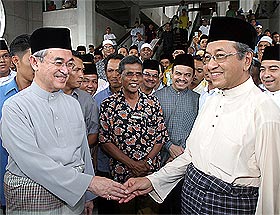 By quitting Umno, Mahathir has given an ultimatum to Abdullah to step down, and has compelled members to force his hand-picked successor to quit.
However, he said Mahathir's influence among the Umno grassroots could be on decline.
He does not foresee many branches closing down or leaders emulating Mahathir in leaving Umno.
While several political observers believe that Mahathir, 83, has made a tactical final move to up the ante against Abdullah's leadership, they also argue that the former premier "may have shot himself in the foot".
They feel that Mahathir's attacks on Abdullah are to protect personal interests rather than party interests.
Three reasons
Penang PPP chairperson Logabalan Mohan said Mahathir's decision could have been influenced by three reasons.
"He could be unhappy with the royal commission's probe into the VK Lingam video clip, which questioned his discretionary power when he was the prime minister.
"Secondly, he is unhappy with the present Umno leadership and political style.
"Thirdly, he is forcing the party leadership to sit down and deliberate on the need for leadership change."
Logabalan called on Umno and Barisan Nasional to stem the turmoil before the crisis gets out of control.
Sivamurugan predicted that the problems triggered by Mahathir's dramatic departure would only last until the Umno polls at year's end.
Once the delegates have decided on the leadership, he said the internal crisis will die down and "Mahathir will become irrelevant".


