




Batu Puteh dispute: World Court's decision on Friday
The International Court of Justice will hand down on Friday a judgment to settle a 28-year-old dispute between Malaysia and Singapore over ownership of the tiny, uninhabited island of Pulau Batu Puteh.
The International Court of Justice will hand down on Friday a judgment to settle a 28-year-old dispute between Malaysia and Singapore over ownership of the tiny, uninhabited island of Pulau Batu Puteh.
Both countries have undertaken to abide by the ruling of the tribunal, the United Nations' highest court, on sovereignty over the half-football field sized island and its two rocky outcrops - Middle Rocks and South Ledge.
And despite a hearing that court officials have described as marked by cordiality, both parties are confident of victory.
"Having gone through the items, the grounds of submission and the case law that has been relied upon, Malaysia has a very good case," the country's Foreign Minister Rais Yatim was quoted as saying last week.
"We are confident that the judgment will be in our favour," he told New Straits Times daily.
And Singapore's deputy prime minister S Jayakumar told Singapore's Straits Times he was "quite confident" the verdict would be in his country's favour.
Court to play biblical Solomon role
Having heard the arguments from both parties last November, the court will now have to play the role of a biblical Solomon in deciding who has control over the island which Malaysia claims was always its property but on which Singapore has been operating the Horsburgh Lighthouse for more than 130 years.
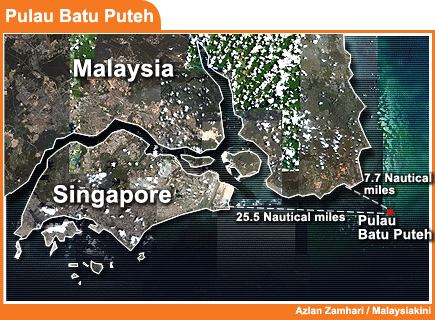
Pulau Batu Puteh, called Pedra Branca by Singapore, is considered important for its strategic position and impact on territorial marine boundaries. It lies 7.7 nautical miles off the Malaysian state of Johor on the eastern approach to the Singapore Strait from the South China Sea.
Singapore protested in 1980 against a new Malaysian map of its maritime boundaries which claimed the islet for itself.
Years of bilateral talks failed to resolve the matter and the parties agreed to seek the intervention of the UN court.
They jointly submitted a dispute over sovereignty in July 2003, attached to which was a special agreement in which the countries agreed "to accept the judgment of the court ... as final and binding upon them".
Rais told Bernama state news agency the boundary between the two countries might change if the decision was in Singapore's favour.
"For example the question of EEZ (Exclusive Economic Zone) or the continental shelf. All this will change if the decision favours Singapore."
A special technical committee would be set up to put the court's decision into effect, he added.
KL claims original title to island
Bilateral ties have often been stormy since Singapore was ejected from the Malaysian Federation in 1965, at which time sovereignty of the island was not stipulated. Both countries have said Friday's ruling would not affect relations.
On a website dedicated to the island dispute, the Malaysian government claims the original title to the island.
"Pulau Batu Puteh is, and has always been, part of the Malaysian State of Johor," it says. "Nothing has happened to displace Malaysia's sovereignty over it.
"Singapore's presence on the island for the sole purpose of constructing and maintaining a lighthouse there - with the permission of the territorial sovereign, Johor - does not displace Malaysia's sovereignty over Pulau Batu Puteh."
Singapore, in turn, accuses Malaysia of seeking to overturn the status quo.
In a submission to the tribunal last November, Jayakumar stated that Malaysia was "suddenly claiming title to Pedra Branca after 130 years of inaction in the face of Singapore's exercise of Singapore's sovereignty over the island."
The country's economic well-being, he added, depended on its status as a major port of call, which in turn relied on the smooth flow of maritime traffic through the Singapore Strait.
International Court of Justice vice-president Judge Awn Shawkat Al-Khasawneh will deliver the judgment on Friday.


