




Nazri blames EC chief for ink fiasco
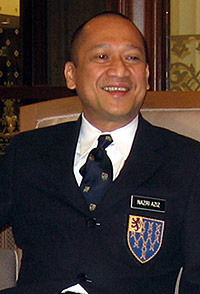
Minister in the Prime Minister’s Department Mohd Nazri Abdul Aziz faulted the Election Commission for the debacle over the indelible ink as the commission had not consulted the attorney-general for his advice.
Minister in the Prime Minister’s Department Mohd Nazri Abdul Aziz faulted the Election Commission for the debacle over the indelible ink as the commission had not consulted the attorney-general for his advice.
In his winding-up speech, Nazri told Parliament that the cabinet had told EC chairperson Abdul Rashid Abdul Rahman two weeks before the Feb 13 dissolution of Parliament that it rejected the commission's proposal to mark voters’ thumbnail with indelible ink.
 Despite receiving the cabinet’s advice that ‘kekecohan’ (havoc) could arise and the general election itself "jeopardised" if some voters insisted on voting despite declaring in writing their unwillingness to have their thumbnail marked with indelible ink, the EC went on with its plan for its usage, said Nazri.
“We raised this issue and informed the EC, and it was for the EC to decide whether to carry on or not. They made the decision and perhaps they made the decision without referring to the attorney-general,” he said in answer to a question from Tian Chua (PKR-Batu).
“It is clear that the decision was taken without the advice of the AG, and this would have jeopardised the general elections if anything happened,” he added.
'I would not lie'
Nazri also insisted that there was no order for the EC to cancel its plans for the indelible ink.
“We did not issue an order. I can assure you, we did not order it. I would not lie,” he said.
 Soon after, Fong Po Kuan (DAP-Batu Gajah) insisted on knowing as to who was lying as the EC chief had previously said the usage of indelible ink had been “rejected” by the cabinet.
“There must someone to take responsibility for this and not to spin the facts. Tell the truth! Who is the one trying to lie here?” Fong demanded.
She also noted that if the EC had taken the trouble to refer to the National Fatwa Council for its position on the use of indelible ink on Muslim voters, the EC would surely have referred to the AG if it thought it was necessary.
“Who is the one that did not do their work?” she thundered.
Nazri quipped back: “It is the EC that did not do its work, lah !”
Nazri also told Fong that there is a difference between the cabinet rejecting a proposal and an order for a proposal to be scrapped.
“If we (the cabinet) do not agree (with a proposal), that means we reject (it). But whether the EC wants to take (our) advice is up to them. If we had ordered them (to scrap indelible ink) early on, the EC would have announced it would not use indelible ink,” said Nazri.
“We surrendered (the decision) to them,” he added.
Nazri also said that the eventual scrapping of the indelible ink four days before the general elections was among the reasons Barisan Nasional lost many votes due to the perception that it was seeking to win through illegal means.
Other than the security issue of counterfeit ink, he added, the scrapping of indelible ink was due to the concern that its imposition on voters would have violated their constitutional right to vote.
Recommend sacking of EC chief
Dr Dzulkifli Ahmad (PAS-Kuala Selangor), however, rejected the argument by arguing there was ample time to make the necessary constitutional amendments to accommodate the usage of indelible ink.
This is borne by the fact that an amendment to the Federal Constitution was made to extend the retirement age of EC commissioners to 66 years, said Dzulkifli.
“If the EC chairperson really is the culprit, we should recommend that the EC chairperson be dismissed,” he challenged.
Khalid Abdul Samad (PAS-Shah Alam) claimed that Nazri was seeking to “ridicule the intelligence” of the MPs in the House by arguing that the reason behind the scrapping of indelible ink was to preserve the constitutional right of citizens to vote.
If that was the case, said Khalid, then all the other electoral laws and regulations - such as the stipulated time to cast ballots and the filling in of forms and documents - could also be seen as being a hindrance to the constitutional right to vote.
“If you want to (present a weak argument), at least look for arguments which do not ridicule our intelligence,” said Khalid.
To this, Nazri said such matters as the times of casting ballots was something found in all electoral systems while the issue of qualifying a person’s right to vote by imposing the use of indelible ink was a matter of “exchange”.
“There is a difference... I don't know the level of your intelligence, but we do not want to insult anybody’s intelligence,” said Nazri.
“This (scenario of chaos) can happen. We can bring this issue to court for it to determine (whether a person's right can be qualified in such a way).
"We can argue until the cows come home. I have given the true explanation and I am not lying in the matter,” he said.


