




Revise pay offer or face picket, TNB warned
Tenaga Nasional Bhd pays its chief executive officer Che Khalid Mohamad Noh renumeration of RM1.1 million - but is only willing to offer unionised workers a three percent raise in salary.
Tenaga Nasional Bhd pays its chief executive officer Che Khalid Mohamad Noh renumeration of RM1.1 million - but is only willing to offer unionised workers a three percent raise in salary.
The TNB workers union, which has 20,000 members, now plans to hold pickets if the national utility supplier - a blue-chip listed company - refuses to budge from its stand.
A union leader, who requested anonymity, said TNB does not provide a housing allowance or a cost of living allowance (Cola) to workers.
“We have negotiated four times with them since last April, but we have yet to reach agreement because TNB remains insistent on a three percent raise,” he said.
“If the issue is not resolved in the near future we will organise pickets.”
However, in an immediate response, three TNB workers unions issued a joint statement that they had no intention of organising a picket.
"We strongly deny the statement which appeared in Malaysiakini regarding the plan for a picket by TNB workers union," said Amalgamated Union of TNB Workers president Abu Hussin Nekmat, TNB Junior Officers Union president Md Zamri Md Yasin and Association of TNB Executives president Abdul Shukor Hassan.
 TNB, which was privatised in 1990, employs 28,000 people nationwide. It is now under Khazanah Nasional Bhd, the investment arm of the finance ministry.
“The management rejected the union’s request for a higher rate of adjustment on grounds of increased operational costs following the rise in fuel prices,” said the source.
But the reason is unacceptable, he said, because the corporation made a record RM4 billion in profits last year, the highest since its establishment.
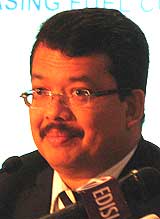 The company’s latest annual report states that Che Khalid
(right)
owns 735,000 shares in TNB and that his annual salary amounts to RM600,000.
The company’s latest annual report states that Che Khalid
(right)
owns 735,000 shares in TNB and that his annual salary amounts to RM600,000.
Bernama yesterday quoted Khazanah National Bhd managing director Azman Mokhtar as defending the high salaries of top managers in government-linked companies, saying this was one way of attracting and keeping talent.
This was in response to unconfirmed speculation in blogs that Che Khalid and chief financial officer Izaddin Idris could receive up to a 100 percent increase in salary.
However, the TNB source said “Azman’s statement shows that he clearly does not understand the situation of the lower-ranking staff”.
“I wonder if the TNB management has told Azman the situation of the employees and their take-home salary,” he said, urging Azman to contact the union for “the right picture”.
“More TNB employees would rather work as civil servants than remain in TNB. They have asked the union to look into ways for them to be absorbed into the civil service, which is seen as a more secure environment,” he added.
“Their pay is lower than that of civil servants, whose salaries were raised (up to 35 percent last July).”
On April 17, TNB announced a half-year net gain of RM2.01 million before foreign exchange translation.
This included a RM827 million increase in revenue from electricity sales, on the back of demand growth of 7.7 percent in the peninsula and 8.2 percent in Sabah. Operating costs went up by 14.7 percent.
TNB has also announced that it plans to increase electricity tariffs by up to 20 percent beginning July 1.


Are you sure you want to delete this comment?
This action cannot be undone.