




Ex-top judge: Dr M sought control of judiciary
One of the six former judges implicated in the 1988 judiciary crisis today revealed how the integrity of the judiciary was encroached by the interference of former prime minister Dr Mahathir Mohamad.
One of the six former judges implicated in the 1988 judiciary crisis today revealed how the integrity of the judiciary was encroached by the interference of former prime minister Dr Mahathir Mohamad.
 Ex-Supreme Court judge Azmi Kamaruddin claimed that Mahathir had wanted to amend Article 121 of the Federal Constitution - a provision on the separation of power between the legislature, judiciary and the executive.
"I felt that he wanted to rule like a dictator. He (Mahathir) was already the head of legislature (and) he wanted the judiciary to be under his control as well. That was his intention," said Azmi.
"I'm sorry to say but Mahathir is actually very clever in killing two birds with one stone. I say that because what he did was very clever in a sense because he wanted to amend the constitution and have the judiciary under him," added Azmi.
Azmi was talking to reporters after receiving his ex-gratia payment in person from de facto law minister Zaid Ibrahim for his sufferings in the 1988 judicial crisis.
Zaid handed an envelope to Azmi at his house near Jalan Ampang in Kuala Lumpur this morning. Both individuals however refused to disclose the money involved.
Back to Mahathir, the former judge also said that at that critical moment in 1988, Mahathir was facing a court case where 11 supporters of Tengku Razaleigh Hamzah who then challenged Mahathir's post as Umno president had referred the matter to the court.
"That was why he wanted the judiciary to be under him. I'm sure he would deny it," added Azmi.
The altercation between Mahathir and Razaleigh then led to the subsequent banning of Umno as a legal party. A new Umno was later registered with the Registrar of Society.
Azmi also revealed how his suspension had killed off his career as a senior judge.
Azmi: Mahathir killed off my career
"I lost my promotion and seniority when all this happened. Back then, in the hierarchy of judges, I was number six in line when I was suspended.
"And when I was found not guilty (by the tribunal) I remained at number six and was promoted to number five only for the ten years I have served while my juniors were jumping over me like nobody's business," lamented Azmi.
 Azmi and five other top judges, including the then Lord President Salleh Abas (
left
) was forced to face tribunals in 1988 which resulted in the sacking of three supreme court judges including Salleh Abas and the suspension of the rest.
Azmi and five other top judges, including the then Lord President Salleh Abas (
left
) was forced to face tribunals in 1988 which resulted in the sacking of three supreme court judges including Salleh Abas and the suspension of the rest.
As part of government effort to restore the integrity of the judiciary following pressure from the legal fraternity that reached its peak after the explosive expose of the Lingam tape, Prime Minister Abdullah Ahmad Badawi on April 17 said that ex-gratia payments will be made to the judges implicated.
Zaid also issued payment to Salleh in his house in Setiawangsa. All the other affected judges have also received their ex-gratia payments.
Salleh welcomes government effort
Salleh welcomed the payment as a sincere effort by the government to "bring an end to the shameful event of the 1988 judicial crisis".
"Though it is difficult for the government to issue a complete apology even in the current political scenario, the ex-gratia payment is a compromise and reflects courage on the side of the government," said the former lord president.
Salleh was surrounded by his family members when he received the enveloped cheque from Zaid.
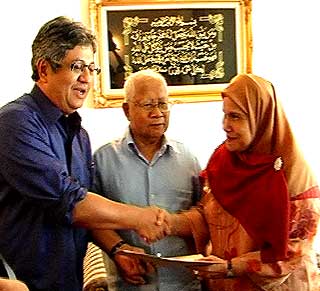 In the meantime, Zaid said that the government must learn from what had transpired today.
"One of the lesson is that the principle of separation of power where there is no interference in the judiciary by the executive must be respected and that is why I am proposing to the cabinet the restoration of Article 121 in the Federal Constitution," he said.
"If we can do this, it means that the principle that Azmi and Salleh were trying to uphold in 1988 would achieve its objectives. We don't want a dictator running the country alone where he alone can arrange everything, we want the judiciary to uphold democracy" said Zaid.
The second thing to learn from today, added Zaid, was the necessity to have brave and chivalrous judges whose integrity cannot be questioned.
The prime minister has also announced that the government will establish a judicial appointments commission to identify and recommend suitable candidates for the judiciary to him as part of the judiciary reform.
Azmi's remarks on Mahathir today follow a similar revelation made by a senior High Court judge earlier this month.
Then justice Ian Chin had accused Mahathir of threatening judges in 1997, a claim which was denied by the former premier.


