




BN report-card: More red marks than black
First 100 days Unlike the new state governments formed in Kedah, Penang, Perak and Selangor after the 12th general election, Barisan Nasional’s rule at the centre has never been interrupted.
Unlike the new state governments formed in Kedah, Penang, Perak and Selangor after the 12th general election, Barisan Nasional’s rule at the centre has never been interrupted.
Other than a hiccup from 1969-1971, when the National Operations Council ran the country under a proclamation of emergency, BN has led the federal government for 48 years if the Alliance years are included. As such, it has no need of a settling-in period.
Still, while Pakatan has been engaged in house-cleaning chores since March 8, BN and its chairperson have had to focus on fending off attacks from within and without the coalition.
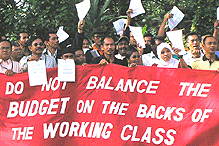 The most notable feature of a fractious 100 days for the BN government has been its
reduction
of the fuel subsidy from June 5. This has overshadowed pledges of reform toward civil liberties and judicial appointments.
The most notable feature of a fractious 100 days for the BN government has been its
reduction
of the fuel subsidy from June 5. This has overshadowed pledges of reform toward civil liberties and judicial appointments.
Abdullah’s second mandate as prime minister has dovetailed with a series of global financial and economic factors, such as the fallout from US subprime lending, depreciation of the US dollar, and escalating oil and food prices.
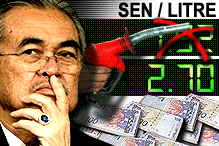
The government unexpectedly brought forward a cutback in fuel subsidies, causing the price to shoot up by 41 percent for petrol and 63 percent for diesel. A 30-sen subsidy will be maintained as a buffer for at least a year.
To soften the blow, the government offered cash rebates of RM625 (for cars under 2,000cc) and RM150 (bikes under 250cc).
Out of the RM13.7 billion saved, RM7.5 billion has been set aside to maintain fuel subsidies for fishermen and public transportation operators. The savings will also be diverted toward a food security policy that offsets the cost of such staples as cooking oil, rice, flour and bread.
 Higher energy prices prompted Tenaga Nasional Bhd to raise the electricity tariff with effect from July 1.
With the increased price of food, building materials, manufactured goods and electricity tariff, the consumer price index hit a 22-month high of 3.8 percent year-on-year in figures released last week.
Abdullah has formed an Anti-Inflation Council but it remains to be seen how effective this will be in fighting inflation, given the still-volatile global oil price.
As Malaysians wrestle with higher prices, the last thing they need is indecisiveness by the government. A case in point is the issue of fortnightly salary payments to civil servants.
The decision on June 11 to make bi-monthly payments was reversed 10 days later, after the civil service workers union Cuepacs disagreed with the move.
In between, ad hoc announcements, such as expanding the cash rebate to cover cars of 3,000cc in Sarawak, show that there was lack of thought over the fallout from the new fuel prices.
While the government seems committed to prevent a surge in public transportation fares, there have been complaints that some inter-state bus companies have done so anyway. There has been no update on the outcome of enforcement action.
 As part of a
cost-cutting package
, the entertainment allowances of ministers have been reduced by 10 percent, while their paid holidays are now limited to the Asean region. However, the general sentiment is that this is
far from satisfactory
.
As part of a
cost-cutting package
, the entertainment allowances of ministers have been reduced by 10 percent, while their paid holidays are now limited to the Asean region. However, the general sentiment is that this is
far from satisfactory
.
On hold, too, are development projects in the East Coast Economic Region, Northern Corridor Economic Region, Sabah Development Corridor and Sarawak Corridor of Renewable Energy, which had been announced in the run-up to the general election.
Conflicting stance
One positive move has been the confirmation by Higher Education Minister Khaled Nordin on June 3 that amendments to the Universities and University Colleges Act (UUCA) will be tabled during the current sitting of Parliament.
Students and human rights groups have long demanded the repeal of the UUCA, labeling it a ‘draconian law’ for prohibiting students from being active in politics.
Prior to this, the government had maintained that the act was necessary keep students focused on their education.
 Other small but no doubt crucial moments were the granting of a
publishing permit
for the PKR newsletter after a wait of eight years, and the go-ahead for the
registration
of Parti Sosialis Malaysia.
Other small but no doubt crucial moments were the granting of a
publishing permit
for the PKR newsletter after a wait of eight years, and the go-ahead for the
registration
of Parti Sosialis Malaysia.
The post-election period revealed a change in mindset by Abdullah’s administration to the alternative media and bloggers.
The new information minister has shown willingness to engage bloggers while Malaysiakini editors have twice been invited on a RTM1 talk-show programme to interview ministers.
Another ‘first’ was the decision to broadcast part of the Question session of Dewan Rakyat proceedings. Despite the chaotic events of the first ‘live’ telecast , the cabinet did not retract its decision.
Juxtraposed against these, however, has been the refusal to release Hindu Rights Action Force (Hindraf) leaders - P Uthayakumar, V Ganabatirau, R Kenghadharan, T Vasantha Kumar and M Manoharan - who are being held under the Internal Security Act (ISA).
The police have continued to act against protesters. Three PKR parliamentarians and three activists were arrested during a protest outside the King’s palace on June 14, but were released after questioning.
Sri Lankan Buhary Syed Abu Tahir was released from ISA detention on June 6, being no longer deemed a security threat. Buhary was detained four years ago over alleged links to a nuclear black market run by Pakistani Abdul Qadeer Khan.
Buhary, who has permanent residence status, faces travel restrictions and has to report to the police station every week. He is also not allowed to go out at night without permission.
 National disgust was stirred by excessive force used by about 20 Federal Reserve Unit officers who beat up Chang Jiun Haur at Bandar Mahkota Cheras (BMC) on May 28.
The youth was dragged out of his car before being kicked and beaten with batons, allegedly after he tried to run down an officer. He has since been charged with reckless driving .
The federal government could averted this if it had not delayed a response to clashes over a barricade on a toll-free access road in the housing estate. BMC residents clashed with police before Works Minister Mohd Zin Mohamed ordered the removal of the barricade on May 30.


Are you sure you want to delete this comment?
This action cannot be undone.