




The siege of Abdullah
BN's first 100 days In addition to a drastic reduction of fuel subsidies, Abdullah Ahmad Badawi’s government will be remembered as one which has been the most unstable.
BN's first 100 days In addition to a drastic reduction of fuel subsidies, Abdullah Ahmad Badawi’s government will be remembered as one which has been the most unstable.
Not since the racial riots of 1969, have voices demanding an Umno president and prime minister quit have been so loud.
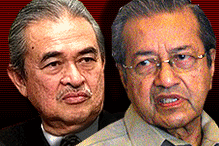 Interestingly, for the nation and Umno this is also the second time that the chorus is led by none other than Abdullah’s predecessor Dr Mahathir Mohamad.
If Abdullah fails to hold on to his position by Sept 16 or Umno polls in December or anytime Pakatan Rakyat does enough to entice crossovers, it will mark the end of Barisan Nasional’s reign since Independence, including the Alliance years.
Not a day goes by, since the day he was sworn in as prime minister, that he is not attacked by one or the other. In fact, barely hours after BN’s unprecedented electoral setback on March 8, Mahathir led the assault by telling Abdullah to quit.
“I’m sorry but I apparently made the wrong choice,” Mahathir said of his successor.
A day later his son and newly-elected Jerlun MP Mukhriz begged Abdullah to “do the right thing”. Five days after the elections, in a “confidential letter” very similar to the one his father wrote to first prime minister Tunku Abdul Rahman in 1969, Mukhriz urged him to quit too.
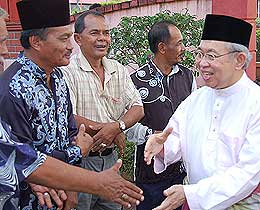 Ten days later, Umno stalwart Tengku Razaleigh Hamzah
(right in photo)
announced in Kota Baru that he would challenge for the position of president at Umno’s election.
Ten days later, Umno stalwart Tengku Razaleigh Hamzah
(right in photo)
announced in Kota Baru that he would challenge for the position of president at Umno’s election.
Since March, the Mahathirs and Tengku Razaleigh (Ku Li) have been going from town to town , telling grassroot members of the need to remove Abdullah.
High-profile Umno leaders like Rais Yatim and Muhyiddin Yassin, Johor information chief Dr Mohd Fuad Zarkashi, and veterans Sanusi Junid, Ruhanie Ahmad and Mazlan Harun have lent their voices in the drive to oust Abdullah.
Other than blaming him for both BN’s loss of four additional states (Kedah, Penang, Perak and Selangor) to Pakatan and two-thirds majority in Parliament, Mahathir has also accused him of nepotism and incompetence.
On a positive note, Umno deputy president Najib Abdul Razak has backed his boss and is said to have agreed to a handover , although the date has not been set.
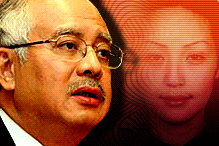 But Najib too is under immense pressure following persistent allegations linking him to the murder of Mongolian national Altantuya Shaariibuu, which he has denied. The latest is a
statutory declaration
by popular blogger Raja Petra Kamarudin.
But Najib too is under immense pressure following persistent allegations linking him to the murder of Mongolian national Altantuya Shaariibuu, which he has denied. The latest is a
statutory declaration
by popular blogger Raja Petra Kamarudin.
To counter Ku Li’s roadshows, Abdullah’s advisers have worked overtime, bringing in branch leaders from every state for weekend briefings.
While there is no way to accurately gauge Abdullah’s popularity until the divisions begin their annual general meetings in October, his position in Umno is at its lowest ebb.
Those who did not press for his resignation are not backing him to stay on either. His strongest supporters, like Johor Baru chief Shahrir Abdul Samad, have merely asked for him to be allowed to leave after the Umno polls. Wanita chief Rafidah Aziz and information chief Muhammad Muhd Taib have echoed the sentiments.
Pakatan taunts BN
Abdullah’s weakness has not gone unnoticed, most of all by Parti Keadilan Rakyat de facto leader Anwar Ibrahim. Knowledgeable about Umno’s workings and weaknesses, the former deputy premier has declared his intentions since his “government-in-waiting” statement .
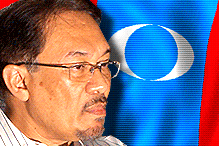 Since then, Anwar and other PKR leaders have taken turns to taunt Abdullah with “impending” crossovers almost on a weekly basis. Pakatan now claims it has enticed two more MPs to add to the opposition total of 82. It has issued an
open invitation
to other BN parliamentarians to join them.
Since then, Anwar and other PKR leaders have taken turns to taunt Abdullah with “impending” crossovers almost on a weekly basis. Pakatan now claims it has enticed two more MPs to add to the opposition total of 82. It has issued an
open invitation
to other BN parliamentarians to join them.
The two are speculated to be from Sabah Progressive Party (Sapp) which stunned everyone last week by announcing that it would file a no-confidence motion against Abdullah. This did not materalise but did enough to shake up the coalition.
Tengku Razaleigh and Anwar were not the only ones exploiting Abdullah’s weaknesses. After a long hibernation, the royal houses of Perlis, Perak and Terengganu have reasserted their influence over the appointment of chief ministers.
In Perlis , the ruler chose little known Md Isa Sabu, while the Terengganu royal house picked Ahmad Said .
In Perak, DAP, Pas and PKR had to give their word to the Perak sultan that they could work together before the menteri besar was sworn in.
Promises of reform
Less controversial but no less important are the cabinet’s promises of reform for the judiciary.
Many lauded the move when outspoken lawyer Zaid Ibrahim was picked as Minister in Prime Minister’s department in charge of legal affairs, although he had not defended his Kota Baru seat.
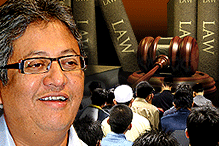 Within the month, Zaid made all the right noises about
apologising
to the six judges affected by the 1988 judicial crisis; cleaning up judiciary appointments; and amending the widely-detested Internal Security Act, Official Secrets Act and Printing Presses and Publications Act.
Within the month, Zaid made all the right noises about
apologising
to the six judges affected by the 1988 judicial crisis; cleaning up judiciary appointments; and amending the widely-detested Internal Security Act, Official Secrets Act and Printing Presses and Publications Act.
However, the cabinet did not share his enthusiasm and he was rapped for shooting off his mouth before decisions had been made.
Although he did not tender an apology to the judges, Abdullah made two significant announcements during the Bar Council dinner in April - to make an ex-gratia payment to the six judges and to reform the judiciary.
A judicial appointments commission is in the works, while the ex-gratia payments have been made.
Following the formation of his post-election cabinet on March 18, Abdullah promised that all ministers and their deputies would have to publicly declare their assets .
More than 100 days later, the public waits for the pledge to be delivered.
Related report


Are you sure you want to delete this comment?
This action cannot be undone.