




Abdullah launches 9MP mid-term review
Prime Minister Abdullah Ahmad Badawi today said that among the main objectives for the second phase of implementation of the Ninth Malaysia Plan was to ensure that the quality of life of Malaysians is protected.
Prime Minister Abdullah Ahmad Badawi today said that among the main objectives for the second phase of implementation of the Ninth Malaysia Plan was to ensure that the quality of life of Malaysians is protected.
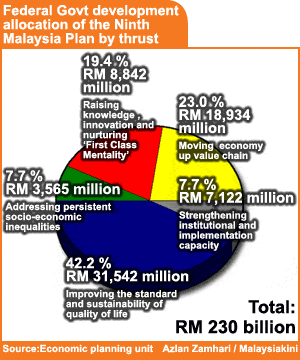 "Programmes to increase earnings propensity as well as to provide social safety nets will continue to be implemented and enhanced," he said when tabling the mid-term review of the Ninth Malaysia Plan at Parliament today.
Among the salient points of the review are:
On track to eradicate poverty
"The overall incidence of poverty among Malaysians has been reduced, from 5.7 percent in 2004 to 3.6 percent in 2007. The number of poor households has also declined by 33 percent from 311,300 to 209,000 over the same period.
"The incidence of urban poverty has been reduced from 2.5 percent in 2004 to 2.0 percent in 2007; whereas in rural areas, the incidence of poverty has been significantly reduced from 11.9 percent to 7.1 percent.
"The incidence of poverty in Sabah has declined from 23 percent in 2004 to 16 percent in 2007, whereas in Sarawak, the incidence of poverty has declined from 7.5 percent in 2004 to 4.2 percent in 2007.
"Hardcore poverty has declined from 1.2 percent in 2004 to 0.7 percent in 2007. The number of hardcore poor households has declined by 43 percent, from 67,300 to 38,400 over the same period. Based on this trend, the government is confident that the Ninth Malaysia Plan target to eradicate hardcore poverty by 2010 will be achieved.
"Over the remaining period of the Ninth Malaysia Plan, efforts to eradicate poverty will continue to be strengthened. A more streamlined and coordinated monitoring and assessment mechanism will be implemented at various levels of state and district administration. This effort will be spearheaded by the "Focus Group on Poverty" which is chaired by the Chief Secretary to the government.
Average household income continues to rise
"The average household income of Malaysians has continued to rise from RM3,249 in 2004 to RM3,686 in 2007. The increase has largely been the result of positive economic growth, which in turn has generated employment opportunities and raised the income levels of all Malaysians.
Decline in disparity between average incomes of ethnic groups
"All ethnic groups registered an increase in household income over this period. In 2007, the average household income of the bumiputera rose by 5.2 percent to RM3,156 a month, whereas the average income of ethnic Chinese households rose by 3 percent a year to RM4,853 while that of ethnic Indian households rose by 3.2 percent to RM3,799."
The disparity between the average income of the bumiputera community and the Chinese community continued to improve with the disparity ratio declining from 1:1.64 in 2004 to 1:1.54 in 2007. Similarly, the disparity with the Indian community also improved, from 1:1.27 to 1:1.20 over the same period.
Growth forecast
"For the latter period of the Ninth Malaysia Plan, the government will continue to manage the macro economy in a prudent manner to ensure that economic fundamentals remain strong. With global economic growth projected to moderate at a rate of 4.1 percent for the 2008-2010 period, the Malaysian economy is forecasted to expand at an average of 6.0 percent per annum."
New fair trade laws
"Good legislation is critical in providing a conducive market environment. In line with this, a Fair Trade Practices legislation will be introduced. To strengthen protection of intellectual property, the number of intellectual property courts will be increased while the capabilities of intellectual property practitioners will be enhanced."
Expansion of broadband infrastructure
"High-speed broadband infrastructure is necessary to facilitate the growth of a knowledge-based economy. Through public-private cooperation, the coverage of broadband infrastructure will be expanded with the aim of achieving 50 percent household penetrations by 2010."
National energy policy
"The development of a sustainable energy sector is critical to ensure energy sufficiency for the economy in the long term. Energy efficiency initiatives will be intensified to affect more productive and prudent use of energy resources.
"The government will also step up R&D activities in clean and cost-effective renewable energy towards enhancing energy security. Given that the nation's hydrocarbon energy supplies are depleting, and to ensure long-term energy security, the government will draft a comprehensive National Energy Policy."
Improving education quality and accessibility
"The government will continue to emphasise education as an integral part of its development plans. Among others, greater focus will be given to rural education in order to reduce the wide gap in academic achievement between rural and urban schools.
"With regard to this, RM13.5 billion will be allocated to improve school infrastructure, provide more (Information and Computer Technology) ICT facilities as well as encourage more experienced teachers to serve in rural areas. Special emphasis will be given to rural schools in Sabah and Sarawak.
"Also, national type Chinese and national type Indian schools will continue to be given aid and upgraded."
Greater access to indigenous, minority groups
"Access to healthcare for Orang Asli and minority groups in the interior of Sabah and Sarawak will be enhanced. Mobile clinics, including flying doctor services, will be added to serve remote areas.
"One main challenge that confronts the health sector is the shortage of personnel in public health. To address this, the intake of students into institutes of higher education for critical courses will be increased. The government will also consider an improved benefits package to retain doctors and health personnel in the public health sector.
Housing needs to be expedited
"Housing development will focus on adequate, quality and affordable housing for sale or rent, for all Malaysians, especially those in the low and middle income groups.
"Among others, the implementation of the low-cost program will be expedited in the final phase of the Ninth Malaysia Plan with the additional construction of 18,500 Public Housing Programme units for rent. Furthermore, 12,300 units under the Rumah Mampu Milik programme will be built by 2010."
Water and electricity supply to be enhanced
"The use of modern technology such as solar power generation, wind turbines and rainwater harvesting systems will be enhanced, especially for areas in the interior. In highly populated areas such as the Klang Valley, the quality of water supply and sewerage systems will be enhanced with the establishment of the National Water Services Commission (Span)."
Public transportation improvement to be prioritised
"... The coverage of the urban rail transit system will be extended while more integrated public transportation terminals will be built. Furthermore, the efficiency of commuter train, bus and taxi services will be enhanced in order to reduce the usage of individual vehicles compared to the usage of public transport, particularly in the Klang Valley.
"To ensure that future development of the transportation sector will proceed in a smooth and orderly manner, the government will set up a Public Transportation Commission and draft a Transportation Master Plan.
"In order to address inadequate road coverage, especially in Sabah and Sarawak, rural road networks will be further extended. These efforts are expected to further encourage economic growth for areas in the interior."
Climate change to be given due attention
"The government remains concerned over the effects of rapid development on the environment. Specifically, focus will be given towards efforts to continually improve air and water quality as well as initiatives to reduce contamination of water and land resources as a result of the illegal discharge of solid waste as well as toxic and hazardous substances.
"At the same time, the phenomenon of climate change will be given due attention. Focus will be given towards promoting energy efficiency and renewable energy, as well as in improving the public transportation system.
"Preventive measures such as flood mitigation programmes will also be implemented so as to ensure that the impact of climate change can be dealt with effectively."
'Positive' Community Development
"To strengthen the family institution in a holistic manner, a National Family Policy will be formulated. This initiative will involve various services, including counselling, parenting skills training, as well as reproductive health services.
"... Youth development programs will focus on socialisation, leadership and education aspects, where the involvement of the private sector, NGOs and youth organisations are emphasised. In ongoing efforts to develop sports, attention will be given to health and active lifestyle aspects, while also nurturing sporting talent towards excellence."
One Number Call Centre, No Wrong Door
"In order to improve complaints monitoring and resolution (regarding public service delivery), a "One Number Call Centre, No Wrong Door" online complaints management system for the public sector will be established.
"This integrated and centralised system will encompass all ministries, agencies, state agencies and local authorities. In addition, a consolidated National Registry System will be set up to allow for sharing of data across relevant agencies and to reduce data errors or duplication."
Personal Data Protection Bill
"To increase understanding of and confidence in issues such as cyber security, particularly in protecting private information, more awareness programs will be provided to users of electronic public services.
"In addition, a Personal Data Protection Bill is currently being drafted. To further strengthen cyber security, official guidelines on electronic banking will be introduced to reduce risks in Internet banking."
Greatest challenge: rising global oil prices
"The greatest challenge confronting our economy is the rise in global oil prices - a global phenomenon which is affecting all nations, and is caused by various factors.
"... Apart from the extreme rise in oil prices, our economy is also affected by the state of global financial markets, which have yet to recover from the sub-prime crisis...
"... Rising oil prices and uncertainty caused by external factors makes it difficult for any nation to fully shield its citizens from hardship.
"Nevertheless, the government remains committed towards doing everything within its power to lighten the burden of the people and preserve their quality of life."


Are you sure you want to delete this comment?
This action cannot be undone.