




Penang CM: Kedah is destroying God's gift
The DAP-led Penang state government continues to be at loggerheads with their Pakatan counterparts in PAS-led Kedah over their obdurate desire to log their economy up, at the expense of water catchment areas and Penang's water security.
The DAP-led Penang state government continues to be at loggerheads with their Pakatan counterparts in PAS-led Kedah over their obdurate desire to log their economy up, at the expense of water catchment areas and Penang's water security.
The RM16 billion logging option in the Ulu Muda forest reserve comes at the price of drying up water supply to about five million northern region inhabitants - which includes 1.7 million Penangites - within the next five years.
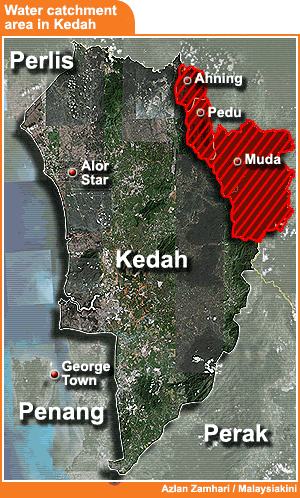
The Ulu Muda forest reserve - which is the last remaining tract of forests in the state - is a crucial water catchment area for the Pedu, Muda and Ahning dams which supply drinking water to Kedah, Perlis and Penang.
 Ironically, Penang is relying on the federal government to intervene on their behest and stop the Kedah government's plan.
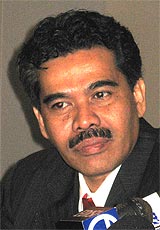
Penang Water Supply Corporation (PBAPP) CEO Jaseni Maidinsa ( right ) has written on behalf of the state government to the Ministry of Energy, Water and Telecommunications and the National Water Service Commission (Span), expressing its stand on the matter.
The state government wants the federal government to invoke the 2003 cabinet directive to all state governments to gazette their water catchment areas and use it as a basis to halt Kedah's ambition.
Penang has already gazetted 62.9 sq km of its catchment areas in 2004, while Kedah has received brickbats from green groups for increasing, not reducing, its logging zones.
 Speaking to journalists after officiating the PBAPP annual general meeting in Georgetown today, Penang Chief Minister Lim Guan Eng did not hide his disappointment.
"Kedah is destroying God's gifts to the world. Logging will destroy natural forest and raw water source."
Lim is willing to meet Kedah Menteri Besar Azizan Abdul Razak to resolve the matter.
He unwittingly praised previous BN administration in Kedah for not executing their planned logging of the catchment areas in order to "protect public interest".
"I am surprised with the present government approach despite it being fully aware of the adverse effects to living beings, nature and socio-economic developments," he said, referring to Kedah's PAS government.
Pose grave threat
Jaseni wrote to Azizan yesterday to explain in great detail the dire consequences to Penang, Kedah and Perlis if Kedah persisted with its logging.
He enclosed copies of findings from environmental studies showing the ecological and socio-economic impact.
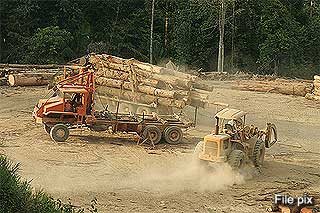 Rainfall will be affected by indiscriminate felling of trees, causing water pollution, drought and massive flooding. Overall, the northern region will become hotter.
"Tropical forest is a natural power to balance out the ecological system of a region," Jaseni had told Azizan in the letter.
The water catchment areas supply the bulk of irrigation water to rice fields across the three northern states of Penang, Kedah and Perlis besides water supply for industrial parks and townships.
Penang derives 80 percent of its 865 million litres of daily water consumption from Sungai Muda, which flows from the eastern part of Kedah to the Straits of Malacca.
Green activists and public interests groups including the Malaysian Nature Society, Sahabat Alam Malaysia and Water Watch Penang have opposed Kedah government's approval last Wednesday of a 22,798 hectare timber concession to Sibu-based WTK Holdings Sdn Bhd and Yayasan Islam Kedah.
A grave threat
Jaseni pointed out too that the 400km long roads necessary for logging transportation would pose a grave threat to industrial and township developments in the Northern Corridor Economic Region.
The companies will also carry out ‘heli-logging' in six forest areas at Ulu Muda, Pedu, Padang Terap, Chebar Besar, Bukit Keramat and Bukit Saiong.
These areas encompased 36 percent of Kedah's forest reserves.
Azizan is adamant to log timber in water catchment areas because "it is a matter of survival for Kedah due to escalating costs to administer the state and implement out beneficial programmes for Kedahans".
However, Penang government and green groups have argued that the spin-offs of conservation would eclipse the revenue through substantial long term socio-economic gains for the region.


