




Najib: Chinese community will not lose out
The government's strategy to restructure wealth in favour of poor bumiputeras and Indians will not be at the expense of the Chinese community and other groups, said Deputy Prime Minister Najib Abdul Razak.
The government's strategy to restructure wealth in favour of poor bumiputeras and Indians will not be at the expense of the Chinese community and other groups, said Deputy Prime Minister Najib Abdul Razak.
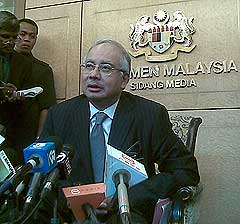 "I wish to clarify here that the implementation of the strategies under this drive (to tackle social imbalances) will not exclude opportunities for the other communities," he said in his ministerial speech on the mid-term review of the Ninth Malaysia Plan tabled last week by Prime Minister Abdullah Ahmad Badawi.
Najib's speech was boycotted by Members of Parliament of the opposition Pakatan Rakyat following their contention that it was against parliamentary convention and practice.
Najib, however, said it was important for him to make several clarifications regarding some of the strategies touched upon in Abdullah's speech on Thursday "in order to prevent it from being misinterpreted".
Focusing on the section on tackling socio-economic imbalances, Najib said the government's approach was to lessen the continuing disparities that existed between ethnic groups, between rural and urban areas, and between regions.
Bumiputera community, for instance, still own only 19.4 percent of corporate equities, 15 percent of premises and average income of RM3,156. In Sabah and Sarawak, bumiputeras have only three percent share of the corporate sector and an average income of RM2,063 to RM2,858.
Ethnic Indians, meanwhile, own only 1.1 percent of the corporate sector, 3.8 percent of premises, and an average income of RM3,799.
In comparison, the Chinese community have seen an increase of corporate shares to 42.4 percent, 76.1 percent of premises and average income of RM4,853, said Najib.
Private sector participation
The mid-term review of the Ninth Malaysia Plan will review the restructuring mechanisms that have been put in place to increase the involvement of bumiputeras in the economy, including the guidelines of the Foreign Investment Committee, Public Procurement Procedures and Industrial Coordination Act 1975.
"I wish to clarify here that the review of these instruments does not mean a tightening of equity restructuring conditions that will effect domestic and foreign investments," said Najib.
Conditions pertaining to bumiputera involvement and foreign ownership conditions had been loosed since the 1980s, while progressive liberalisation measures had been put in place to drive economic growth, he said.
Foreign Investment Committee guidelines are also being reviewed so as not to be seen as hindering the involvement of the private sector in the economy.
Another strategy to be taken to tackle socio-economic imbalances will be the encouragement of bumiputera participation in the private sector while non-bumiputeras will be encouraged to go into the public sector, said Najib.


