




Two debates, worlds apart
Middle-aged observers of the Anwar Ibrahim versus Shabery Cheek televised debate on the oil price hike found the electric atmosphere, keen argumentation, taut moderation, and the unabashedly partisan applause reminiscent - in respect of the atmospherics at least - of a similarly charged debate that occurred almost 40 years ago.
Middle-aged observers of the Anwar Ibrahim versus Shabery Cheek televised debate on the oil price hike found the electric atmosphere, keen argumentation, taut moderation, and the unabashedly partisan applause reminiscent - in respect of the atmospherics at least - of a similarly charged debate that occurred almost 40 years ago.
This was the Great Malaysian Cultural Debate held in the Mara Auditorium in Batu Road (later renamed Jalan Tuanku Abdul Rahman) in Kuala Lumpur on a Sunday morning in November 1968.
This debate pitted the leading lights of the newly-formed political party, Gerakan Rakyat Malaysia, with the young, vibrant and professionally qualified intelligentsia of DAP.
Great were the expectations roused by the formation of Gerakan, which was an amalgam of Labour Party luminaries like Dr Tan Chee Khoon and V David, with United Democratic Party stalwarts like Dr Lim Chong Eu, joined by a coterie of academicians that included Professor Dr Syed Hussein Alatas, who would become its president, and professor Wang Gung-wu.
The presence in the party of Dr JBA Peter of the Malaysian Medical Association only served to highlight the attraction of the party for public spirited professionals.
Curtain raiser to 1969 elections
The Great Malaysian Cultural Debate was a much anticipated event. It arose from a statement made by DAP’s Lim Kit Siang about the concept of Malaysian Malaysia and drew a riposte from Dr Syed Naguib Alatas, younger brother of Syed Hussein.
An exchange of rhetorical petards at party functions and in the press paved the way to a challenge to debate the issue before a live audience in a public hall. The moderator was opposition luminary DR Seenivasagam of the People's Progressive Party.
The third general election, held in May 1969, was looming. The debate, held six months prior to the polls, was a sort of a curtain raiser to the campaign.
The term 'culture' in the debate's tagline not only stood as code for the linguistic and cultural policies of each party - about which not a lot of candour was considered permissible in public debate at that time - but also for the intellectual streams from which leaders of either party drank.
The university students, young graduates, academicians, professionals and ordinary government servants who packed the auditorium that day must have been motivated by a desire to see which of the two parties that would compete for their vote in the upcoming general election had greater intellectual traction on the issues.
The crowd was eager, expectant and able to thrill to the elegance and cogency of the arguments deployed by the speakers. Unlike the crowd at the Anwar-Shabery contest, the one at the Cultural Debate was bipartisan, cheering for compelling individual speakers rather than for party positions.
Tension of two opposing blocs
The one parallel the Anwar-Shabery match-up had with its historic antecedent was that both took place at an expectant time in Malaysian history when calls for political change were reverberating throughout the land.
Both juxtaposed the conflicting visions of its protagonists: in the earlier encounter, the cultural policies of one set of opposition politicians versus another set; and in the latter match-up, the differences in political outlook that impact the allocation of revenue from a vital and depleting natural resource for national development.
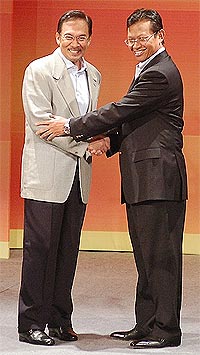 The Anwar-Shabery debate was fraught with the tension of two opposing blocs in endgame collision; the earlier debate was taut with the expectation of exhilarating visions waiting to be given birth.
The protagonists in both debates were keen to display their fitness to rule the country on the strength of their grasp of the issues. Like all such debates, the question of who won or lost mattered less than what it suggested of the calibre of the protagonists and of what it portended for the future of the country if one or the other came to power.
The earlier debate was not a head-to-head contest like Anwar versus Shabery, though in large part the principal exchanges - in terms of intellectual quality - were between Syed Naguib of the Gerakan and Goh Hock Guan, then the most voluble exponent of the DAP's democratic socialism. Each party deployed a panel of speakers but the main protagonists were Syed Naguib and Hock Guan.
Both debates, with its heady promise of intellectual treatment for the regnant issues of the day, had a nasty little incident in its undertow. A skirmish between guards and media personnel in the immediate prelude to the Anwar-Shabery debate had an echo in the choler of a slew of attendees at the earlier event who vociferously shouted their disapproval when the debate veered, inadvertently rather, on to religious grounds.
Both were ugly, if fleeting, incidents. But both were reminders that the Malaysian apple of democratic debate almost always sports a worm of self-destruction.
Related reports


