




M'kini mentioned in Singapore's national day speech
In a move acknowledging the power of new media, Singapore Prime Minister Lee Hsien Loong plans to loosen the island state’s ham-fisted control over the Internet.
Taking a leaf from a number of countries including neighbouring Malaysia, Lee said politics had shifted online and politicians themselves now operated blogs and websites to reach out to their voters.
In a move acknowledging the power of new media, Singapore Prime Minister Lee Hsien Loong plans to loosen the island state’s ham-fisted control over the Internet.
Taking a leaf from a number of countries including neighbouring Malaysia, Lee said politics had shifted online and politicians themselves now operated blogs and websites to reach out to their voters.
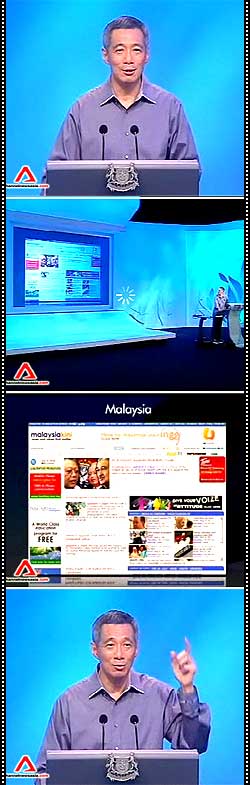 “Everyone is plugged in and connected,” he said in his annual National Day Rally speech. “We used to talk about grassroots, now we have to talk about ‘netroots’.”
Describing the Internet as a global trend that his government needs to keep up with, he pointed to Malaysia, the island’s closest neighbour, as an example where cyberspace has become an "active space for information and engagement".
“There is lively debate and serious contributions, together with the more doubtful stuff,” he said in a speech telecast live nationwide on Sunday night, accompanied by a slide presentation.
“There are blogs and chatrooms and news sites such as Malaysiakini , which is very popular, and I know many Singaporeans visit it, and it has got quite a lot of news.”
Lee flashed the Malaysiakini homepage on the large screen he traditionally uses on National Day Rally speeches to underscore his points.
"The politicians themselves actively participate in cyberspace. Dr Mahathir (Mohamad) has a blog now, he uses the name Cetdet."
Lee said while Mahathir began as a politician and got into blogging, there were others who started as bloggers and became politicians.
"You have heard about Jeff Ooi, famous blogger, stood for election, and got elected."
He showed the 'Screenshot' blog of Ooi, who was elected Jelutong parliamentarian in the March 8 general elections, as well as the website of opposition icon Anwar Ibrahim.
BN was also present in cyberspace, said Lee, although not to the same extent.
According to Lee, issues such as rising costs of living, poor public service delivery, and perceived inequalities in the Malaysian government's policies were picked up in the new media, and amplified through viral distribution.
Internet can be a dangerous place too
However, Lee warned that the Internet can be a place where rumours could boil over, such as in South Korea where the newly-elected President Lee Myung-bak came under fire after stories of rampant mad-cow disease sweeping the nation surfaced in cyberspace.
This, said Lee, turned out to be untrue.
Nevertheless, the Internet has changed the way Singapore conducts its politics.
"We have to adapt, get used to it, and turn it to positive effect," he said.
Lee pointed out that the impact of the Internet in Singapore’s next general election, to be held in five years’ time, will be far greater.
“Cyber years are like dog years, so five years in cyberspace, is like 35 years in the real world.”
The Singapore PM also said his government would make the changes, but move cautiously, especially in the case of outdoor public demonstrations.
“The overall thrust of all these changes is to liberalise our society, to widen space for expression and participation. We encourage more citizens to engage in debate, to participate in building our shared future,” he said.
He said that the government will lift the long-standing ban on political documentaries and films.
Over the years, Singapore has banned a number of political films, including director Martyn See’s documentary about former journalist and dissident Said Zahari’s 17 years in detention under the Internal Security Act.
Critics have however argued that the such baby steps do not go far enough in making Singapore a democratic society.


Are you sure you want to delete this comment?
This action cannot be undone.