




DAP's 'rocket' ready to go mainstream
Buoyed by jubilance and self-confidence, DAP delegates agreed to launch their famous trademark logo - the ‘rocket’- onto a journey into a future fraught with uncertainty and challenges during the party’s 15th annual congress held over the weekend.
Buoyed by jubilance and self-confidence, DAP delegates agreed to launch their famous trademark logo - the ‘rocket’- onto a journey into a future fraught with uncertainty and challenges during the party’s 15th annual congress held over the weekend.
 In a speech closely monitored by members and observers, secretary-general Lim Guan Eng laid out the theme and vision for the party’s struggle, its role in the Pakatan Rakyat opposition coalition and DAP’s own coming of age.
“We must transform DAP into a mainstream party perceived by most Malaysians as capable of providing strong and innovative leadership with the highest integrity,” Guan Eng, who is also Penang chief minister said.
The DAP’s breakthrough in the March general elections, where it won 28 parliamentary seats, its biggest haul after 42-years of struggle, has raised hopes of an even brighter future ahead.
But there were also delegates who feared their success might be short-lived given the strong fightback from the ruling Barisan Nasional coalition.
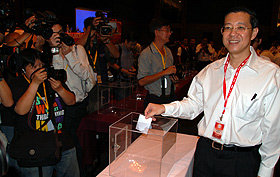
 Still, when Guan Eng urged party members to take cognisance of internal institutional and organisational weaknesses, and then followed up by announcing plans to build a new DAP headquarters, there were loud cheers and applause from the 739 attending delegates (
right
).
Still, when Guan Eng urged party members to take cognisance of internal institutional and organisational weaknesses, and then followed up by announcing plans to build a new DAP headquarters, there were loud cheers and applause from the 739 attending delegates (
right
).
On getting Malay support that has been eluding the party, he said, “Whether we can gain Malay support depends on our performance as a partner in Penang, Perak and Selangor. Especially DAP as the leading government in Penang, to prove that we can take care of the Malays and deliver what BN cannot do in 50 years. Our challenge is to consolidate existing support while reaching out intensively to urban Malays, as well as bumiputeras of Sabah and Sarawak.”
Guan Eng also reassured his Pakatan coalition partners, saying, “We dedicate ourselves to being a responsible partner in power towards our vision of establishing a people’s government based on the six tenets of democracy, justice, rule of law, integrity, human dignity and freedom.”
 He continued, “DAP’s vision of this people’s government shall ensure political equality, equal economic opportunity, socio-economic justice and compassion.”
He urged DAP legislators and leaders to practises good governance through ‘CAT’ - an acronym for competency, accountability and transparency.
Guan Eng also reiterated the DAP would remain committed to the Pakatan by adhering to four tenets that bind members of the alliance.
 Firstly, DAP will back opposition icon Anwar Ibrahim as prime minister should the Pakatan succeed in forming a new government.
Secondly, DAP will reject any proposal to turn Malaysia into a theocratic state, be it an Islamic or a Christian state.
Thirdly, the Pakatan remains a coalition of “equals” and fourthly, belief in a two-coalition political system.
Guan Eng: DAP not kingmaker
“DAP is not a kingmaker and do not aspire to be one. Only the people are the kingmakers,” Guan Eng said.
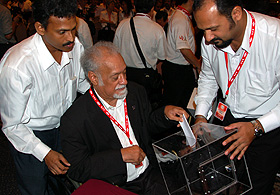
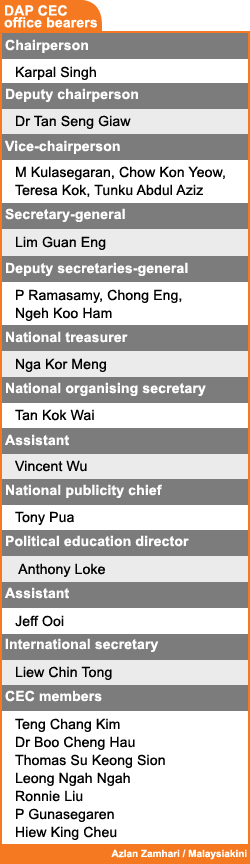 There was little surprise during the two-day congress. The majority of incumbents were re-elected, a result observers say reflected members’ happiness with their leaders for taking the party to new heights in the March national polls.
DAP veteran supremo Lim Kit Siang got the clear thumbs-up when delegates voted him into the party’s power central executive committee with the highest number of votes, scoring 624 out of 739 casted. His son, Guan Eng, was next most popular, with 620 votes.
Ten other delegates who were co-opted into the national line-up are Teo Nie Ching, Vincent Wu Him Ven, Thomas Su, Leong Ngah Ngah, Liew Chin Tong, Jeff Ooi, Ronnie Liu, P Gunasegaren, Hiew King Cheu and Tunku Abdul Aziz.
Outspoken critics Teng Chang Khim (417) and Boo Cheng Hau (332) were also voted into the CEC. Observers believe delegates wanted the duo to continue infusing check-and-balance into the party’s top decision-making organ. However, neither men were appointed as office-bearers.
Only two women made it into the CEC, namely Teresa Kok and Chong Eng, who were appointed as vice chairman and deputy secretary-general respectively.
Two notable new entrants voted into the CEC to provide new blood and more youthful perspective were Tony Pua, ex-economic adviser to Guan Eng, and Gobind Singh Deo, MP for Puchong and also the son of DAP chairman Karpal Singh.
DAP also announced a ‘catch’ towards the end of the second day of the congress - Tunku Abdul Aziz, a UK-educated Malay intellectual who was former adviser to Bank Negara and ex president of Transparency International Malaysia.
 DAP veterans Karpal and Kit Siang welcomed the entry of Abdul Aziz, who was appointed one of the party’s vice-chairman.
“Tunku Aziz joining DAP should be emulated by other Malays. The DAP is a multiracial party - and it is a great day for the party,” said national chairman Karpal Singh.
Tunku Aziz reciprocated the goodwill, declaring there was no future for race-based parties.
“DAP will indeed become a multiracial party. There is no future for race-based parties. After 50 years of independence, we (Malaysians) have to decide, do we want a divided people or an integrated people?”


Are you sure you want to delete this comment?
This action cannot be undone.