


/file/publisher-c1a3f893382d2b2f8a9aa22a654d9c97/2023/11/4bf2cd54885aac49ba1a9ce289ada9d2.jpg)

Govts change but authoritarian legalism stays, activist says after court defeat
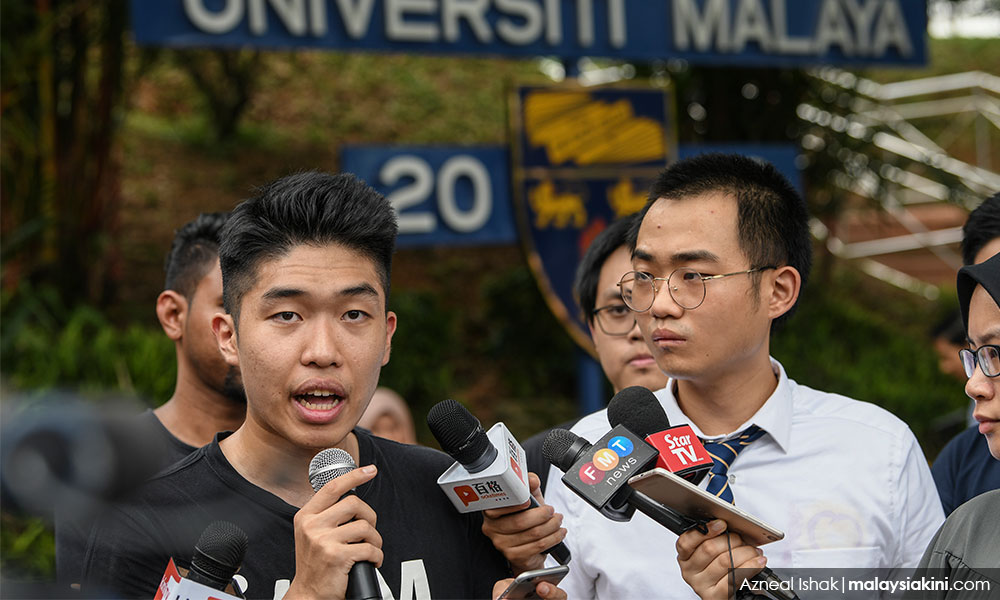
Activist Wong Yan Ke has raised concerns over the future of Malaysia’s democracy after the Court of Appeal upheld his conviction and RM10,000 fine for insulting then Universiti Malaya vice-chancellor Abdul Rahim Hashim and convocation attendees during a 2019 protest.
In a statement, Wong said he respected the court's authority but warned that the ruling could set a troubling precedent for dissent.
According to him...
Activist Wong Yan Ke has raised concerns over the future of Malaysia’s democracy after the Court of Appeal upheld his conviction and RM10,000 fine for insulting then Universiti Malaya vice-chancellor Abdul Rahim Hashim and convocation attendees during a 2019 protest.
In a statement, Wong said he respected the court's authority but warned that the ruling could set a troubling precedent for dissent.
According to him, it could create further obstacles for student activists, social movements and citizens exercising their right to protest.
"Nearly seven years have passed since I raised that placard. Malaysia has changed governments, but authoritarian legalism persists. Arrest, detention and prosecution, cloaked in legal procedure, are used to wear down civil society.
"Lengthy proceedings keep activists returning to court, diverting time and resources from pursuing reform and holding the government to account towards defending themselves.
"When the process itself becomes punishment, the chilling effect spreads," said the Kuala Lumpur and Selangor Chinese Assembly Hall youth chief.
/file/publisher-c1a3f893382d2b2f8a9aa22a654d9c97/2022/01/86a3e9b51f738dd4d3c47e747ad81fcf.jpg "Judge judging gavel court generic 120122")
Below is his full statement:
After six years and eight months, my legal battle has reached a deeply disappointing conclusion.
The Court of Appeal dismissed our appeal, upholding my conviction under Section 504 of the Penal Code and the RM10,000 fine. I held up a placard at my graduation ceremony to protest against the racism and abuse of power of Universiti Malaya’s then Vice-Chancellor. That act of protest ultimately brought me a criminal conviction.
I respect the court’s authority to adjudicate and interpret the law, but deeply regret the outcome.
My disappointment is not about being punished or bearing a criminal conviction. It lies in our failure to persuade the court to fully understand the nature of protest and interpret freedom of expression more broadly. More troubling is the precedent this judgment could set for suppressing dissent, creating further obstacles for student activists, social movements and citizens exercising their right to protest.
Peaceful protest can interrupt ceremonies, disrupt everyday routines and cause discomfort, displeasure or even anger—particularly among the powerful. Their displeasure, however, should never be grounds for denying the legitimacy of protest.
Where power is unequal and accountability fails, such friction serves a democratic purpose. Protest is a weapon for the powerless. It brings ignored grievances into public view, mobilises public opinion and pressures those in power to confront problems, answer criticism and correct their mistakes.
My protest was not driven by a personal grudge. It challenged the Vice-Chancellor’s use of the university’s name to help organise a racist congress and endorse politicians’ agenda. Reducing such a public protest to a personal insult ignores the imbalance of power and evades the public responsibilities of those who hold office.
/file/publisher-c1a3f893382d2b2f8a9aa22a654d9c97/2025/06/94539bae7906f14cfffea31239e9608e.jpg "Universiti Malaya malaysia aka UM generic 160625")
Those who wield power must accept greater scrutiny. High office does not entitle them to dictate how they may be criticised.
The government must therefore amend Section 504 of the Penal Code to explicitly protect peaceful protest and prevent its use to punish dissent and restrict civic space. Public protest is fundamental to democracy.
Throughout these proceedings, one argument kept recurring: you have freedom of speech, but must exercise it through “proper channels”; a graduation ceremony is solemn, and holding up a placard disrupts “order”.
The focus is thus shifted, almost without question, from the failures of those in power to whether protesters have behaved appropriately. When society scrutinises how people protest but not why, and demands restraint from citizens but no accountability from those in power, "order" becomes a shield for vested interests.
"Proper channels" are meant for the elites, and have never been equally accessible to everyone. Status, resources, connections and acceptance by elite circles often determine whether a person’s voice is heard. Even after exhausting every channel, citizens are accused of not doing enough. Whether those in power have genuinely listened rarely receives the same scrutiny.
These seemingly reasonable social norms entrench elite power and serve those who benefit from the system. They raise barriers to protest, dismiss its demands and deny its moral basis and legitimacy.
During Abdul Rahim’s tenure as Vice-Chancellor, students and academics repeatedly sought to raise concerns, including over the Malay Dignity Congress. They wrote letters, issued statements, requested meetings, asked the Deputy Vice-Chancellor to convey their concerns, protested outside his office and even waited in the car park for a face-to-face conversation. They received no response. Only after I raised my placard at the graduation ceremony did the university issue two successive statements—and lodge a police report against me.
These failures extend beyond universities. Civil society has used established channels to object to public land development in Kuala Lumpur, waste incinerators in Selangor, and the decisions to reduce Najib (Abdul Razak's) sentence and subsequently approve conditional house arrest.
But when have those in power truly listened to the public and delivered accountability? All too often, “proper channels” become a façade of democracy by the ruling elites, deflecting the people’s demands rather than addressing them.
Protest emerges precisely because these channels repeatedly fail. It empowers people excluded from decision-making to reclaim their voice. It challenges the legitimacy of those in power and makes their responsibilities harder to evade.
We must not confuse cause and effect by blaming civic protest for social disorder.
What truly undermines society is the honouring of racists while those who oppose racism are harshly punished; repeated leniency for the corrupt while protesters are convicted; and a state that strengthens those in power while continually restricting people’s rights. When these injustices become normal, public trust in the law, the state, and the promise of fairness and justice steadily erodes.
Nearly seven years have passed since I raised that placard. Malaysia has changed governments, but authoritarian legalism persists.
Arrest, detention and prosecution, cloaked in legal procedure, are used to wear down civil society. Lengthy proceedings keep activists returning to court, diverting time and resources from pursuing reform and holding the government to account towards defending themselves. When the process itself becomes punishment, the chilling effect spreads.
It is especially disheartening that, under Anwar’s government, civil society must still expend so much effort defending even the most basic civic space. Mandiri and Hayat have been targeted; Bersih and Borneo Komrad members have been barred from entering Sabah; and the president of Sahabat Alam Malaysia has been denied entry to Sarawak.
I understand that reform takes time. But ending the repression of civil society and the targeting of dissent requires no prolonged effort or consensus. With political will, Anwar (Ibrahim) could do so today.
/file/attachments/orphans/pmx1sdd_635776.png "PMX Prime Minister Anwar Ibrahim circa 29th of September 2026 300926")
I stand in solidarity with everyone facing repression for defending freedom and democracy.
Finally, I offer my heartfelt thanks to the lawyers who have been part of my defence team: Haijan Omar, Farida Mohd, Chan Yen Hui, Asyraaf Abu Bakar Hamzah, Chong Kar Yan, Samantha Chong, Shashi Devan, Rajsurian Pillai, Nooradila Abdul Aziz and Neil Tan.
I also thank my civil society colleagues and everyone who has stood by me. Your solidarity, support and donations over the years have sustained this legal struggle and ensured that I did not bear its burden alone.
Although the appeal process has ended, I will discuss with my lawyers whether there remains any scope for judicial review. I recognise that the threshold is high, but the struggle to defend freedom of expression will not end here.
If fines or even imprisonment are the price of civil disobedience in the struggle against racism and authoritarianism, I am prepared to pay it.
I'd rather die standing than live kneeling.
In solidarity,
Wong Yan Ke
Chief of KLSCAH Youth
/file/publisher-c1a3f893382d2b2f8a9aa22a654d9c97/2024/10/2a534061ec1d0225e1ac663b0363c7d6.jpg)
/file/publisher-c1a3f893382d2b2f8a9aa22a654d9c97/2026/08/f19d99c7a4adb182c34da9f43800bc7c.jpg)
/file/publisher-c1a3f893382d2b2f8a9aa22a654d9c97/2021/01/8d2e3060d6ef020b772519e8ff2dcac6.jpg)
/file/publisher-c1a3f893382d2b2f8a9aa22a654d9c97/2019/10/a67789dd50235a702583cd76ef29cd64.jpg)


Court been lenient. It must be the reformasi at work.
Kesopanan dan kesusilaan. Don't be biadap.
The head of a tertiary institution is expected to show concern and care for all students and not be unapproachable. Dialogue and clarification puts to rest any apprehension or concern the students may have in the way the administration carries out its job. These students are our future keaders and should not be deprived the space yo express their views and concerns. No authority is absolute and is answerable to the people. Being authoritative in administration, isolates the principles of good governance.
Report this comment
Are you sure you want to delete this comment?
This action cannot be undone.