




He's back on the cusp of leadership
Anwar Ibrahim is just about where he was 10 years ago.
The price of living a long life is the discovery that it is circular, not linear. This may well be what's going through the mind of Anwar as, on the morrow of his triumphant return to Parliament, he reflects on events 10 years ago to the day literally.
Anwar Ibrahim is just about where he was 10 years ago.
The price of living a long life is the discovery that it is circular, not linear. This may well be what's going through the mind of Anwar as, on the morrow of his triumphant return to Parliament, he reflects on events 10 years ago to the day literally.
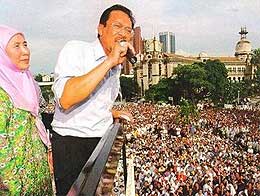 He was then still deputy premier as rumours swirled in Kuala Lumpur about the impending strife between political power blocs on a collision course. The mills churned with stories of disaster lying in wait for some, of minions of one bloc scurrying to flee the country to avoid arrest, of a flurry of meetings amongst people who matter, and of imminent implosion to the careers of high flyers.
Of course, you could not rely on the mainstream media to give you some inkling of what was brewing. The government-controlled media's raison de'tre is to justify the implosion once it happens, not intimate it's in the works, never mind that in the lead-up weeks it may have not stopped carrying stories on the virtues of the lamb being readied for ritual slaughter.
What's a concerned follower of national affairs to do in times like that when speculation is rife, knowledge of actual goings-on is scanty, and the demand for on-the-spot omniscience insistent?
If you happen to be old enough to remember, you try to recall what the equivalent situations were in times past for a way of figuring out what's in the works and how it will play in Permatang Pauh or, for that matter, in Pontian.
Umno’s third implosion
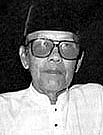 On the theory that the book of history never lies, one recalled in the fraught days of late August 1998 how things were in November 1975 when Kuala Lumpur swirled with rumours of powerful Selangor Menteri Besar Harun Idris's (
left
) imminent arrest for corruption.
On the theory that the book of history never lies, one recalled in the fraught days of late August 1998 how things were in November 1975 when Kuala Lumpur swirled with rumours of powerful Selangor Menteri Besar Harun Idris's (
left
) imminent arrest for corruption.
One also harkened back to February 1986 when the grapevine churned with word of popular Deputy Prime Minister Musa Hitam's resignation.
Both events, at the times they occurred, impinged on the body politic with explosive force. In late August 1998, about the only thing a seasoned follower of national affairs could say with certainty as the rumour mills worked overtime was that Umno was going through its decanal season of internecine strife.
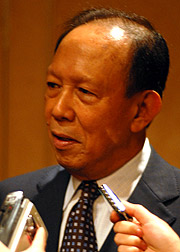 Every 10 years or so Umno convulses. Anwar's political and judicial decapitation in the closing months of 1998 was the third edition of this decanal distemper, if you saw the Harun and Musa (
right
) implosions of 1975 and 1986 respectively as the first two.
Every 10 years or so Umno convulses. Anwar's political and judicial decapitation in the closing months of 1998 was the third edition of this decanal distemper, if you saw the Harun and Musa (
right
) implosions of 1975 and 1986 respectively as the first two.
The inevitable question arose: would the third implosion lead to the formation of a splinter group more enduring than its predecessor?
Umno's implosion over Harun did not lead to a splintering of the party so much as a long period of dissidence assuaged by his pardoning in early 1981 and election in June that year to a vice-president's post at the triennial elections.
The implosion over Musa Hitam in 1986 eventuated in the formation of Tengku Razaleigh Hamzah's Semangat 46. Had this party not dissolved itself and rejoined Umno in April 1996, it would have been the chief beneficiary of the Umno's 1998 implosion over Anwar, and Razaleigh, supposedly Malaysian politics' man of manifest destiny, would conceivably been prime minister by the 10th general election of November 1999.
Umno's third implosion, over Anwar, led to the formation of Parti Keadilan Rakyat (PKR), which unlike Semangat 46, is a non-race based party.
In terms of evolutionary extrapolations on the matrix of Umno’s periodic fractures, PKR was a decided improvement over Semangat 46. In fact, PKR is the delayed evolution of Umno's arrested development of 1952 when its founder Onn Jaafar wanted to open the party's membership to non-Malays.
Still floundering six months after
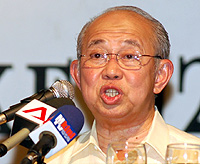 As it is now, Razaleigh (
right)
is trying to lead the movement for reform in Umno, hoping that it would carry him to the premiership of Malaysia.
As it is now, Razaleigh (
right)
is trying to lead the movement for reform in Umno, hoping that it would carry him to the premiership of Malaysia.
The problem is how to reform a party void of ideology. The latter is the lifeblood of a political party. It helps you frame a vision and configure an agenda for its fulfilment. Ideology is what a party is left with when it has hit a dead end and seemingly there's no way out.
Is there any surprise that almost six months after the political tsunami of March 2008, Umno is still floundering away, its bankruptcy starkly evident in the abominable racial tactics it employed to prevent Anwar's return to Parliament in the Permatang Pauh by-election.
The concept of noblesse oblige that motivated Tunku Abdul Rahman, who sustained Umno when founding leader Onn Jaafar left in 1952, and now drives Razaleigh is a code of personal conduct; not a substitute for a political ideology.
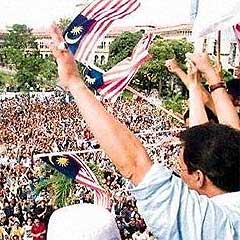 And manifest destiny only applies when you help generate and anticipate political waves that enable you to swim in its currents and to guide and channel them. By that measure, Anwar is more the man of manifest destiny, proven in the way he anticipated the irruptions for change in the past year of ferment in Malaysian politics and levered them to PKR's advantage.
Today, on the morrow of his return to Parliament, the wheel of political fortune has come full circle for him: he is back on the cusp of the premiership of Malaysia where he was this time 10 years ago before being dragged through Fate's mangle.
Right now, whether defections from the government's bench to his party occur by the much ballyhooed date of Sept 16 to catapult him to the top of the pole are not as important as awareness that political fortunes are cyclical and that it always greasy at the top, necessary wisdom for the path ahead.
TERENCE NETTO is a journalist of nearly 30 years' experience consisting of spells spent in the mainstream papers interspersed with bouts of freelancing.


Are you sure you want to delete this comment?
This action cannot be undone.