




M'sians have more freedom of speech now: Pollster
Malaysians are literally at the crossroads when asked for their opinion on the topic on 'Freedom of Speech and the Media'.
Polls conducted on www.sarawakpollster.com.my shows that 54% of the respondents were of the view that Malaysians under Prime Minister Abdullah Ahmad Badawi have a greater freedom of speech and openness of expression now than five years ago, while 44% would still want more say, so to speak.
Malaysians are literally at the crossroads when asked for their opinion on the topic on 'Freedom of Speech and the Media'.
Polls conducted on www.sarawakpollster.com.my shows that 54% of the respondents were of the view that Malaysians under Prime Minister Abdullah Ahmad Badawi have a greater freedom of speech and openness of expression now than five years ago, while 44% would still want more say, so to speak.
 The opinion poll was launched by
Malaysiakini
chief editor Steven Gan in Kuala Lumpur on July 16 in the presence of Sarawak Pollster Sdn Bhd director Goh Yong Tat.
The opinion poll was launched by
Malaysiakini
chief editor Steven Gan in Kuala Lumpur on July 16 in the presence of Sarawak Pollster Sdn Bhd director Goh Yong Tat.
Malaysiakini journalists Syed Jaymal Zahiid and Ashley Boncimino conducted the interview ( see photo ).
The poll ran for a month and the results were tallied 10 days ago.
Respondents were equally divided on the question of the extent of free expression exercised by online media, with 49.82% who were not satisfied and would want more freedom for such expression.
This is despite the fact that the Malaysian government is more liberal than its Singapore counterpart in respect of online expressions.
Any attempt to further impose conditions on freedom are viewed negatively by the respondents (80%), who considered the “Pressgate” forbidding media reporters at the Parliament lobby for security reasons as an incidence to restrict media freedom of movement in Parliament.
The right to freedom of speech and expression is not absolute. Control and restrictions are imposed by statutes for public order and security reasons, while the law of defamation protects the individual’s reputation.
It is difficult to ascertain the limits to such freedom and ultimately it is the maturity of the nation’s populace that sets the invisible line which a person crosses at one’s own peril.
As the saying goes: My freedom is a constraint on your freedom. The recent Bar Council forum incident on conflict of laws relating to Islam showed the ugly head of such suppression of freedom of expression.
About 84% of the respondents acknowledged that while providing useful public feedback, online media such as blogs and opinion polls do influence public opinion and perceptions.
They therefore opined that increased freedom of the media and expression would lead to less political unrest and demonstrations. This was an apparent preference to have open discourse on issues rather than locking away any discussion at all on so-called “sensitive issues”.
For meaningful media freedom reforms, 54% would like such a move to be spearheaded by a Parliamentary Select Committee headed by the Speaker and media activists, rather than by a minister in the Prime Minister’s Department. This is to ensure greater independence and neutrality in such a move.
Polls analysis on Pak Lah
Meanwhile, another opinion polls was conducted by Sarawak Pollster on Prime Minister Abdullah and from the respondents, these responses form the basis of their analysis.
Economic policies by the BN in response to the global financial downturn and fuel hike were seen to be too little, too late. The scattered subsidy strategies were perceived to be ad hoc responses gorging in the abyss of complex economic equations.
The sudden rise in costs of living overshadowed any long term remedies of the government. This explains why 85% of the polls responded with the answer that they do not have confidence in the government’s present economic policies.
About 67% felt that a change of prime minister would bring about political stability, economic certainty and stabilisation of the costs of living in Malaysia. Only 23% did not think a change would make any difference.
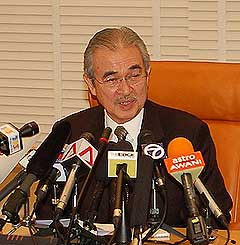 On the political front, 19% of those polled think that PM Abdullah Badawi is more democratic and administratively transparent, with 78% not sharing the same conclusion.
There is also a loud cry (80%) for racial, religious and social relationship improvement to be had under his leadership style.
It is therefore understandable that many of the respondents (86%) perceived Pak Lah as displaying a weak and inconsistent leadership, with about 10% grading him as a moderate and considerate leader.
Most (72%) favour reforming the term of the prime minister to a maximum of two terms, with 12% opting for three terms. The rest expressed no opinion on this matter.
The road to the top is preferred by 65% of the polls to be through direct election by the people (like the US presidential elections). 21% feel that a confidence vote by the majority in Parliament might do, while 14% preferred a smooth leadership transition within the majority party and then endorsed by the majority in Parliament.


Are you sure you want to delete this comment?
This action cannot be undone.