




King and politics, ball is in the royal court
It appears that the public now seems to think that the Yang di-Pertuan Agong should intervene to put certainty and order back in the country. Some quarters however felt that such is not desirable, arguing that it is not appropriate to get the king involved in it.
It appears that the public now seems to think that the Yang di-Pertuan Agong should intervene to put certainty and order back in the country. Some quarters however felt that such is not desirable, arguing that it is not appropriate to get the king involved in it.
Apparently this view fails to take into consideration various facets of the king’s role and functions under the constitution. On top of that the intervention seems the only available option given that the prime minister has already refused to consider, let alone allow, the convening of parliament to see whether he still has the majority behind him.
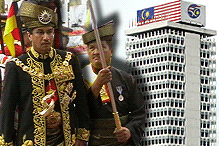 The role of the king – like head of states in other Westminster countries – is to become the symbol of the nation as well as becoming the formal repository of state authority and powers. While this is the primary one, he may, once in a while in critical situations, assume the guardianship role.
This is the theme that provides the legitimacy for drastic actions; something comparable to the dismissal of Australian prime minister Gough Whitlam by the country’s head of state, governor-general Sir John Kerr in 1975. Not far from home we have seen how King Bhumipol Adulyadej, the world’s most senior head of state, occasionally intervened in Thai politics.
The advantage of having a monarchy like ours is that this institution, unlike appointed heads of states, is generally able and indeed seen to stay above politics. Some of the appointed heads of states were indeed politicians before they came to the office and this is one of the reasons why it is quite difficult for them to stay above the political fray.
Even when they eventually managed to do it, their past keeps reminding those who are not convinced about their neutrality. For one thing impression and perception matter and these may have been due to the manner of their appointment.
In Malaysia these two types of offices exist side by side though the non-royal heads of states may be said as to have been created to fill the void. In any case under our constitution the Yang di-Pertua Negeri is appointed by the king through his discretion after consulting the chief minister of the state concerned.
But the impression of the public seems to be that the Yang di-Pertua Negeri is virtually put in office by the prime minister. And this is something which is difficult to deny given what has been the practice since 1957.
The rulers on the other hand do not owe their position to the politicians. Indeed the constitution has undertaken to protect the rule of succession in all nine states with sultanates, obviously as part of the guarantees provided for by the constitution for the states under the Malaysian federal system.
Flexing their muscle
The position of the rulers as hereditary heads of states has helped, in some ways, stabilise the states. This was quite evident in the aftermath of the 12th general election whereby the rulers in Perak, Selangor, Perlis and Terengganu have taken an active part in the formation of governments following the shift in our political landscape.
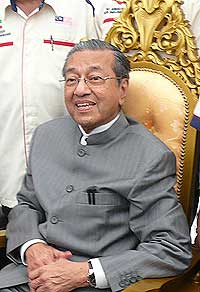 Such a phenomenon has prompted some political observes to say that the rulers – despite the amendments initiated by former premier Dr Mahathir Mohamad in 1983, 1993 and 1994 – have started to flex their muscle and assert their influence.
But this is not true for what the rulers did was exactly within their constitutional powers. Although they also took some additional measures but these were nonetheless very much ancillary to those constitutional powers.
Generally speaking the role and powers of the heads of states are quite similar with that of the king at the federal level. However unlike the former, the latter has not been equally assertive although the Conference of Rulers has, on a number of occasions, been willing to take quite a proactive role.
Their initiatives on the appointments of certain senior members of the judiciary is a case in point. The Conference has also been representing the rulers during the constitutional crises in 1983 and 1993 where it has somehow shown that it was quite good at it. Interestingly enough, the king retired to the background on both occasions.
Why has the king – or more accurately the kings – been taking a largely subdued role? One obvious reason is the nature of the office: while a ruler virtually reigns for life in his own state the King is only in the capital for five years on a rotation basis.
He is there representing his other brother rulers, lending the Malay and Muslim image and identity to the federation. In the first 51 years of independence we have seen how the kings come and go the prime ministers stay: we have had 13 kings in the half century only five premiers within the same period.
 This has obviously made it difficult for the king to be assertive or take the role similar to those assumed by the Thai King or Queen Elizabeth II. The latter, who has been in office since 1952, has presided over regime changes involving some 11 prime ministers; from the conservative Winston Churchill to liberal or Labour politicians such as the current Prime Minister Gordon Brown.
Being on the throne for more than 56 years has given the Queen an enormous amount of experience and tact. Such was the reason why she has never put her foot wrong when it comes to her constitutional duties.
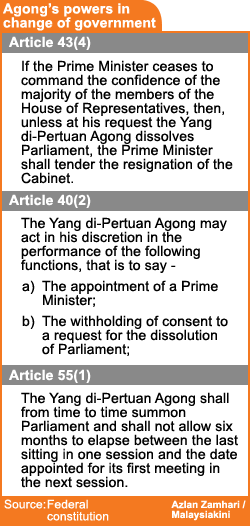
The Constitution has divided the powers into three broad categories; namely the formal powers, those exercisable on advice and the discretionary ones. Admittedly it is easy to divide the powers of the king as a matter of theory.
However the same could not be said when it comes to their actual exercise. Take what is termed as the discretionary power to appoint the prime minister under article 40(2)(a) of the Federal Constitution - which corresponds to the power to appoint mentri besar in the case of the rulers and chief minister in the case of the Yang di-Pertua Negeri – as example.
Given the nature of the democratic nature of the constitution this power will only become discretionary in situations whereby there is a hung parliament; that is when the there is no clear majority or that there is a majority but it has no clear leader. In situations whereby there is a majority group of MPs who has a clear leader there is no question of discretion: the Yang di-Pertuan has to appoint that leader as prime minister.
Ball in the royal court
In most part of the Commonwealth political parties indicate their leader, indeed in countries like the United Kingdom they have what is known as parliamentary party which consist of party members in the house and a leader who is elected by these MPs. Thus the power of appointment vested in the sovereign is a mere formal appointment with no real discretion involved even though as a matter of law it is still termed as the prerogative power of the Queen.
While appointment has become largely a mere formal exercise of power there are other aspects of the constitution which require the proactive part of the king. It has to be said that some of these powers are quite controversial. However, this is quite inevitable for state running is essentially politics or political in nature.
It is not easy to disentangle politics from government policies and administration, even the routine ones. This is something which perhaps should be borne in mind by the palace advisers: some of them have already indicated their apprehension on the calls for the king to intervene.
Be that as it may the office of the king has effectively been politicised by the government of the day on several occasions. We have seen how the government backbenchers accused Karpal Singh of committing sedition when the latter raised issues on certain matters touched by the royal address during the official opening of parliament.
Their action was obviously wrong as the speech, despite the name, was actually the policy speech of the government of the day. In other words what happened was simply this: the Barisan MPs hid behind the throne when they got attacked by the opposition.
 One recalls that in the aftermath of the Bersih demonstration in the city last November one of the palace officials came out with a statement – purportedly made on behalf of the king – distancing the palace from the polls reform group.
Not too long ago the name of the king popped up in the case of pardon granted to the grandson of a former finance minister who was convicted of murder, a decision that was obviously made by the government.
In the light of democracy and constitutionalism the issue now is not whether the king’s involvement is political or otherwise. What matters most is that something needs to be done in order to put the country back on the democratic process which at the moment means the testing of the claim made by Opposition Leader Anwar Ibrahim that he has got the numbers to form the new government. As parliament has been denied the opportunity, the ball is now at the king’s court.
Fitness to govern is a grave matter and thus it is inappropriate for us to delay it.
Dr ABDUL AZIZ BARI is professor of law at the International Islamic University Malaysia.


Are you sure you want to delete this comment?
This action cannot be undone.