




Foreign workers: Are they welcome in S'pore?
It was a question that had tongues wagging in Singapore. Just how accommodating must the city-state be when embracing foreign workers?
It was a question that had tongues wagging in Singapore. Just how accommodating must the city-state be when embracing foreign workers?
Or put it another way, just how close should the average Singaporean - raised on its national pledge that extols the virtues of unity, justice, freedom and equality, a pledge recited daily by the country's school children - allow foreign workers from neighbouring Asian countries to reside in proximity to where they live?
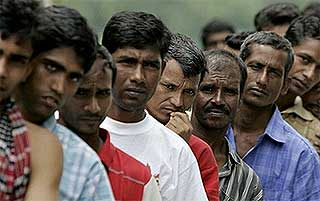 Or precisely just how much must that embrace extend when the workers in question are the very individuals who do all the manual work in construction sites and shipyards etc?
Whilst the issue undoubtedly was something to ponder about particularly in the context of Singapore's warm embrace of globalisation, it exposed an entirely different scenario on the ground when residents in an upscale residential area in Serangoon Gardens vehemently opposed a proposal to have foreign workers in their midst.
Rightly or wrongly it also tested the country's accommodative instincts particularly when a quarter of the city-state's population of 4.4 million actually happens to be foreigners.
Another test was the city-state's other intangible traits. That whilst Singapore badly needed these workers to do the jobs shunned by its own people, it seemingly faced difficulties when giving them the choice of allowing these very people the country depends upon the nation's infrastructure etc, the opportunity of staying close to their bosses.
Again and again, the controversy prised upon a paradox.
Different treatment
The republic makes it a virtue to constantly scout the world for white-collar expatriates to come, work and service its complex economy.
To ensure that it provides all the creature comforts and security of residence for them to make their sojourns in Singapore as hospitable and memorable as possible
But when those workers are the ones destined for the very construction sites that build the houses for these white-collar expatriates; their treatment becomes vastly dissimilar to the white-collar expatriates.
So much for equality, mused some quarters in the Republic chagrined by the apparent lack of civility and human fellowship for other beings.
The outcry also resonated with a vindication the telling words of the republic's former president Wee Kim Wee, who shortly before his death in 2005 lamented about the somewhat 'cavalier' attitude of his compatriots towards foreign workers.
And just nowhere is that more revealing than in the treatment of the legions of domestic maids (called amah elsewhere in the world) who like the foreign workers in construction sites and shipyards are seen "as being there but just not there", at least as far as getting some space in Singapore is concerned.
 Never a month goes by, with the newspapers in the republic documenting cases of abuse - physical or otherwise - of employers tormenting their charges for seemingly trivial domestic transgressions.
That being said and worsened otherwise by the lack of an animated civil society campaign to champion the cause of abused maids and coupled with the somewhat 'lenient' jail terms handed down to culprits of maid abuse, have inadvertently lent the impression that foreign workers are only transient and therefore 'transitory'.
"Even as they maybe with us, they are just not one of us" is the refrain commonly bandied about.
Seen as a social peeve
And just how distant that social contract is, can be gleaned from the commonplace practice of where maids stand or sit away from the dinner table of their employers in restaurants in the republic.
From that inference, the practice then also extends to workers from Bangladesh, Thailand, India China and other parts of Asia who whilst being needed in Singapore to build the rail lines, housing estates etc, are kept as far as possible for reasons of eschewing theirs eventual assimilation.
Yet the complex social impulses generating the kind of apathy – or antipathy in some cases – cannot be more distinct that the generally pervasive notion that foreign construction workers whilst being welcome to help pitch in the country's development, are construed as a social peeve.
Reports of Thai workers in drunken brawls and the sometimes occasional instance of local girls being sexually assaulted in desolate lanes in parameters where foreign workers reside, have undeniably given in to a sense of apprehension – rather understandably.
Little wonder therefore, tongues just needed to wag.
For as it is often known about Singapore the other equation in its social contract are cleanliness, order and efficiency among others.
That momentarily began to look threatened by the proposal to locate foreign workers from lands not known to exhibit such qualities.
Henry McIntyre is a Singapore-based journalist.


Are you sure you want to delete this comment?
This action cannot be undone.