




All eyes on Najib to shore up market confidence
Malaysians can expect another week of turbulent markets after the much-awaited Group of Seven finance ministers’ meeting failed to produce specific measures to curb the world’s worst financial crisis.
All eyes are now on new Finance Minister Najib Abdul Razak - who is due to submit the 2009 Budget for debate at Parliament tomorrow - for solutions to buffer the country from the worst meltdown since the 1929 Great Depression, which had shackled global growth for more than a decade.
Malaysians can expect another week of turbulent markets after the much-awaited Group of Seven finance ministers’ meeting failed to produce specific measures to curb the world’s worst financial crisis.
All eyes are now on new Finance Minister Najib Abdul Razak - who is due to submit the 2009 Budget for debate at Parliament tomorrow - for solutions to buffer the country from the worst meltdown since the 1929 Great Depression that shackled global growth for more than a decade.
 Local shares hit multi-year lows last week, with the benchmark Composite Index closing Friday at 934.01 points, or 8.1 percent lower compared with the previous week’s closing of 1,016.70 points.
Experts told Malaysiakini the only silver lining was a possible technical rebound after the week’s steep losses, but they warned any relief rallies would be temporary as investors the world over were still looking for ways and means to cash out from the equity markets.
The Kuala Lumpur Composite Index is expected to test the psychological 900 points support in the absence of positive leads.
“There will be more volatility ahead because the advanced economies could not come with a unified approach to solve the problem,” said Lee Heng Guie, chief economist at CIMB Bank, told Malaysiakini on Sunday.
“All we have is rhetoric, that they have intention to do something, but what exactly? That’s the question that still has to be answered. That is what is imperative - that there must be some form of solution that can convince investors a turnaround is possible to stop the panicking.”
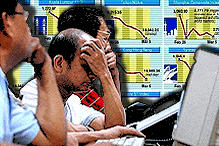 On Friday, finance officials from the world’s top top economic powers issued a five-point plan aimed at reversing the credit crisis that has toppled Wall Street and markets around the globe. They pledged to take “decisive action and use all available tools.”
Under the plan, they vowed to protect major banks and to prevent their failure. They also committed to working to get credit flowing more freely again, support the efforts of banks to raise money from both public and private sources, bolster deposit insurance and revive the battered mortgage financing market.
But the G7 - made up of the United States, Canada, Britain, France, Italy, Germany and Japan - announced none of the new moves that many investors and financial experts, like Lee, have been hoping for - such as a British plan to guarantee inter-bank lending.
“It really is no point flushing the international money markets with liquidity as they have been doing in the past. What is the point if nobody dares to lend out the money especially to those who need the funds the most to recapitalise.” Lee had said last week.
Banks around the world have remained unwilling to lend money to one another. At the same time, they have also been unable to raise money from investors, undercutting their ability to lend to customers - creating a widening vicious cycle of banking bankruptcies.
Malaysia will not be spared
In Malaysia, the banking system has been protected to a large degree by its high amount of liquidity, thanks to the accumulation of export earnings over the past few years as commodity and crude oil prices rocketed to the benefit of the resource-rich country.
Nevertheless, economists warn the country cannot be spared by the spreading global recession and the government will need to pull together a better plan to deflect the worst of the economic pain that will be inevitable.
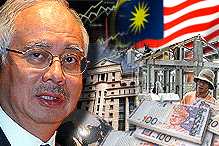 On Monday, Najib, who is also deputy prime minister, can expect to be grilled by his arch rival, Opposition Leader Anwar Ibrahim and his Pakatan Rakyat alliance.
“This is Najib's first challenge as finance minister – to demonstrate that he is on top of his new task as finance minister and not be accused of being a latter-day Nero of "fiddling while Rome burns,” DAP supremo Lim Kit Siang said.
“Najib should suspend all Umno commitments for the rest of the weekend and burn the midnight oil to table a revised 2009 Budget in Parliament on Monday , with the centrepiece on the strategy to enable Malaysia to tide through the financial maelstrom, but also incorporating new lowered pricing for petrol as world crude oil has plunged below US$78 per barrel,” Lim added.
Prime Minister Abdullah Ahmad Badawi had in August presented a RM207.9 billion expansionary budget - the country’s largest spending plan ever - to pump-prime economic growth.
While analysts agree the economy need to be stimulated, they also worried about how the spending spree would be implemented, given the many past instances of leakages due to corruption and wastage.
“I think Najib will have to address that, reinforce confidence by giving more specifics about how the money will be spent,” said Lee.
“But overall, I think the budget is not so bad, although they may have to readjust the parameters on which it was first drafted because of the sharp changes since. Take for example the fuel is now below US$80 per barrel - almost half the peak prices.”
Lower fuel prices immediately
Meanwhile, Gerakan, a political party within Najib’s ruling Barisan Nasional coalition, also joined the DAP’s call to further cut pump prices.
“When the global fuel price falls, we have to wait a month to feel the benefits. Now the price is at US$82 (RM287) per barrel, this must be felt immediately by the rakyat,” said party president Dr Koh Tsu Koon after closing the party’s 37th National Delegates Conference on Sunday.
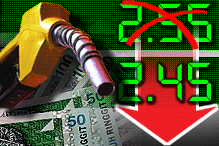 Koh said it was not right that the public should have to wait a month to reap the benefits of a drop in global fuel prices, when price falls in crude palm oil could be felt immediately by farmers and traders who straightaway had to contend with the pinch of lower selling prices.
“If not floated, at least revise the fuel price once a week, either every Monday or every Sunday, so we can follow the world market closer,” he said.
The government has cut petrol and diesel prices by 10 sen each to RM2.45 and RM2.40 per litre last month, the second time in as many months after hiking fuel prices by 41 percent to $2.70 in June.
It subsidises petrol at 33 sen a litre and has in place a plan to adjust fuel prices at the beginning of each month.


Are you sure you want to delete this comment?
This action cannot be undone.