




US financial crisis mirrors 1997 Malaysia
The Bush government’s US$700 billion plan to help stem the US’s current financial bedlam is reminiscent of the currency crisis in 1997 that had undermined the viability of Malaysia’s leading banks and firms.
Malaysia’s problems then were due to Dr Mahathir Mohamad’s subscription to an economic model that has now contributed to the chaos of the financial system in the US.
But what is also interesting about this US bill, derided in some circles as a bailout of Wall Street, is that members of the Republican Party, a keen supporter of big business, were so hesitant to support it. (Only 65 Republicans backed the bill when it was first proposed on Sept 29.)
Even Treasury Secretary Henry Paulson, formerly CEO of Goldman Sachs, publicly acknowledged that he had been very reluctant to propose this bill as it went against the very economic ideas he espoused.
The Bush government’s US$700 billion plan to help stem the US’s current financial bedlam is reminiscent of the currency crisis in 1997 that had undermined the viability of Malaysia’s leading banks and firms.
Malaysia’s problems then were due to Dr Mahathir Mohamad’s subscription to an economic model that has now contributed to the chaos of the financial system in the US.
But what is also interesting about this US bill, derided in some circles as a bailout of Wall Street, is that members of the Republican Party, a keen supporter of big business, were so hesitant to support it. (Only 65 Republicans backed the bill when it was first proposed on Sept 29.)
Even Treasury Secretary Henry Paulson, formerly CEO of Goldman Sachs, publicly acknowledged that he had been very reluctant to propose this bill as it went against the very economic ideas he espoused.
 The roots of this reluctance by Republicans to endorse a bill to help the government deal with the bad debts accumulated in the financial sector are to be found in the pro-market policies introduced by Ronald Reagan when he assumed the US presidency in 1981.
Reagan had proposed a basket of economic policies, later known as neoliberalism, that involved the retreat of the government from the economy. Neoliberalism advocated curbing the role of trade unions, promoting liberalisation of the economy through privatisations and, very importantly, encouraging deregulation to reduce hindrances to the workings of free-market capitalism.
These ideas acquired much currency as the American economy had then been struggling to cope with numerous problems, including a recession, an oil crisis and competition from Japan, whose enterprises were actively acquiring prominent US firms.
Government deregulation was to eventually spawn major developments in the corporate sector, giving new meaning and scale to activities such as acquisitions, takeovers and mergers.
Mahathir inspired by neoliberalism, Japan
The pace of the global sweep of neoliberalism in both industrialised and industrialising countries was swift. In Malaysia, Mahathir’s method for economic and enterprise development when he took over the premiership in 1981 was heavily inspired by neoliberalism’s strong emphasis on the promotion of the private sector as the primary engine of growth.
 Mahathir was, however, equally influenced by Japan’s developmental state model – well-known as his ‘Look East’ policy – which entailed government control over the financial sector.
Through his control of banks, Mahathir would channel loans and concessions to a selective group of business people to promote large well-diversified Malaysian firms, an idea inspired by the rapid rise of South Korean chaebols, or privately-owned conglomerates, which had adopted a similar pattern of growth.
Mahathir’s active encouragement of the participation of foreign companies in the Malaysian economy was not merely to secure foreign direct investments, which were channelled to productive economic endeavours, such as manufacturing. He also strongly cultivated foreign portfolio investments that were used to help develop the country’s stock exchange, the Bursa Malaysia.
Mahathir was extremely enamoured with the stock market, an instrument he felt had been effectively deployed by American businesspeople to rapidly create huge firms.
He saw the stock market and mechanisms such as takeovers, shares-for-assets swaps, rights and bonus issues, etc., as important devices to facilitate his endeavour to create Malaysian conglomerates that would have the capacity to compete internationally.
By the mid-1990s, when the Bursa Malaysia was listed as the fourth largest bourse in Asia and the 15th largest in the world in terms of market capitalisation, government leaders proudly proclaimed this as a major national feat. This achievement, however, did little to hold the Malaysian economy or many of its new corporate captains in good stead when the currency crisis occurred.
The practice of American financial firms of similarly providing loans extensively to those not sufficiently creditworthy and the introduction of even more sophisticated market techniques to permit this, such as collateralised loan obligations and collateralised mortgage obligations, as well as derivatives, futures, options and portfolio insurance, has contributed to the US economy’s present financial quagmire.
After the 1997 crisis, Malaysian firms had to go through a serious re-evaluation of their pattern of enterprise development involving in particular the viability of availing themselves to loans to facilitate corporate expansion. The government also had to review its regulatory processes involving an extensive discussion on corporate governance.
Similar painful experience in US
American firms are going through a similarly painful evaluation of their corporate activities. As Nancy Pelosi, Democrat speaker of the House of Representatives has argued, a thorough assessment is required of US business practices to understand its financial sector’s current dire straits.
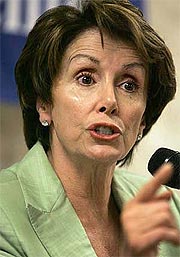 It is, as Pelosi hints, inevitable that government oversight of corporate activities will have to improve, involving the introduction of new regulation.
But the primary reason why Republicans were reluctant to endorse the bailout bill was probably because this would mean the inevitable return of government ownership of key sectors of the economy.
The funds from this bill will enable the government to actively intervene in the market to buy over and control major corporations, similar to its ownership of the diversified multinational insurance enterprise, the AIG group, after its bailout.
This suggests that what appears imminent for the US economy is a form of state-led capitalism, a scenario that many Republicans, who support free market capitalism, would view with much disdain.
After the currency crisis, the Malaysian economy had witnessed the same re-entry of the state in the corporate sector. The government intervened in the corporate sector to take over deeply debt-ridden publicly-listed firms, such the Renong/UEM group, to re-nationalise the privatised Malaysia Airlines and to bail out banks deeply mired in non-performing loans.
By the end of Mahathir’s tenure as prime minister in 2003, Bursa Malaysia’s leading enterprises were state-owned, now known as government-linked companies, or GLCs. These GLCs include Malayan Banking, Commerce Asset Holdings, Petronas Gas and Sime Darby.
One key problem with state-led capitalism is that it is hardly seen as entrepreneurial for it tends to adopt a pattern of diversified-style growth primarily through the acquisition of firms.
However, unlike Malaysia, the US economy is characterised by a large base of highly entrepreneurial small and medium enterprises from where new innovative business ideas could emerge to drive its growth.
For such entrepreneurial firms to thrive, however, the US government has to ensure a thoughtful review and revamp of the regulatory processes of its corporate sector to ensure that unchecked financial practices do not derail the economy.
The imminent review of the government’s regulatory procedures will probably be dreaded by the Republicans for it could well spell the death knell of neoliberalism.
TERENCE GOMEZ is associate professor of political economy at Universiti Malaya.


Are you sure you want to delete this comment?
This action cannot be undone.