




Curtain call for Bush as Apec meets
Asia-Pacific leaders were wrapping up a summit on Sunday to forge united front on the world finance crisis as US President George W Bush went on a last diplomatic drive to push for free trade.
Asia-Pacific leaders were wrapping up a summit on Sunday to forge united front on the world finance crisis as US President George W Bush went on a last diplomatic drive to push for free trade.
Bush wound up his final scheduled trip overseas by saying goodbye to key foreign leaders. He enjoyed praise from the leaders of China and Japan but had an frosty final encounter with Russian President Dmitry Medvedev.
 The 21 leaders of the Asia-Pacific Economic Cooperation (Apec) forum, which accounts for half the global economy, met for a second day of talks a day after Bush offered an impassioned plea for free trade.
"We refuse to accept protectionism in the 21st century," said Bush, who has less than two months left before he hands over power to president-elect Barack Obama.
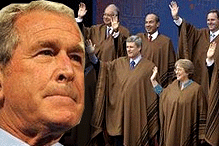
Bush and fellow leaders were set Sunday to take a annual "family photo," a lighthearted annual ritual in which Apec leaders dress in attire unique to the host country.
Despite the bleak state of the global economy, delegates said that the Peruvian hosts put on a gala dinner on Saturday inside the army headquarters, as thousands of police patrolled outside.
Unfettered capitalism
Malaysia's incoming leader Najib Abdul Razak said that the Apec members agreed on the need to discourage "unfettered capitalism because of sheer greed" while not restricting free trade in principle.
 "We felt that a proper regulatory mechanism is critical - not to overegulate but to check on the excesses to ensure market discipline," Najib told
AFP
.
"We felt that a proper regulatory mechanism is critical - not to overegulate but to check on the excesses to ensure market discipline," Najib told
AFP
.
Despite Obama's wide popularity around the world, some regional leaders have voiced fears he would erect greater barriers to foreign trade under pressure from labor unions.
Apec leaders issued a statement Saturday warning that limiting free trade "would only exacerbate the current economic situation."
The statement was light on details, however, and there was no indication strong measures would be announced in a final statement Sunday to address a financial crisis that has shown no sign of improving.
Before Sunday's closing session, Russian President Dmitry Medvedev and Chinese leader Hu Jintao met and agreed to cooperate closely on the financial crisis.
Any world financial reforms "should seek a balance among the interests of all parties and reflect, in particular, the interests of emerging markets and developing countries," Hu said Saturday before the meeting.
Russia and China have been developing increasingly close relations, seen as a potential check on US power.
Russia and the United States have had a tense relationship recently due to disputes including US plans to erect a missile defense system in eastern Europe.
However, Bush and Medvedev made soothing noises during a bilateral meeting Saturday, calling for a "practical" approach to their relationship, Russian Foreign Minister Sergei Lavrov said.
The leaders agreed "not to get hung up on such problems that always exist between big powers," Lavrov told reporters.
Six-decade territorial row
In an another high-profile meeting on Saturday, Bush, Japanese Prime Minister Taro Aso and South Korean President Lee Myung-Bak gathered to jointly press North Korea over a stalled six-nation pact on ending its nuclear program.
The three leaders called on North Korea to draft a document showing how it will carry out a landmark disarmament-for-aid deal.
Aso said afterward that Bush promised to impress upon Obama - who takes office in January facing a host of major problems - the importance of continuing the drive for a negotiated disarmament of North Korea.
In one surprise, Aso and Medvedev appeared to make progress in a six-decade territorial row, agreeing to assign officials to come up with concrete ways to resolve the dispute.
Russia and Japan have never signed a peace treaty to formally end World War II due to Tokyo's claims over four islands which Soviet troops seized in 1945 off Japan's northern island of Hokkaido.
"We have to define the border otherwise this problem will remain an element of destabilization in the region," Aso told Medvedev.
-AFP


Are you sure you want to delete this comment?
This action cannot be undone.