




Penang gears up to fish in troubled waters
The Penang government is not waiting for a miracle to stop the state from possible decimation by the current global economic uncertainties.
The Penang government is not waiting for a miracle to stop the state from possible decimation by the current global economic uncertainties.
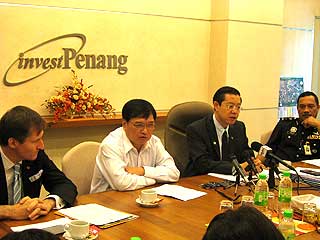 To tackle the issue, Chief Minister Lim Guan Eng has set up two advisory panels, to be headed by him, for the service and industrial sectors, the state's two main economic contributors.
The panels will outline counter measures to face the imminent economic impact and stimulate growth during the post-crisis recovery period.
The service sector contributed 57 percent while industrial activities contributed 39 percent to last year's Penang GDP.
Since 70 percent of the state economic turnover is tied up to the global market chain, the state government is not taking its chances when the global crisis predictably hits the region early next year.
Outline counter measures
Speaking at a press conference at the Penang Skills Development Centre (PSDC) in Bayan Lepas today, Lim said the panels, among other things, would identify Penang's imminent economic challenges and draw out counter measures to control the impact of recession.
The panels would also look into future growth areas in both sectors to enhance Penang's strength, especially its manpower strength in technical knowledge, and capacity to fish socio-economic gains effectively during the post-recession period.
"The panels will plan for immediate counter measures and future strategies to stimulate growth during and after crisis.
"The Penang government is not only looking at the immediate challenges posed by the economic uncertainties but also beyond the crisis. All strategies would be based on pro-growth, pro-jobs and pro-poor objectives," he said.
 Mini Circuits Technologies Malaysia managing director Kelvin Kiew Kwong Sen and PSDC chief executive officer Boonler Somchit have been appointed as vice chairpersons of the industrial panel.
The Indonesia-Malaysia-Thailand Growth Triangle (IMT-GT) Business Council chairperson Faudzi Naim Noh and Malaysian Association of Hotels - Penang chapter chairperson Marco G Battistotti have been appointed likewise in the service panel.
This year, Penang attracted some RM8.1 billion investments, comprising RM4.8 billion domestic and RM3.2 billion foreign investments, to come third behind Sarawak (RM13 billion) and Johor (RM10.9 billion) in attracting investments.
Penang's domestic investment is highest among states in the country and for the first time exceeded the quantum of foreign ventures.
Domestic industrial investments
Kiew hinted that among the strategies is to encourage more domestic industrial investments and development to boost the state economic fundamental strength to survive the crisis and stimulate future growth.
"For instance, South Korea and Taiwan started off with massive foreign investments. But today, their domestic companies are dominant in global economy," he said.
 In the tourism sector, the main revenue earner in the service sector, Penang has attracted some RM2.7 million hotel occupants so far this year, coming fourth behind Kuala Lumpur (9.5 million), Pahang (3.4 million) and Sabah (3.2 billion).
Battistotti said that Penang’s current 8,000-hotel room capacity was expected to leap to 12,000-capacity in the next five years to cater to the needs of projected six million annual tourist arrivals.
Currently Asean records some 80 million human movements within the region per year and this is forecast to leap by 100 percent in 2013.
Battistotti said Penang has vast potential to grow in the service sector as both a regional and international destination for tourists, businessmen and industrialists.
"If it can tap on regional human movement, Penang can realise this potential," he said, suggesting that turning the heritage value of George Town into a hub for weekend leisure tourism would be a lucrative prospect.
Both sectors would be looking into training and re-training programme to develop the knowledge, skills, durability and mobility of Penang's domestic human resources.
This human resources development programme has become imperative especially since the state's unemployment rate is expected to leap drastically in the next few months due to massive retrenchment within and outside the country.
The service sector is rapidly becoming a dominant feature in Penang’s economy as many industrial giants such as Intel, AMD and Motorola are investing in the global service industrial chain such as purchasing, finance and research and development.
"The multi national companies are investing more to transform their plants here into international hubs for the service sector, and not much in manufacturing.
"Our future strategy is to strengthen this area," InvestPenang executive chairperson Lee Kah Choon told Malaysiakini .


Are you sure you want to delete this comment?
This action cannot be undone.