China and Taiwan celebrate launch of direct flights
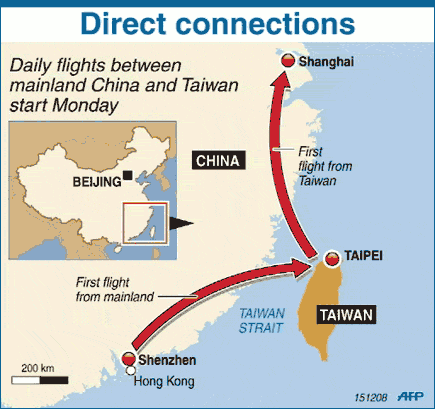
China and Taiwan launched direct daily flights, postal and shipping services today in a historic move hailed by both sides as cementing a new era in warm ties between the long-time rivals.
The direct links ended the tedious and costly delays of having to go via a third party's air space or territorial waters, while also providing one of the most tangible benefits of a dramatic rapprochement this year.
China and Taiwan launched direct daily flights, postal and shipping services today in a historic move hailed by both sides as cementing a new era in warm ties between the long-time rivals.
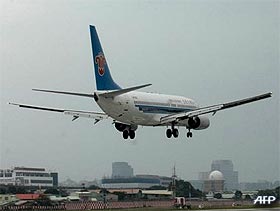 The direct links ended the tedious and costly delays of having to go via a third party's air space or territorial waters, while also providing one of the most tangible benefits of a dramatic rapprochement this year.
"From now on, dialogue will replace opposition," Taiwan President Ma Ying-jeou said at a ribbon-cutting ceremony for the launch of a direct shipping service to China from the southern Taiwanese port of Kaohsiung.
Ma's election as Taiwan's president in March, ending eight years of rule by the independence-minded Chen Shui-bian, triggered the warming of ties between the sides, which split at the end of a civil war in 1949.
The mood among mainland Chinese officials on Monday was equally upbeat.
"Today is another important day in the history of cross-strait relations," said Wang Yi, the director of China's Taiwan Affairs Office, at a shipping ceremony in the northern Chinese port city of Tianjin.
"The trend of peaceful development for the relationship between two sides cannot be stopped. Today the prospects of peaceful development are brighter."
The first flight from the mainland left the southern Chinese city of Shenzhen for Taipei on Monday morning, followed shortly after by a commercial service from the Taiwanese capital to Shanghai.
In total, 12 airlines from the two sides are expected to fly more than 100 flights a week, providing links between four Taiwanese and 12 Chinese cities.
Pro-China leadership in Taiwan
Meanwhile, ships began sailing directly across the 160-kilometre Taiwan Strait on Monday, cutting up to four days off travel time in some instances, and post was for the first time allowed to be sent directly.
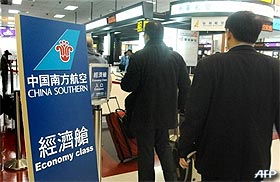 Previously, planes had to usually fly through Hong Kong or Macau airspace, while cargo ships were generally forced to detour through Japanese waters.
Chen, Taiwan's former leader who has now been indicted for corruption, had refused China's overtures for direct daily transport links, wary that it would draw the island too close to China.
Direct transport was suspended at the end of the two sides' civil war.
China still regards Taiwan as a renegade province that must eventually come back into Beijing's political fold, by force if necessary, and the stalemate has long been one of Asia's most dangerous potential flashpoints.
But the election of pro-China Ma changed the political atmosphere dramatically.
Top officials from both sides met in Beijing in June for the first direct dialogue between the two parties in 10 years.
Those talks led to the launching of the regular direct flights between China and the island, as well as other measures to boost tourism.
Regular direct flights began operation in July, but only at weekends. Before that, direct flights were allowed on public holidays.
The ramping up to daily services was widely seen as a confirmation that warming relations remained on the right track.
A significant meeting
In another significant step, Chinese President Hu Jintao met with Lien Chan, former Taiwan premier and honorary chairman of the island's ruling Kuomintang party, on the sidelines of an Asia Pacific leaders' summit in Peru last month.
It was the highest-level official meeting to take place overseas between the rivals since their split.
Taiwan's transport ministry estimates local airlines and passengers will save about three billion Taiwan dollars (90 million US) a year, and shipping companies around half that, with the direct links.
Shanghai Airlines chairman Zhou Chi was also upbeat at the send-off for his carrier's first direct daily flight from the eastern Chinese city on Monday.
"I think this is a market with huge growth potential given there are millions of Taiwanese here," Zhou told reporters.
-AFP