




Landmines in Sarawak, Part 2
A reader sent me an email to enquire why Sarawak cannot secede itself from Malaysia and become an independent nation like Singapore. The same query has also been making the round on Internet postings in Sarawak, behind the safe veil of anonymity.
It is a tabooed subject in the nation’s public sphere. But I feel that our nation’s citizens are mature enough to discuss this issue openly, without resorting to panic mongering and witch-hunting.
Because of the lack of public discussion, we do not know how rampant this sentiment is. I have heard of talk pointing to Brunei as an illustration. The Sultan of Brunei decided not to join Malaysia in 1963, preferring to become an independent nation on its own. Today, because of the wealth from oil and gas, the Sultan of Brunei is the richest man in the world, and the wealth of the Brunei people is the envy of Asia.
The rhetorical question is: if Brunei can do it, why not Sarawak and Sabah?
A reader sent me an email to enquire why Sarawak cannot secede itself from Malaysia and become an independent nation like Singapore. The same query has also been making the round on Internet postings in Sarawak, behind the safe veil of anonymity.
It is a tabooed subject in the nation’s public sphere. But I feel that our nation’s citizens are mature enough to discuss this issue openly, without resorting to panic mongering and witch-hunting.
Because of the lack of public discussion, we do not know how rampant this sentiment is. I have heard of talk pointing to Brunei as an illustration. The Sultan of Brunei decided not to join Malaysia in 1963, preferring to become an independent nation on its own. Today, because of the wealth from oil and gas, the Sultan of Brunei is the richest man in the world, and the wealth of the Brunei people is the envy of Asia.
The rhetorical question is: if Brunei can do it, why not Sarawak and Sabah?
As a sentiment, it is the right of every Sarawakian to feel whatever he or she might feel. But as the ideology of a political movement, then the merits and demerits of such a volatile objective must be examined from every angle in great detail.
Whatever my own view on the matter is, I would like to examine the practicability of such a proposition.
In the case of Canada, there was a national referendum on whether French-speaking Quebec should be allowed to secede from the Canadian Federation. The proponents of secession were defeated by a few percentage points in the national poll.
But Canada is one of the very few highly developed liberal democracies of the world. In contrast, Malaysia belongs more to the group of developing nations with fledgling opaque democratic practices tinged heavily with patriarchal violence of the state.
The lived geo-political experiences of Sarawakians for the past 45 years have been those of federalism, with power slowly but surely tilting to the federal centre in Kuala Lumpur. The most important function of such a federal government is to ensure the territorial integrity of the nation state, not only in military defence against external aggressors, but also in the repression of internal impulse for secession.
In short, anyone who wants to start a secession movement in Sarawak must be prepared for the ultimate option of a protracted armed struggle with no certainty for success, in view of the heavy concentration of federal troops in Sarawak and Sabah. The blood of many innocent people will be spilled, as in Sri Lanka, Aceh, Nigeria and numerous other regions of the world. Is the doubtful trophy worth the price to be paid?
Once you banish the impractical option, then you have to seek recourse through the peaceful democratic process within the context of the Malaysian federation. Such recourse is available through the vote. But Sarawak voters and opinion makers must explore a more open and enlightening mode of public discussion not shaped by mere prejudices.
Sarawak parties not necessarily good
Take the argument that PKR is a party of Orang Malaya, and therefore not worthy of support from Anak Sarawak. Sarawak, they say, is for Sarawakians. Some say that only Sarawak-based parties can serve Sarawak.
This point of view ignores the fact that the component parties of the Sarawak Barisan Nasional, which are all home grown blue-blooded Sarawakian political parties, have done tremendous injustices to the poor people of Sarawak. We all know how corrupt and rich the top leaders of these parties are, while the people – especially rural native Sarawakians – are teetering on the brink of abject poverty.
Sarawak political parties are not necessarily good for Sarawakians.
Furthermore, we must unveil the disguise of the “Sarawakness” of these Sarawak BN component parties.
They are all components of the national BN structure, and therefore they are part and parcel of all the ills of the country, racial posturing, economic mismanagement, cancerous corruption in public life, waste of the taxpayers’ money, corruption even in the judiciary and the police, and the numerous laws that curtail the liberties of all Malaysians and Sarawakians.
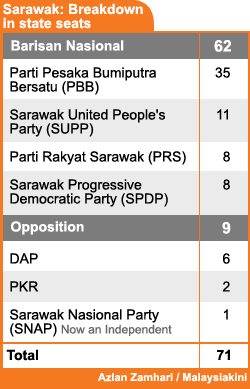 The cause of neglect of the social-economic development in Sarawak has its roots in Kuala Lumpur. In this, the Sarawak BN component parties – especially the PBB under the absolute control of Chief Minister Abdul Taib Mahmud – are the leading accomplices and proxies of this criminal neglect.
A kind of unholy symbiosis exists between the Sarawak BN and the national BN dominated by Umno. As long as the Sarawak CM can deliver most, if not all, the 28 parliamentary seats to prop up the Umno prime minister in the Dewan Rakyat, Taib can enjoy absolute rule over Sarawak.
He and his close circle of top political confidantes can enjoy monopoly over the timber and land resources as well as all kinds of government contracts without fear of the federal agencies supposed to curb corruption.
In this scenario, it is very hard for Sarawak-based opposition parties to make headway in state politics in Sarawak. They simply do not have the resources to fight the Sarawak BN during elections.
As a result of this dim prospect of making real political gain on the ground, the opposition parties find it hard to recruit young budding political leaders from their newly emergent middle-class to stand as candidates during elections. This will continue the vicious cycle of further weakening the opposition camp.
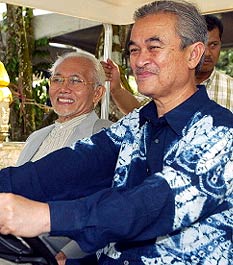 For the sake of argument, even if a coalition of Sarawak opposition parties can defeat the Sarawak BN and form the state government, there is always the threat of the federal BN government putting the squeeze on Sarawak socio-economic development funds. This did happen to the PBS-held Sabah state government in those years when PBS was the opposition at the federal level.
In short, the unique power relation between the federal and the state governments must compel aspiring Sarawak reformers to look to federal alliances. The true cause of socio-economic backwardness is still the national BN in Kuala Lumpur, working in tandem with a self-serving BN Sarawak government. Unless the BN government is replaced by another alternative coalition, Sarawak will continue to degenerate even if an opposition government is able to take power in the state.
By now, we know that coalition politics is an undeniable imperative in multi-racial, multi-religious, and multi-cultural Malaysia.
Perhaps, leaders, members, supporters, sympathisers of opposition parties in Sarawak, and even neutral citizens who want change in Sarawak, must put on their thinking cap to explore ways and means of establishing strategic linkages with parties in West Malaysia and Sabah, rather than withdrawing further into their exclusivist cocoon of “Sarawak for Sarawakians”.
Enemy of my enemy is my friend
But how about the perception that PKR is a party from Malaya?
I understand and share many of the emotional aversions of many Sarawakians against all things Malayan on the personal and social levels. But politics is entirely a different cattle of fish altogether.
The problem of Sarawak’s socio-economic backwardness and political injustices is not a Sarawak problem alone. It is a national problem that requires a national solution. Toppling the BN federal government must be the top agenda for Sarawakians.
As many of my leftist SUPP (Sarawak United People’s Party) friends had taught me in the early years of my political activism, their tactic of a united front is based on this single dictum: the enemy of my enemy is my friend – at least for now (I think the original author of this dictum is Mao Tze Tung himself).
In politics, not all Orang Malaya are as contemptible as some Sarawakians think. The Orang Malaya of five states – Kelantan, Penang, Selangor, Perak, and Kedah - have voted out their BN state governments, often across racial, religious and party lines. This is a feat that many Sarawakians can only pine for.
I have always insisted that Orang Malaya have a thing or two to learn from Sarawakians and Sabahans, especially on harmonious race relation. The West Malaysian Pakatan Rakyat leaders have to learn about the social and cultural sensitivities of Sarawakians and Sabahans, if they are to avoid the BN landmines when campaigning in Sarawak.
But is it not true that Sarawakians also have a thing or two to learn from Orang Malaya about politics? Is it not true that blind parochial xenophobia can also be a stumbling block to greater democratisation and redemption in Sarawak politics?
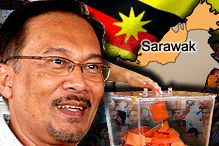 Then there are other questions. Can Sarawakians trust Anwar Ibrahim, with his very chequered past records and his seemingly endless ambition to become the next prime minister? Even if the Pakatan Rakyat coalition can topple the Sarawak BN government, do they have an honest clean candidate to become the next Sarawak CM? How can we be sure that a Pakatan state government will not be even more corrupt than the previous regime.
I will try to answer those questions next week. Don’t touch that dial!
To be continued…
SIM KWANG YANG was the MP for Bandar Kuching from 1982 to 1995. He can be reached at kenyalang578@hotmail.com.


Are you sure you want to delete this comment?
This action cannot be undone.