




How the gov't shot itself in the foot over KLIA East
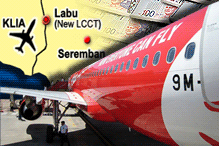
The cancellation of KLIA East @ Labu will present a significant challenge to AirAsia’s growth strategy. At the same time, the government’s reasons for rejecting the project are difficult to understand.
The cancellation of KLIA East@Labu will present a significant challenge to AirAsia’s growth strategy. At the same time, the government’s reasons for rejecting the project are difficult to understand.
 AFP
reported that Deputy Prime Minister Najib Abdul Razak rejected the proposal because “the AirAsia airport plan is
not a viable project
… the cost of the construction may escalate and (the government) may be forced to inject funds. The government does not want the project to be a burden.”
AFP
reported that Deputy Prime Minister Najib Abdul Razak rejected the proposal because “the AirAsia airport plan is
not a viable project
… the cost of the construction may escalate and (the government) may be forced to inject funds. The government does not want the project to be a burden.”
The statement is unusual because the low-cost carrier terminal (LCCT) at Labu was to be built on privately-owned land by a privately-owned company. Hence, there is no obligation for the government to bail out the project, should it fail.
AirAsia projects that it can carry 27 million passengers to Kuala Lumpur in 2014. That is almost double the number that the current LCCT is able to handle.
Malaysia Airports Holdings Bhd (MAHB) has said that it will complete a new LCCT by late 2011. Whether MAHB can meet this deadline is questionable given that the current LCCT is already 18 months behind schedule.
AirAsia has said publicly that it doubts whether MAHB will be able to complete a new LCCT before 2014.
So the lack of capacity at the current LCCT and the cancellation of KLIA East mean that AirAsia will have to change its growth plans.
Instead of relying on Kuala Lumpur as a hub for connections between its long haul and short haul flights, AirAsia will seek to decentralise away from Kuala Lumpur.
AirAsia could build up its hubs at less congested airports in Malaysia and in other Southeast Asian cities. It could also slow its growth by delaying aircraft deliveries.
MAHB’s high charges & poor service
For MAHB the cancellation of KLIA East is very good news.
Aseambankers Malaysia Bhd senior analyst Khair Mirza told Business Times on Dec 23 that AirAsia pays RM175 million in revenue to KLIA in airport charges and aeronautical fees.
This reportedly makes AirAsia MAHB’s second-biggest customer after Malaysia Airlines.
AirAsia had repeatedly complained about MAHB’s high charges and poor service.
But MAHB had rightly pointed out that airport tax at KLIA is already low when compared to other airports in the region. Even the Singapore Budget Terminal charges RM65 in airport tax per passenger, compared to RM25 at the KLIA LCCT.
 However, AirAsia claims that airport charges can be lowered further still.
It says it can make KLIA East one of the cheapest and most efficient airports in the world.
The business case for very low-cost aviation is compelling. AirAsia has one of the lowest cost per available seat kilometre (ASK) in the world.
The ASK of AirAsia is about 2.5 US cents. The ASK of Malaysia Airlines is about 5 US cents.
So if AirAsia’s very low-cost structure is combined with a very efficient and low-cost airport, then Kuala Lumpur will have a very strong competitive advantage over rivals Bangkok and Singapore.
A successful LCCT will also mean that AirAsia will pose a more serious competitive threat to Malaysia Airlines.
This explains why Khazanah Nasional Bhd was strongly opposed to KLIA East as its companies, MAHB and Malaysia Airlines would be negatively affected by the project.
Gov’t unsupportive of private enterprise
The government has clearly decided in Khazanah’s favour and it did not seek a compromise between AirAsia and MAHB.
It could have let AirAsia build and manage a new LCCT at KLIA. Instead the government has told MAHB and AirAsia to “collaborate”, which brings AirAsia back to square one.
 AirAsia has said that LCCT designs by KLIA Consulting Services Bhd (KCSB) are too expensive.
KCSB has been hired by MAHB to design the new LCCT. Earlier LCCT designs were budgeted at around RM3.8 billion.
This amount was subsequently lowered to RM2.9 billion following complaints from AirAsia. AirAsia has been asking for a simple, single-storey terminal.
Spokespeople from MAHB and KCSB have refused to release the price of the new LCCT, saying that the figure is “confidential”.
They also could not say if the price would be less then RM1.6 billion, the amount AirAsia planned to spend on a KLIA East, a brand new airport development.
It appears that MAHB is insisting on building a relatively expensive LCCT. The government’s support in this matter means that it has not played the role of impartial arbiter. Instead, it has chosen to protect the profitability of MAHB and the competitiveness of Malaysia Airlines.
This decision is at the expense of RM1.6 billion of private investment and it has made AirAsia, one of the country’s most successful private companies and strongest international brands, considerably less competitive.
A foreign aviation expert familiar with the Labu project said: “Malaysia has managed itself to be second class, as always… the government is clearly unsupportive of private enterprise and foreign investors will notice this.”


Are you sure you want to delete this comment?
This action cannot be undone.