




Defending Anwar over frog culture
Veteran political activists in Sabah have come to the spirited defence of Anwar Ibrahim in the wake of the "two MBs Syndrome in Perak".
They point out that the opposition leader, while not strictly against the "frog culture" in politics, draws a line "when legislators, already tainted by corruption charges, go back on their word after resigning their seats and are used by the BN to launch a coup d'état in cahoots with other key players".
Veteran political activists in Sabah have come to the spirited defence of Anwar Ibrahim in the wake of the "two MBs Syndrome in Perak".
They point out that the opposition leader, while not strictly against the "frog culture" in politics, draws a line "when legislators, already tainted by corruption charges, go back on their word after resigning their seats and are used by the BN to launch a coup d'état in cahoots with other key players".
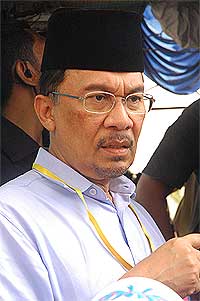 They were dismissing attempts by Parti Bersatu Sabah leaders and Sarawak Chief Minister Abdul Taib Mahmud, among others, to see parallels between the downfall of the Joseph Pairin Kitingan Administration in 1994, when Anwar was deputy prime minister, and ongoing attempts to oust the Pakatan Rakyat-led state government in Perak.
This follows a spate of reports in the local mainstream media virtually labeling Anwar Ibrahim as the "King of Frogs", advising him to drop his "holier than thou attitude" and stop "the crocodile tears".
Generally, Sabah BN leaders think that Anwar "played with fire and got burnt", PBS vice-president Herbert Timbon Lagadan credits Anwar for starting "the frog culture in politics", Deputy Sabah Speaker Johnny Mositun sees Perak as déjà vu, and Taib sees the political crisis in Perak as the result of the "hijack politics" practiced by Anwar, a reference to his oft-stated pledge to take over the federal government by Sept 16 last year. "It (hijack attempts) backfired," said Taib giving some fatherly advice. "Let this be a lesson."
Taib himself has bitter memories of the "Ming Court Affair" - a reference to a hotel in Kuala Lumpur where a majority of the Sarawak state assemblypersons gathered in 1987 to overthrow his government but made the cardinal mistake of recruiting his maternal uncle and predecessor, Abdul Rahman Yakub, to lead them. Rahman advised the state assemblypersons to gather in Kuala Lumpur for "brainstorming" and in the meantime tipped off his nephew who dissolved the state assembly and called for snap elections.
Heroic and acceptable
 PKR vice-president Dr Jeffrey Kitingan opines that "Anwar is not complaining about political frogging, if there's such a term, but rather the fact that the three errant state assemblypersons in Perak no longer have seats and are being used by Umno to claim the government."
"I think political frogging in the national or public interest is heroic and acceptable but doing so for personal and narrow political interests is despicable, unacceptable and should be condemned," said Jeffrey who won on a PBS state ticket in the 1994 state election and defected within a month to the newly-formed PBRS (Parti Bersatu Rakyat Sabah) for exactly 24 hours with five other legislators before parking his group for a while with Akar (Angkatan Keadilan Rakyat) which has since merged with Umno.
Jeffrey castigated the three errant Perak state reps as "not motivated by the people's welfare and therefore should be roundly condemned in no uncertain terms".
His remarks are echoed by PRS (Parti Rakyat Sarawak) supreme council member, Tedewin Ngumbang Datu, an ex-police officer who has his suspicions about the disappearing act of the errant state assemblypersons before their defection. "It's for nothing that BN is known as a winners' club," said Ngumbang with an eye on history.
"Anwar Ibrahim had nothing to do with it (1994) and neither did Mahathir initiate anything. Let's be fair," said one senior PBS activist who has since gone back to the farm. "I remember Megat Junid (then Home Minister) was involved because certain Special Branch officers were used by a Sarawakian businessman to simply barge into the homes of wavering PBS state assemblymen to encourage them to defect to the BN."
"Mahathir in fact was very surprised that the PBS Government fell just a month after the state elections. He thought that it would last at least six months or so before a clearer picture emerged. He expected some attempts to form a coalition government with BN."
Pairin was caught in it
The senior PBS activist and others in the know, across both sides of the political divide in Sabah and elsewhere, swear that the frog culture which brought down the PBS Government in 1994 was in fact initiated by two moneybags, including one from Labuan, "and surprisingly Pairin was caught up in it".
 Bernard Dompok's Parti Demokratik Sabah, now known as Upko (United Pasokmomogun KadazanDusunMurut Organisation), according to several ex-PBS veterans, "in fact had the blessings of Pairin who chose the party's name, logo and colour scheme. Pairin was the king maker in those days and even now."
"Dompok was subsequently labeled a frog by PBS leaders just to pull the wool over the voters' eyes in the state and general elections. But no one said anything about Dr Jeffrey being a frog when he initiated the crisis by stating in Kuala Lumpur that his brother was going to step down and take up an ambassadorship," said a veteran who witnessed the defeat of BN in a 1984 by-election in Tambunan when Pairin's seat was declared vacant and he had to re-contest his seat. "Pairin did not stop his brother (Jeffrey) either from joining PBRS along with Joseph Kurup and five other state assemblymen. He then advised Bernard on the importance of protecting our people and keeping them together."
"Pairin's strategy - as a formidable chess player in Sabah - is to kick out Umno from Sabah once the state is developed."
"Financers of political party activities play a major role in shifting alliances," explained another veteran politician. "They see legislators as commodities to be traded and an opportunity to re-coup their investments many times over through government projects. The Sarawakian businessmen managed to get a lot of federal contracts in Sarawak and also Sabah after the BN formed the state government in 1994."
"Subsequently, he was involved in the de-registration of another political party in Sarawak and the near de-registration of another one. These people are mercenaries who use legislators as errand boys, commission agents and gatherers of commercial intelligence available from the government."
One Anwar critic who sees no parallel between Sabah in 1994 and Perak in recent days points out that "BN went ahead quietly and did it (luring defectors) while Anwar was just talking about it. The BN had Anwar's script."
"I don't think that he was serious about it," said the critic from Sarawak who has since retired from the media world and now provides consultancy and advisory services. "In fact, I have stopped caring about Anwar a long time ago. Why should anybody give his strategy - Sept 16 - away. It doesn't make sense."
The other side of Sept 16
A fellow retiree from the news world suspects that Sept 16 should not be seen as an invite to BN legislators to defect but rather an elaborate ploy to keep the opposition herd together by dangling the prospect of taking power at the centre.
 "When it doesn't happen as predicted, Anwar was in a situation to blame the BN by pointing at the Taiwan trip for 50 legislators from Sabah and Sarawak," said the ex-newsman from Kuala Lumpur who lectures at a government university in Kota Kinabalu. "It's really comical the way that BN fell for the idea of a People's Revolution on Sept 16. It was pure entertainment. It was like a guy telling a girl how wonderful it was going to be and then, at the end of it, he simply falls asleep without nothing to match his rhetoric."
Adds a former Sabah editor: "I remember one PBS federal minister referring to Sept 16 as the Frog Revolution. He was really getting worked up over it considering what happened to his party in 1994. He is in fact a member of the inner circle but keeps up this pretence in public on political frogs. He almost became a frog himself but was asked to stay back in PBS at the very last minute."
"Anwar gambled and lost and that is among the factors that has made him angry," thinks Malay Mail assistant editor Zainal Epi. "He's not against anyone leaving political parties."
Bisaya Chief Lajim Okin, a former PBS strongman from among the KadazanDusunMurut Muslims, makes no apologies for being a political frog.
"If you ask me, I feel it (political frogging) is a democratic practice. Those who jump do not do it for personal gain. They do it for the interest of the people," said Lajim, a federal deputy minister, with a straight face and wants Anwar to accept his loss. "When I jumped to Umno, it helped the BN to form the state government, and the result was that Sabah was given the UMS (Universiti Sabah Malaysia)."
Among other benefits in his constituency, Lajim mentioned the asphalt road linking Beaufort to Sipitang on the border with Sarawak, and better medical and health services


