




Was Nizar's removal constitutional?
comment At the core of the Perak crisis is the issue of whether the forced removal of Menteri Besar Nizar Mohd Jamaluddin from his post was constitutional. If it was not, then Nizar is still the menteri besar.
The answer to this question would depend on:
a. whether Nizar had lost the support of the majority in the state assembly, and if he had,
b. whether the sultan had the power to dismiss him.
Let us firstly look at the issue of whether Nizar had lost his majority. At a press conference on Feb 4 at 1640 hours in Putrajaya, Deputy Prime Minister Najib Razak announced that Barisan Nasional (BN) had the majority to take over the Perak government as the assembly was tied at 28 vs 28 with three ‘friendly independents’.
comment At the core of the Perak crisis is the issue of whether the forced removal of Menteri Besar Nizar Mohd Jamaluddin from his post was constitutional. If it was not, then Nizar is still the menteri besar.
The answer to this question would depend on:
a. whether Nizar had lost the support of the majority in the state assembly, and if he had,
b. whether the sultan had the power to dismiss him.
Let us firstly look at the issue of whether Nizar had lost his majority. At a press conference on Feb 4 at 1640 hours in Putrajaya, Deputy Prime Minister Najib Razak announced that Barisan Nasional (BN) had the majority to take over the Perak government as the assembly was tied at 28 vs 28 with three ‘friendly independents’.
The next morning, after meeting Najib and the 28 BN assembly persons and the ‘three independents’, the Sultan of Perak issued a statement at 1425 hours, ‘ordering’ the menteri besar and the state executive council to resign immediately, failing which, these posts were ‘regarded as vacant’.
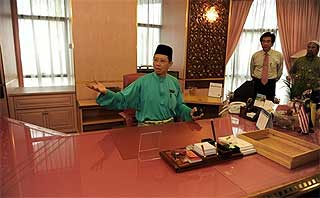 Two hours later, the police took over the state government building and evicted the state cabinet.
Nizar refused to resign on the grounds that he had not lost majority support, as the ‘three independents’ had already resigned as assembly persons. He promptly re-appealed to the sultan to give his consent to dissolve the state legislative assembly for fresh elections. The sultan instead installed a new menteri besar the next day (Feb 6).
The resignations of the ‘three independents’ came into effect earlier when the assembly speaker accepted their genuine letters of resignation and declared their respective seats vacant. However, the Election Commission declined to regard the seats as vacant on grounds of ‘doubtful’ resignations.
Despite the speaker’s assertion that he was the rightful authority to accept these resignations and not the EC, the former nevertheless applied to the courts to declare these seats vacant so as to dispel possible ambiguity. Meanwhile, the speaker maintained that these ‘three independents’ were no more assembly persons unless decided otherwise by the courts.
Najib’s press conference on Feb 4, where he introduced the four ‘defectors’ – the ‘three friendly independents’ plus one ‘double-hopper’, crowned almost two weeks of intense speculation under a cloak-and-dagger ambience of intrigue that included mysterious disappearances, hide-and-seek games, hopping, double-hopping, bribery and ‘kidnapping’.
Questionable defections
The intrigues started when two PKR executive council members – Jamaluddin Radzi and Osman Jailu – who were both facing corruption charges, disappeared on Jan 25 and remained incommunicado to party leaders, only to reappear at Najib’ Feb 4 press conference.
Rumours were rife that they were victims of a ‘carrot-and-stick treatment’ while under ‘protective custody’ as throughout the period of their disappearance, they failed repeatedly to answer frantic calls by party leaders to surface to clarify their positions. The duo, meanwhile, intermittently leaked out vague messages via the BN-controlled media.
The third ‘independent’ – DAP assembly person and deputy speaker of the assembly Hee Yit Foong – had been playing hide-and-seek for one week, failing to appear for several important functions.
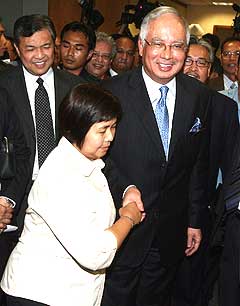 While she did express unhappiness over alleged poor treatment by party leaders towards her, she nevertheless repeatedly pledged – right up to the day before her appearance with Najib on Feb 4 - that she would never betray the party that she had served faithfully for more than two decades.
Granted that it should not have been a complete surprise when she quit DAP to become an independent as she was already frustrated with her party; but why then take the completely illogical step of sleeping with the enemy – an enemy that she had fought tooth and nail all her life?
In the absence of any apparent reversal of her political conviction, who would believe that her hand that helped topple the Pakatan Rakyat Perak government was not encouraged by an irresistible inducement, tinged perhaps with an element of coercion?
That Hee was still undergoing emotional upheaval was obvious from her body language during Najib’s press conference where she remained sullen and silent throughout.
At the end of the press conference, she was immediately whisked into the room of Najib’s political secretary where she was given more than 90 minutes of ‘counseling’ by Umno assembly person Hamidah Osman. Hee’s countenance in the room was serious and non-smiling.
Mysterious double-hop
The prize catch of that fateful day of Feb 4 was undoubtedly the fourth ‘defector’ Nasarudin Hashim who double-hopped back to Umno, thus narrowing the gap between Pakatan Rakyat (PR) and BN in the state assembly by two, making the tie of 28 vs 28.
Nasarudin’s double-somersault (from Umno to PKR and back to Umno) was perhaps the most dramatic of the four ‘defections’.
In the afternoon of Feb 4, Nasarudin’s wife Umi made a phone call to Nizar at 1510 hours in the midst of his press conference. Nizar then told the press that Umi had called to say that her husband had been ‘kidnapped’ and brought to see Najib.
Nasarudin was said to be on his way from Kuala Lumpur to the state secretariat in Ipoh to meet Pakatan leaders when he was intercepted by two Umno assembly persons, Ahmad Pakeh Adam and Hamdi Abu Bakar who claimed that the Regent of Perak wanted to see him in Kuala Lumpur.
Eventually, Nasarudin ended up with Najib in Putrajaya. By 1640 hours, he appeared at Najib’s press conference, where Najib announced that Nasarudin had returned to Umno.
 It appears that Nasarudin’s (
left
) abrupt move to re-join Umno was a surprise, as since his defection from Umno to PKR on Jan 25, he had shone as a credible leader with political conviction, repeatedly turning down strong overtures to return to Umno including the rumoured offer of the post of menteri besar.
It appears that Nasarudin’s (
left
) abrupt move to re-join Umno was a surprise, as since his defection from Umno to PKR on Jan 25, he had shone as a credible leader with political conviction, repeatedly turning down strong overtures to return to Umno including the rumoured offer of the post of menteri besar.
So by logical deduction, something most extraordinary – more than just material inducement - must have been brought before him on that fateful afternoon to make such a quick turnover.
Perhaps only a powerful persuader could have persuaded him to take the step that would surely bring him shame and public scorn for his record-breaking double-hopping act. That he was a reluctant ‘defector’ was reflected in his demeanour at Najib’s press conference where the appearance of stoic sufferance was written all over his face.
Appropriately, at the end of the press conference, he threw a pack of his press statements on a table and swiftly left the scene.
Illegal sabotage
There is a common denominator among these four ‘defectors’. None of them have given credible reasons for their switch of loyalty, indicating these ‘defections’ were not motivated by honest political convictions, but rather, the ‘defectors’ were victims of clandestine political machinations that in all likelihood are criminal in nature.
These sordid political maneuvers were but part of a continuing and ever-expanding agenda of sabotage to destabilise and topple the Pakatan state governments, focusing mostly on Perak and Kedah at this moment.
In fact, these agents of such sabotage appear to be on a rampage of political bribery and intimidation of late, judging from the increasing reports by numerous Pakatan assembly persons who complain of harassment via offers of millions of ringgit plus lucrative positions.
 Some have even expressed worries over the security of themselves and their families. Many reports have been made to the police and the Malaysian Anti-Corruption Commission, but no action is known to have been taken.
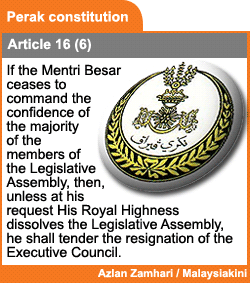
Against the backdrop of these dubious political maneuvers, and with the legal status of the ‘three independents’ in limbo, it is completely amazing as to how the Sultan of Perak could have concluded that the menteri mesar ‘had ceased to command the confidence of the majority of the state assembly members’ as prescribed under Article 16 of the Perak constitution.
The sultan, under these circumstances, was clearly not the correct institution to undertake the task of ascertaining the true state of confidence the menteri besar enjoyed. The only competent body for this task was the state assembly.
[VIDEO:16694]
No loss of majority
Without a legitimate establishment of this loss of majority, there was no constitutional basis to ask for the menteri besar’s resignation. His legal status as menteri besar is, therefore, intact.
At this point, the issue of the sultan’s power to dismiss a menteri besar becomes hypothetical, since the former had no legal basis to make such an attempt. Still, as an academic interest, can the sultan dismiss a menteri besar in the extreme case of the latter having lost majority support and yet refusing to dissolve the assembly?
It is not at all certain that the sultan has such power, as Article 16(7) states that ‘a member of the executive council other than menteri besar shall hold office at His Royal Highness’s pleasure’, implying that the menteri besar may not be dismissed by the sultan.
 But why go into such uncharted terrain when there is an ideal solution at hand to resolve the present predicament – the dissolution of the assembly? Such a solution will kill many birds – the multiplicities of legal complications – with one stone, while returning the mandate to the people, in whom sovereignty lies.
A word on the sultan’s prerogative to withhold consent to the dissolution of assembly. While the sultan may have the legal right to reject a dissolution, such a legal right is not meant to be exercised without accountability.
In a democracy, the decision to dissolve a legislature is rested with the executive head (prime minister or chief minister), and not with the titular head (constitutional monarch or president).
When a constitution provides power to the titular head to overrule such a decision from the executive, it is meant as a protective mechanism to prevent abuses, such as over-frequent elections or fresh elections with no hope of resolving an existing political impasse.
Ousted menteri besar Nizar’s decision to hold fresh election does not fall under this category, and hence the sultan is constitutionally wrong to withhold his consent.
KIM QUEK, a retired accountant, is member of opposition party PKR.


Are you sure you want to delete this comment?
This action cannot be undone.