




SCC Bill renamed, still no real power
The Special Complaints Commission (SCC) Bill - renamed the Enforcement Integrity Commission Bill - is expected to be tabled next month for debate in Parliament.
The Special Complaints Commission (SCC) Bill - renamed the Enforcement Integrity Commission Bill - is expected to be tabled next month for debate in Parliament.
 Minister in the Prime Minister’s Department, Mohd Nazri Abdul Aziz, said yesterday evening that the proposed commission will not have decision-making powers but will only make recommendations to the relevant authority after completing investigations.
“At least now there will be a monitoring system. The relevant agencies will be given a timeframe to act.
“If no action is taken, the findings of the investigation will be made public. The police, for instance, would then be forced to take action due to strong public pressure.”
He said that, according to the federal constitution, action can only be taken by the agencies concerned.
“We have to amend the constitution but the government doesn’t have two-thirds majority in Parliament for this.”
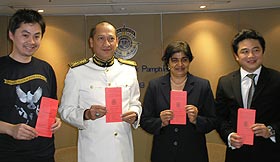 Speaking after launching the Redbook pamphlet, produced by the Bar Council, Mohd Nazri
(second from left in photo)
said Home Minister Syed Hamid Albar will table the Bill for first reading and that he expects it to be passed during the current session.
Speaking after launching the Redbook pamphlet, produced by the Bar Council, Mohd Nazri
(second from left in photo)
said Home Minister Syed Hamid Albar will table the Bill for first reading and that he expects it to be passed during the current session.
The government had back-pedalled on its initial intention to bring in an Independent Police Complaints and Misconduct Commission, as recommended by a royal panel on police operations.
Giving in to police objections, it then drafted SCC Bill which then ran into a wall of criticism from interest-groups and the public due to its watered-down contents and proposal to create a commission to monitor all law enforcement bodies rather than just the police.
Continuing to defend the decision, Mohd Nazri said: “We have more than 20 enforcement agencies. Do we need (separate) complaints commission for the other agencies?
Legal, constitutional rights
Bar Council human rights committee chairperson Edmund Bon said the Redbook project was started after the ‘nude squat’ controversy in 2005, in which a Chinese national was forced to strip and perform ‘squats’ while held in a police lock-up.
A group of lawyers then formed Tangkap - T indakan Anti-Penyalahgunaan Kuasa Polis - to act against police abuse of power by expanding citizens’ knowledge of their rights under the federal constitution and Criminal Procedure Code.
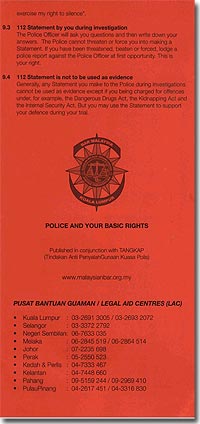
Redbook was launched as a book in April 2006, entitled Police dan Hak-hak Anda (The Police and Your Rights). This has now been turned into a pamphlet.
 “50,000 copies have been published in English. We are also translating it into Bahasa Malaysia, Tamil and Chinese. One day every Malaysian will know their rights without referring to the Redbook,” said Bon
(left)
.
“50,000 copies have been published in English. We are also translating it into Bahasa Malaysia, Tamil and Chinese. One day every Malaysian will know their rights without referring to the Redbook,” said Bon
(left)
.
“It is relevant today, as we don’t want to see cases like those of Francis Udayappan and A Kugan recurring. It is for the betterment of society, not to name or shame the government.”
Bar Council president,Ambiga Sreenevasan said the pamphlet is the Bar’s way of taking the law to the public in an easy-to-read way.
Mohd Nazri said the Redbook will remind citizens of their rights.
“The police have a standard operating procedure and should strictly abide by this. Cases (like that of Kugan) are supposed to be isolated (instances) not the norm,” he said.
“The administration will do all that it can in the interests of the people. (In the case of recommendations of royal commissions, this can’t) be done overnight. We have to look at all aspects, but all recommendations will be adhered to.”


