




Dropout builds hygen for Sabah community
PMR dropout Hamid Jasmin, 42, was one day flipping through a 30-page Indonesian tract on the concept of hydroelectricity.
PMR dropout Hamid Jasmin, 42, was one day flipping through a 30-page Indonesian tract on the concept of hydroelectricity.
It suddenly dawned on him that he could in fact build a mini hydro power generator (hygen) in Kampung Libang Laut, a half hour’s drive from Tambunan, nestled in a mountain valley in the high country. He had some experience as a mechanic with a logging company several years ago before going back to the farm.
Digging deep into his pockets for an initial RM 1,500 and relying on trial-and-error methods, he completed a mini hydro power generator in four months. He became an instant folk hero in all the villages in Tambunan. That was in 2003.
“I collected scrap metal to build the water wheel and a discarded gear box to control the water wheel speed,” recalled Hamid with humble pride. “The most expensive component was the dynamo which was around RM 800 at that time.”
Only RM15 a month now
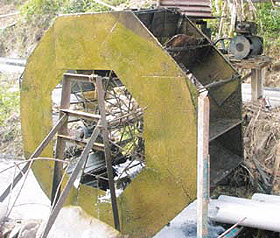 His first generator could supply power almost free around the clock to 12 households in the village. The villagers also had enough power for televisions and their refrigerators besides lighting.
Previously, each household had to fork out RM40 every week to buy fuel oil for their noisy diesel-powered generators which operated only five hours a day i.e. from 6 pm to 11 pm. Sole power utility company Sabah Electricity Sdn Bhd (SESB), a 80 % Tenaga Nasional subsidiary, somehow could never find their way to the village all these years. Now the villagers pay just RM 15 per month per household for maintenance work on the mini hydro power generator.
Hamid didn’t rest on his laurels after his first power project. He built a second mini hydro power generator in 2004 and this time powered four more households.
Eventually, both power projects personally set him back by nearly RM 6,000.
Hamid’s work didn’t go unnoticed either.
Sirim Berhad, the UN-sponsored NGO World Association for Industrial and Technological Research Organisation ( Waitro ) and Mosti (Ministry of Science, Technology and Innovation) came to lend him a helping hand and power the entire village of 200 residents.
On Thursday, two days earlier than scheduled, the newest mini hydro power system with a capacity of 40kv and funded by Waitro to the tune of RM 300, 000 was officially unveiled in a ceremony officiated by Deputy Chief Minister Joseph Pairin Kitingan, also the state assemblyperson for Tambunan and MP for Keningau.
 Dr Maximus Johnity Ongkili, his nephew and the Federal Minister for Science, Technology and Innovation, was there as well beaming with pride, along with Waitro president Di Dieter R Fuchs and Sirim Berhad president Yahaya Ahmad
The community was represented by Hamid’s brother, Dr Yusoff Jasmin, the principal of the nearby SMK Nabayan. It was Dr Yusoff who handed the Indonesian tract to Hamid. The tract was sent by a friend of Dr Yusoff in Indonesia.
The latest project powers an additional 45 households in Kampung Libang Laut where quite a number of families previously relied on the old palasut or kerosene lamps. The new system was built by the villagers themselves with Sirim providing technical assistance and guidance.
Accolades for Hamid
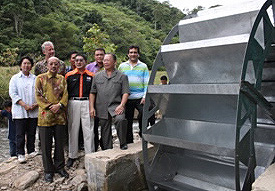 Needless to say, Hamid came in for gushing praise from Pairin, Dr Maximus, Dr Fuchs and Yahaya Ahmad.
“Hamid is an example for others in helping the community,” said Pairin. “Schoolchildren in the village can now study at night. This project should be extended to other villages not only in the district but throughout the state.”
Yahaya Ahmad hailed Hamid as “an example to people who think that inventions and innovations only come from people holding degrees or professional qualifications”. “This is where Sirim comes into the picture to help further develop such ideas as Hamid’s by providing guidance,” said Yahaya. “Sirim hopes to use this project as an educational tool to expose students to technology.”
Dr Fuchs takes the view that it’s not only high-tech projects that can bring benefits to the community but also home-grown technology like that pioneered by Hamid which will pay off for the next generation. “It has been two years since I last visited Kampung Libang Laut,” said Dr Fuchs. “I vowed to come back to help the community.
Dr Maximus disclosed that his ministry had recently launched the Yayasan Inovasi Malaysia (YIM) to breathe new life into projects like that pioneered by Hamid. “Innovation at the village level will be the key to bringing the people out of poverty through their own efforts,” said Dr Maximus.
Looking back, Hamid is glad that he did not let the usual skeptics and quite a few detractors in the village discourage him. He does not know what comes next, having had more than his 15 minutes of fame, but farming has always been in his blood.


Are you sure you want to delete this comment?
This action cannot be undone.