




Sabah health sector needs money, money, money...
The 200-strong medical community at Kota Kinabalu’s ill-fated Queen Elizabeth 11 Hospital (QEH) are at their wit’s end over the “deteriorating conditions of public healthcare in Sabah”.
The 200-strong medical community at Kota Kinabalu’s ill-fated Queen Elizabeth 11 Hospital (QEH) are at their wit’s end over the “deteriorating conditions of public healthcare in Sabah”.
They want either the prime minister or his deputy to loosen the federal purse strings and intervene urgently to help put things right.
They likened the situation to “a public healthcare crisis, no less, not merely a problem” brought about by “a lack of leadership in the Health Ministry, the absence of a full budget for Sabah, and bureaucrats in Kuala Lumpur being in a state of extreme denial about the actual public healthcare situation in the state”.
“The conditions at Queen E are deplorable. There is nothing that local leaders can do to help us since public healthcare, it seems, is a federal matter. All their appeals so far, inside and outside Parliament, have been exercises in futility,” said a specialist who acted as spokesperson for concerned fellow doctors.
They suggested that the federal government should use the special allocation of RM1 billion, pledged last May by Prime Minister Abdullah Ahmad Badawi from his department.
Health Minister Liow Tiong Lai, who was in Kota Kinabalu yesterday, declined to comment on the unavailability of funds for programmes in Sabah but added that “we understand the urgency of having good health facilities in the state”.
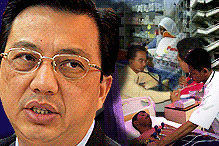 Giving the big picture since the QEH Tower Block was declared unsafe last October, the spokesperson for the doctors said the Health Ministry has failed to take into account the chain reaction after the decanting to decentralise the hospital’s personnel, services and facilities.
“Decanting is easier said than done. When you decant, it automatically means that our need for healthcare staff triples because of the decentralisation. This (the extra staff) is something that we don’t have,” said the spokesperson.
“So, doctors and supporting staff are being overworked and the standard of patient-care has declined tremendously, resulting in needless deaths and longer recovery periods.”
The doctors could not provide precise figures on deaths since “any figure given would be hotly disputed by the ministry” and “we don’t want to get into polemics or an acrimonious public debate on the issue”.
“Suffice it to say that it has been our collective personal experience over the last few months, that needless deaths have occurred,” said the spokesperson.
“My personal experience has been more than one lately. That’s all I can say. Surely, things are not normal and these things (needless deaths) are the logical outcome.”
Three measures needed
Meanwhile, the QEH’s new CT scan lies in a warehouse in the city. By the time it arrived, the Tower Block had been declared unsafe and there was no place to house it.
The old CT scan has been out of order for the past five years and the hospital has been outsourcing all CT scans to the privately-run Sabah Medical Centre (SMC) at a cost of RM6 million to date.
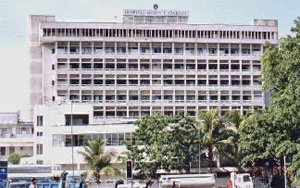 Decanting of QEH has compounded the situation at the dependent hospitals in Kuala Penyu and Pitas, both with 60 beds and built at a cost of RM50 million each; Sipitang (100 beds) which cost RM100 million; and Keningau (400 beds) which cost RM400 million.
“All of them continue to be white elephants sitting in the tropical sun, being understaffed and lacking in the necessary equipment”, according to doctors.
To alleviate the situation, said the spokesperson, three things must happen immediately:
- The QEH Tower Block must be demolished and work must commence on the Twin Tower blocks envisaged under the QEH Master Plan for 2010 on an adjacent site - this will cost an estimated RM500 million.
- The proposed new hospital in Kinarut, just outside Kota Kinabalu, should compensate for the demolished Tower Block.
- The doctors said the Health Ministry must go ahead with the purchase of the SMC - built at a cost of RM150 million - after the owners have renovated the structure as per the ministry’s specifications and requirements. This will cost about RM400 million including the renovations.
The ministry is currently renting space at SMC, paying RM1 million a month. Use of personnel, services and facilities at SMC are billed separately.
No simple solution
Demolishing the Tower Block, however, would create a Catch-22 situation, concede the doctors.
This must be followed by the creation of a 50m free work space around the site for the proposed Twin Tower blocks. This would necessitate the temporary abandonment of the 200-bed colonial blocks on the QEH site which house the medical wards and are still functioning.
Another nearby structure, the emergency and accident centre, does not have to be vacated but is flooded whenever there is a heavy downpour.
The low-rise outpatient block and the Post-Graduate Medical Centre can continue to function as usual during construction work on the Twin Towers.
The medical wards from the colonial blocks could be relocated at the Linqzhi Museum in Jalan Lintas, based on an offer by the owner.
Some have suggested that ministry takes over the vacant nine-storey Wisma Khidmat attached to a four-storey office podium.
The state government had wanted the building to be used to resolve the shortage of beds even before the decanting exercise. The idea is to set up a 250-bed emergency facility.
Neither building, said the doctors, can be converted easily or immediately as renovations would take at least a year.
Another long-standing state government proposal is to build a decanting ward with 250 beds within four to five months near the QEH car park, and to establish a Cardiac Centre, possibly at the SMC in collaboration with the National Heart Centre.


Are you sure you want to delete this comment?
This action cannot be undone.