Change, or reformasi, is the very essence of good governance. As John Maynard Keynes, a very successful economist and public servant once said: "When the facts change, I change my idea. What do you do, sir?"
Within the political context of Malaysia, reformasi, perhaps for the lack of better word, has so far acquired a very peculiar dimension in three stages: When reformasi was borrowed from Indonesia (1998) to tackle similar economic malfeasance in the country; when reformasi was based on a critique of the Federal judiciary (1998-2004); when reformasi has been used to shore up the still gestating political beliefs of Anwar Ibrahim.
Understanding the evolution of this concept would give one a sense of how reformasi in Malaysia is not necessarily what political scientists would call principle-based idea.
Rather, it is an agenda, driven by circumstance or conviction, by political calculations; with context and cultural nuance factored into the equation. To understand how reformasi keeps changing, one has to go back to the chronology.
Chronology of events
1998: The economic dimension
When Amien Rais, an opposition leader of Indonesia began to use reformasi to confront the rule of Suharto during the Asian financial crisis in 1998, reformasi very clearly meant riding the system of corruption, cronyism and nepotism; what in Indonesia then was known as KKN.
Anwar Ibrahim, who was then suing for the same economic agenda in Malaysia, he being the finance minister prior to his dismissal, began using it, albeit to his chagrin.
1998-2004: The judicial dimension
 When Anwar, allegedly the ring leader of reformasi was imprisoned, the clarion call of reformasi in the streets quickly and predictably acquired another face lift.
At issue was not corruption, cronyism and nepotism anymore. Rather, reformasi broadened to challenge the integrity of the entire judicial system, not merely the economic one.
At this stage, reformasi, which continued to echo audibly in opposition circles from 1998 to 2004, was concurrently focused on the Free Anwar campaign.
2004: The political dimension
Since Anwar's release on Sept 2, however, there is no clear sign if reformasi has reverted to changing only specific economic and judicial aspects of the Malaysian government or the country's political culture and structure.
The lack of clarity is mainly due to the inability of Anwar to articulate his vision of reformasi more clearly as he recovers from his back operation.
Yet, the ambiguity is also due to the many statements that Anwar has made in Munich, Germany to different sectors and media with regard to the kind of reforms he has in mind. One can count up to six already:
- Anwar has affirmed that he 'would work with the government', even give it due credit when need be.
For what it is worth, it may well be that reformasi between 1998-2004 could not acquire a more specific agenda, as Anwar, the lead architect, failed to put his thoughts down in print. Barely two weeks after the slogan of reformasi was used, he was already put behind bars.
Stronger, more democratic
Lack of physical freedom certainly deprived Anwar the chance to put a firm imprint on reformasi. Besides, being a leader who makes a clear distinction between strategy and tactics - the former being of a higher order of political thinking in Anwar`s mind - the many permutations of reformasi must seem acceptable, as the broad and general thrust of reformasi still remains the same: To make Malaysian government better, stronger and more democratic.
To be sure, there is nothing wrong with preferring 'reforms' rather than the more pugnacious 'reformasi'.
The former is a constellation of different measures on how to change the government, whereas the latter constitutes challenging the government to change.
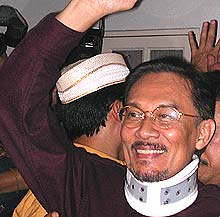 Still, conciliatory reform movement in politics, where everything is voiced and done courteously, is at best an oxymoron verging on being a misnomer. This is because political moderation in temper and means soon enough invites co-optation; a gesture if made in a grand manner would dilute reforms ultimately.
Hence, the reformist politics of moderation, which Anwar seems to want to peddle at the moment, is not something that can sustain itself over the long term.
Nor would the opposition be patient with such mellowed gradualism. If anything, they are counting on Anwar to escalate the response against the government. Such a clash of reformist pace or impulse would complicate Anwar's role in the opposition.
Anwar of course understands the opposition's expectations on him all too well. If one cares to observe, Anwar has consciously or otherwise shied away from using the Malay word 'reformasi' in writing or interviews, preferring the plural English noun 'reforms'.
Such a shift in rhetoric, for someone well-trained in the art of Malay literature, must mean that Anwar has abandoned the more activist form of 'reformasi', which he and his supporters first used as a 'verb' (to change).
Instead, Anwar has adopted a more pluralistic and social-centric concept to prevent the opposition from forcing his hand to confront the government he unwillingly left.
PHAR KIM BENG is author of the Eye Eye You column in malaysiakini . He graduated from the International Islamic University in 1994 as a Muslim revert, having previously been a Buddhist. He has travelled around the world studying at the University of Notre Dame, where he understood the beauty of Catholic scholarship, the University of Cambridge, where he learned the importance of British education, and later the University of Tokyo, where he learned his survival Japanese.