




Someone's got to do it

Tengku Ismail Tengku Su looks tired and withdrawn. From time to time, he looks chirpy, as an idea hits him, before he casts his eyes down.
"There's only me you know. No one else in the family cares, and everyone else outside have their own agenda," he remarks as he takes in the various antiques and memorabilia dotting his home, the famed Pura Tanjung Sabtu.
Pura Tanjung Sabtu is not the usual six star resort. First and foremost it is a private home; home to Tengku Ismail and his brother Tengku Yusof, who lives with his family in one of the refurbished old houses on the estate.
Tengku Ismail was first inspired by his upbringing in the royal family home of Dalam Kota Istana Maziah, a complex of wooden palaces originally built in the early 18th century by Sultan Mansur Shah I of Terengganu (1726-1793), but greatly enlarged by Sultan Zainal Abidin III (1881- 1918) in the early 20th century. As a young boy, he roamed and played in old palaces, and could never see himself living elsewhere.

Tengku Ismail Tengku Su looks tired and withdrawn. From time to time, he looks chirpy, as an idea hits him, before he casts his eyes down.
"There's only me you know. No one else in the family cares, and everyone else outside have their own agenda," he remarks as he takes in the various antiques and memorabilia dotting his home, the famed Pura Tanjung Sabtu.
Pura Tanjung Sabtu is not the usual six star resort. First and foremost it is a private home; home to Tengku Ismail and his brother Tengku Yusof, who lives with his family in one of the refurbished old houses on the estate.
Tengku Ismail was first inspired by his upbringing in the royal family home of Dalam Kota Istana Maziah, a complex of wooden palaces originally built in the early 18th century by Sultan Mansur Shah I of Terengganu (1726-1793), but greatly enlarged by Sultan Zainal Abidin III (1881- 1918) in the early 20th century. As a young boy, he roamed and played in old palaces, and could never see himself living elsewhere.
I built my own castle
His travels abroad to Europe, Thailand, Indonesia and especially Japan were also influential. While working at Malaysia Pavillion during the world exposition 1970, Expo' 70 Osaka (Japan), Tengku Ismail visited the Nijo-Jo Palace built by the first Tokugawa Shogun, Ieyasu, in 1603. This traditional Japanese wooden palace deeply impressed him. It was then that he decided that one day he would do everything in his power to preserve the traditional architecture of Terengganu.
He went all over Terengganu, looking for the houses, "... some I begged, before the previous owners reluctantly agreed to sell their former homes." It was a vision that should stand the heat and time, though with few visitors and a punishing one-man marketing show, Pura Tanjung Sabtu could do with a lot more publicity and activity.
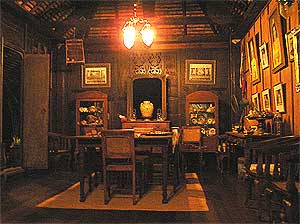 Visiting Pura is like entering a forgotten era, when there were true princes and princesses living in a court; think of it as a bangsawan Dynasty. From the airport you drive to an old and forgotten part of Terengganu, and then you enter a sliproad that passes quaint houses and curious children on bicycles. Finally you come to a huge wooden and weather beaten gate, which leads you into a palatial estate.
Tall coconut trees and jasmine flowers greet you as you drive in. You take in the view of the fields and village animals grazing and playing on the land. You look up and there's Tengku Ismail, waiting happily for your arrival.
The tea that you're served with is only the beginning of a fantastic repast you'll get during your stay.
"Everything is home-made. You'll get nothing but Trengganu specialities when you're here," he said.
You look mah-vellous dahling
Tengku Ismail is a regular fixture on the social and benefits circuit, though he explains, smiling wrily, that " it's all work, darling." But he works the scene, because these personalities buy his songket , and whatever profit he makes from selling songket goes to preserving Pura. ( He is not only a one person marketing/pr/advertising unit, he is a songket designer, royal archivist and amateur historian.)
"I'm scared I'll just drop dead one day. The work is sheer murder, but I have to do it."
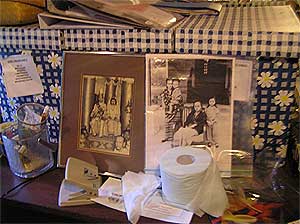 His days are taken up with appointments with Sultans, royalties, family, domestic help and preserving artefacts. He is now taking a course in Adobe Photoshop, to touch up old photographs he has scanned and filed in the computer. He telephones old aunts and uncles, cajoling them to give him their old photographs. They of course indulge in his whims and fancies though Tengku Ismail knows that they think he is insane.
It costs a minimum of RM50,000 per annum to run Pura Tanjung Sabtu. This may seem a pittance to other heritage sites that receive support and grants locally and internationally, but for a small outfit like Pura, it would be godsend. It is because of his zeal and passion for authenticity that may be driving the cost of preserving history and heritage up the roof. There is talk that Tengku Ismail is more than capable of funding the estate, using his inheritance and allowance, but this is finite.
The rest, as mentioned earlier, is all about pr.
S.O.S
Tengku Ismail needs staff. To run and market the place. To care for the guests. To do so means a lot of money, and this is without the frills.
"But I show the guests a good time. They have great food. In the mornings they go on a boat ride and visit the town. There's always something to do here. By the time they get back they're tired. Then they're entertained. By me! I tell them all the scandals, stories, history it's not always one gets served drinks by a prince, no?" he laughs.
The strange thing he notes is that among the locals that visit, it is the non-Malays that are keen to learn about local heritage and culture. The Malays are not keen on their heritage as it's 'about old things, and old things are not flashy'.
"For instance, with songket, the Malays prefer contemporary designs. The more loud and garish they are, the better for them. I prefer the classic designs, as they are so much more attractive and 'softer'. And with Pura they're not keen on old things. I only get the foreigners going crazy over the estate."
Should you come, wander about the rooms. You'll be delighted to find old photos and woodcarvings incorporated into the dcor. Personal touches add colour to the rooms. It is this attention to detail and love that makes Pura special.
While the ambience is warm and cosy, staying at Pura does humble you somewhat. You look at the old floorboards and wonder who had stepped on them many years ago; you visit a room and wonder who slept there, and then you realise, nothing is permanent, except change.
Tengku Ismail and his brother keep up a lively banter as they ferry you to all the spots that are on the tourist map, as well as undiscovered treasures. You can opt for a dawn boat-ride that takes you to town. You can even ask for the local massage specialty (this is for men): Urut Minyak Lintah (The Leech Oil Massage), that purportedly gives men more prowess in the bedroom, boardroom and bathroom. According to the whispers, one's apparatus can grow longer and bigger too.
"No thanks, I'm quite happy with mine," a photographer that was there for a magazine shoot quipped.
It is late at night. Tengku Ismail sinks into his sofa and sighs. "There's a lot of work to do," he says, and closes his eyes.
Pura Tanjung Sabtu is about 45 minutes flight from KLIA to Kuala Terengganu. For more information, visit its website: www.puratanjungsabtu.com . Contact details: Tengku Ismail (+6019-9833365) or Tengku Yusof (+6019-9484854). Telephone: +609-6153655; Facsimile: +609-6155013


Are you sure you want to delete this comment?
This action cannot be undone.