




Golok crossing brings hope to southern Thais
ON a narrow wooden platform along southern Thailand's Golok river, scores of poor Muslim Thai students jump out of a boat just arrived from across the border.
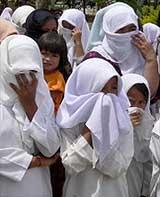 Armed only with school bags, the boys in white shirts and girls with white headscarves make a daily commute to school in wealthier Malaysia, which they and their parents hope will give them a safer, more hopeful future.
The scene is a daily ritual along the frontier in Thailand's insurgency-hit Narathiwat province.
"Teachers in Malaysia are friendly. Those of us who can't afford get free books," said Akilah, 10.
In southern Thailand, in sharp contrast, teachers, students and schools - seen as easy targets representing the Buddhist-majority state - have often been attacked in the provinces bordering Malaysia since a separatist insurgency erupted in January 2004.
Sixty-five of the roughly 2,000 victims have been teachers. Those brave enough to keep working have been allowed to carry weapons outside the classroom since early this year.

 Thailand's army-installed Prime Minister Surayud Chulanont and Malaysian counterpart Abdullah Ahmad Badawi agreed last month to boost cooperation in a bid to end separatist unrest.
Militants responded by staging almost 50 Lunar New Year attacks that left nine dead in the south, where the majority of people are Muslims, like their Malaysian neighbours.
'Malaysia is safe'
In the biggest clash since then, at least eight separatist militants were killed Friday in a battle with Thai troops near the border, security officials said.
"I fear my son will be killed by the bombs. We know Malaysia is safe and only education can ensure his future," said Amir Gani, 30, clutching his son Amirul, three, with his wife Suriyati, 25.
He was heading back to Narathiwat after another day of casual work over the border, and does not see any future for his family in southern Thailand.
Malaysia has tightened border security since the Thai and Malaysian leaders met, but many like Amir and the children still make illegal crossings.
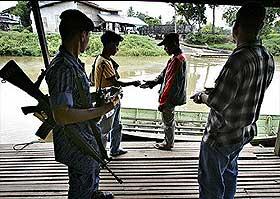 There is a legal border point just metres but many commuters prefer to cross illegally to save time and because they are often too poor to afford passports. Authorities do nothing to stop them.
"There is no job here for me," said Amir, one of thousands of Muslim Thai migrants who enter Malaysia every day in search of work.
"I have applied for a legal document to stay in Malaysia."
Many southern Thais also hold a Malaysian passport, which security forces say makes it easier for insurgents to slip back and forth over the border.
"Given a choice, I want to be a Malaysian. It is safe here. I can feed my family. We live in Golok and we live in fear every night," Amir said.
Golok itself has been hit by deadly bombings.
Akin to ethnic cleansing
But a lawmaker on the Malaysian side, Abdul Fatah Harun of the opposition Islamic party, said Malaysia should not encourage disgruntled southern Thais like Amir.
"Muslims will then become minorities in the south. This is akin to ethnic cleansing," he said.
Amir, for his part, said the Thai government must ensure justice to end the violence.
"The rule of Buddhist first, Muslim second, must end. This policy is making Muslims angry," he said.
Angry and fearful, many are looking south over the border.
Akilah said it was easy to get a place in a Malaysian school. Now, she wants to be a teacher.
Another youngster, nine-year-old Muhamad Akin, has studied for three years in a primary school in Kelantan, which borders Narathiwat.
He said his parents send him to Malaysia because of security concerns, and because the schools are better.
"It is not safe in Golok," said Muhamad, whose father also makes the daily river crossing to work at a supermarket in Rantau Panjang town.
"I want to study hard and join the army," the boy said.
"I want to carry a gun and kill all the bad people," he added as he boarded the boat home to Golok.


Are you sure you want to delete this comment?
This action cannot be undone.