




Telling the stories of refugees in Malaysia
MOTHERS with young children camping in the jungle, with barely enough food to survive. Teenagers alone in a foreign country, unable to work, with no access to education. Men who have escaped torture and slave labour, now working gruelling hours in exchange for little, if any pay.
This is happening in Malaysia, right on our doorstep.
 When I first visited
fiftyrefugees
, I was truly shocked. The painful stories of people our government refuses to acknowledge opened my eyes to an issue which is largely ignored by our society today.
When I first visited
fiftyrefugees
, I was truly shocked. The painful stories of people our government refuses to acknowledge opened my eyes to an issue which is largely ignored by our society today.
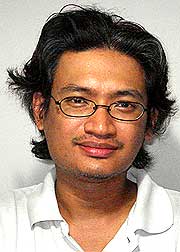
The work of 37-year-old humanitarian Aris Mohamad Oziar ( left ), the website gives a voice to 50 refugees and asylum seekers of various ethnicities and nationalities, highlighting the suffering they endured in their native countries as well as the persecution they continue to experience in Malaysia.
"I thought that our Merdeka celebrations offered a great opportunity for me to do this," said Aris. "We have tasted freedom for 50 years, but we're still not willing to give it to those who come to seek our help."
A life of hardship
Although nobody knows exactly how many undocumented migrants there are in Malaysia, estimates range from several hundred thousand to over a million. Of these, approximately 100,000 are refugees or asylum seekers.
The government's legislation makes no distinction between undocumented migrants and refugee/asylum seeker communities, leaving the latter bereft of international support and protection. As such, the United Nations High Commission for Refugees (UNHCR) has been fulfilling the normally governmental role of registration, documentation and status determination of refugees and asylum seekers in Malaysia.
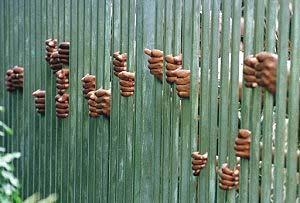 Even those who have fled persecution and conflict are hence regarded as "illegal" in the eyes of the Malaysian law enforcement system. This increasingly includes those who hold UNHCR documentation, with tens of thousands of people vulnerable to arrest, detention, caning, and deportation as well as its associated risk of human trafficking.
The current punishment for illegal entry into the country involves a maximum fine of RM10,000 and/or a jail term not exceeding five years, and a mandatory whipping of up to six strokes.
Banned from working legally, they endure very poor living and working conditions, and live in constant fear of arrest and deportation. Medical care is difficult and expensive to procure, with the refugees risking arrest if they seek help from government clinics and hospitals without appropriate documents.
It is deemed illegal to shelter, help, harbour or employ these people.
Telling their stories
Aris worked for an international medical NGO called Doctors Without Borders, or Medecins Sans Frontiers (MSF) - first in Darfur, Sudan, and then with refugees in Malaysia.
"It was mainly admin and finance work, so I was stuck behind a desk, behind the scenes," he says. "So one day I decided that I really wanted to get to know the people I was working to help."
"I wanted to know who they were, why they were here, what their lives were like."
Over a period of three months, Aris devoted his own time and resources to the project. His experience at MSF had established a sense of connection and trust between himself and various community leaders, which was useful in reaching the people he wanted to meet.
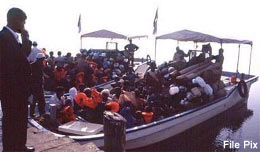 "Of course, there were some problems," admits Aris. "Because most of the people I interviewed did not speak English or Malay, we had to use translators, so the interview process was quite slow."
"The language barrier meant that the stories they told tended to focus on factual recounting. It was very hard for me to gauge and translate their emotions."
Gender became an issue as well.
"Sometimes, I think it was difficult for women to recount their experiences especially if they had been raped, as both myself and the translator were male."
"Also, it was difficult to reach everyone - there were people from some ethnicities I didn't interview, such as the Rohingyas from Myanmar. This was due to time constraints and the fact that I didn't push hard enough to extend my contacts."
What next?
Despite these constraints, Aris has managed to create a comprehensive and detailed account of the plight of these immigrants in Malaysia, aiming primarily to bring their stories to the ears of people who can make a difference.
"People just don't know about the situation in our country," he explains. "But if we can give the refugees a human face, give their stories some publicity, then perhaps the government might actually do something. We can't expect change overnight."
The 'Do Something' link on Aris' page is empty.
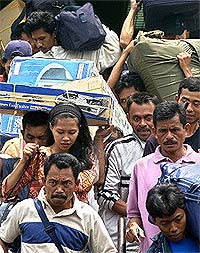 "Because of the official 'illegal' status of these people, the situation is delicate and it's quite difficult to help them. I thought about putting some links or contact details up on the site, but decided against it because I don't think they actually want direct publicity or help."
Although several international NGOs such as UNHCR, Human Rights Watch and Refugees International have called for changes in our country's policies on refugees and asylum seekers, nothing has been done to date.
In April of this year, the government declared that it does not want the nation to become a hub for political dissidents and illegal migrants in the South-East Asian region. Although Malaysia is a member of the United Nations Human Rights Council, it has refused to ratify the United Nations Convention in relation to the Status of Refugees (1951) and Protocol (1967).
Aris is moving on to work with the Wildlife Conservation Society, but he retains his concern for the refugees, hoping to spread the word.
"At the moment the site is receiving 3-400 hits a day. It is being publicised mainly by word-of-mouth and bloggers."
"I just want people to realise that these refugees, these lives, exist. It all starts with awareness. After that, we'll see."
HON YI WEN is an intern with Malaysiakini.


Are you sure you want to delete this comment?
This action cannot be undone.