


/file/publisher-c1a3f893382d2b2f8a9aa22a654d9c97/2025/09/9ae70c22efc69618061903ca512fb666.jpg)

Malaysia opens World Social Security Forum
The World Social Security Forum (WSSF) 2025 opened in Kuala Lumpur today with calls for stronger, fairer and more future-ready social protection systems, as Malaysia positioned itself at the centre of global dialogue.
More than 2,000 delegates from 253 institutions across 133 countries are attending the five-day event at the Kuala Lumpur Convention Centre, the largest gathering of its kind. The forum, themed “Shaping Social Security for a World in Transition,” is organised by the International Social Security Association (ISSA) and co-hosted by Malaysia’s Social Security Organisation (PERKESO) and Employees Provident Fund (EPF), with support from KWAP and the Prime Minister’s Department.
‘No one should stand alone’
PERKESO Group Chief Executive and ISSA President Dato’ Sri Dr Mohammed Azman Aziz Mohammed opened the forum with a reminder that social protection must remain people-focused.
“It is about people, and the promise that when life tests us through age, illness, accident, or uncertainty, none of us will stand alone,” he said.
He noted that while high-income countries are nearing universal coverage, fewer than 10 percent of workers in low-income nations are protected. Worldwide, 3.8 billion people still lack social security.
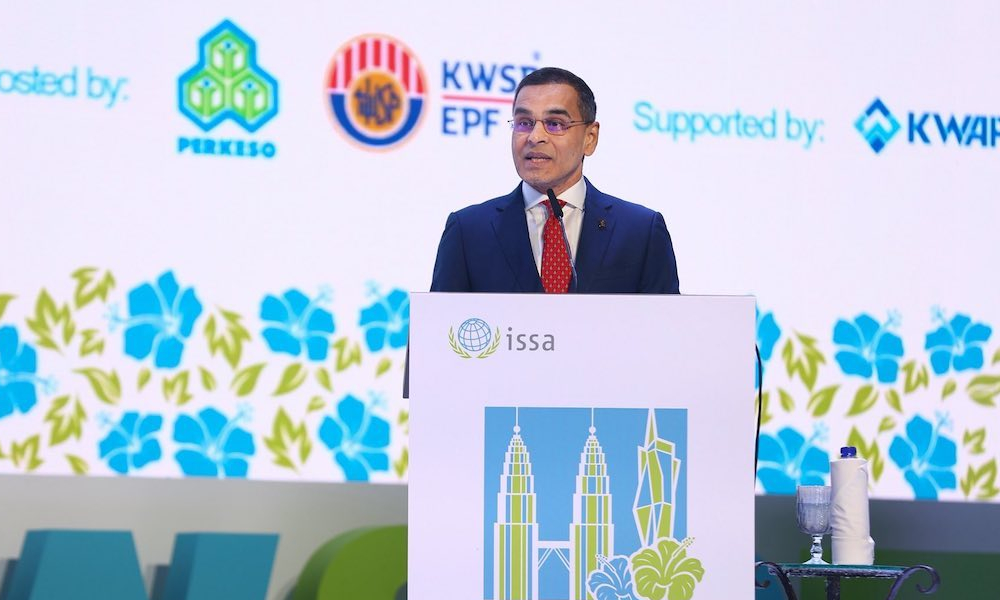
“Let Kuala Lumpur be the heart where a covenant is born - one that says no worker should stand unprotected, no elder should live without dignity, and no child should grow without hope,” Azman said.
Malaysia’s reforms in focus
Human Resources Minister Steven Sim underscored the stakes with the story of two gig workers killed in the 2023 Shah Alam plane crash. One had active PERKESO coverage and left his family with a pension; the other did not, leaving his dependents without support.
“Same accident, same time, same sector, yet two very different fates. The only difference was social security,” he said.
Sim noted that more than 10 million workers are now insured under PERKESO - a 63 percent increase over the past decade - alongside one million self-employed. Over 500,000 homemakers have also been included through the LINDUNG KASIH scheme.
The Gig Workers Bill, passed in Parliament recently, makes coverage compulsory for millions of gig workers, including riders and drivers. “These are the stories of countless Malaysian families. We can now be confident that such tragedies of exclusion will never be repeated,” the minister emphasised.

24/7 protection under SKBBK
Building on that message, Prime Minister Datuk Seri Anwar Ibrahim stated that Malaysia must continue to expand protection to groups long left out.
“I saw how poverty strips away opportunity, and I learned that solidarity can restore dignity and hope,” he said, recalling his early activism in the 1970s.
He said reforms now underway include amendments to the Employees’ Social Security Act 1969 (Act 4) and the proposed Skim Kemalangan Bukan Bencana Kerja (SKBBK). The new initiative is expected to provide 24/7 coverage, extending protection beyond normal working hours and to accidents that occur during travel not directly tied to employment.
Anwar noted that accidents can happen anytime, adding that real progress is judged not by GDP or tall buildings, but by how a nation safeguards the dignity of its people.
Global stage, local leadership
This year’s forum, held for the first time in Malaysia, will run until Oct 3 and end with the World Social Security Summit, where leaders will set priorities for the next decade.
For Malaysia, the spotlight offers a chance to showcase reforms that extend protection to new groups while contributing to a broader global roadmap.
Azman summed up the urgency: “For every day we wait, more lives fall through the cracks. The world is waiting, and the time is now.”
This Social Security series is in collaboration with PERKESO.


