


/file/publisher-c1a3f893382d2b2f8a9aa22a654d9c97/2025/10/4bd0e38387c475278297ce7a9d001c66.jpg)

Closing the gap: Innovative approaches to extending social security
Universal social security coverage - the idea that every person should be guaranteed at least a basic level of protection against illness, unemployment, old age and other risks - remains more aspiration than reality.
Today, more than four billion people still lack it. At the current pace, it could take another 50 years to achieve.
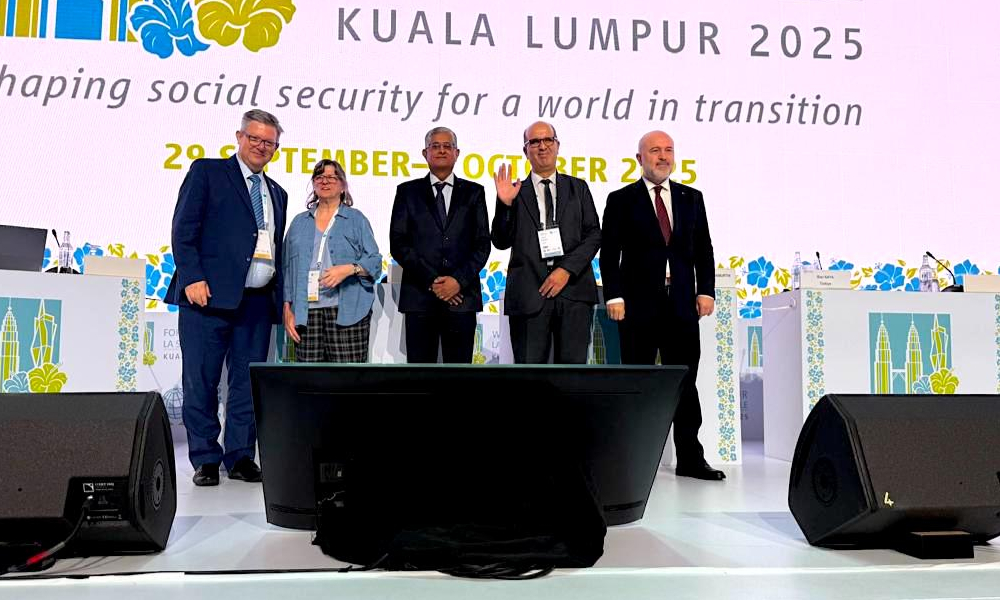
That stark estimate came from Helmut Schwarzer, Head of Public Finance at the International Labour Organization (ILO), a panel at the World Social Security Forum (WSSF) 2025 in Kuala Lumpur.
Moderated by Taoufik Katrou, Secretary-General of Tunisia’s National Social Security Fund, the session asked a central question: if universal coverage is so far off, what are countries actually doing to speed things up?
Schwarzer pointed to promising signs. While progress globally has been slow, some nations have pushed ahead more decisively, showing it is possible to extend protection quickly to groups long left outside the system.
The experiences of Uruguay, India and Türkiye, he suggested, are proof that ambition and innovation can change the trajectory.
Uruguay: Dialogue and union power
In Uruguay, extending coverage has meant combining sector-specific action with broad-based social dialogue. María del Rosario Oiz Márquez of the Social Insurance Bank noted how domestic work, long among the hardest sectors to formalise, now enjoys around 60 percent coverage.
The breakthrough came through unionisation, which forced recognition of workers’ rights and created a pathway to formalisation.
At the same time, programmes like Uruguay Impulsa are bringing unemployed adults into temporary jobs and training, while youth and persons with disabilities benefit from tailored projects.
But Oiz Márquez argued that the country’s real strength lies in its participatory approach. National dialogues in 2006 and 2011-12 led to sweeping reforms in pensions, unemployment benefits, healthcare and taxation. Another year-long consultation is underway today. “Social security is built on participation, not just policy,” she stressed.
India: Digital rails and health as the entry point
If Uruguay’s story is one of dialogue, India’s is one of scale. Ramesh Krishnamurthi, Central Provident Fund Commissioner, said India has expanded social protection from just 19 percent of its population in 2015 to more than 64 percent today.
The leap was powered by what he called the “JAM Trinity”: Jan Dhan mass bank account access, Aadhaar national digital ID system, and mobile phone. Together, these created a robust digital public infrastructure to deliver benefits quickly and widely.
Health insurance became the entry point. The Ayushman Bharat scheme now covers about 400 million people, not just low-income households but also senior citizens over 70, 35 million platform workers, and millions of community health and childcare staff.
“The sequencing matters,” Ramesh said. “Universal health insurance was the first step - then employment incentives and pensions could follow.”
Looking ahead, India is experimenting with new ways to reach informal workers, who still make up the majority of its labour force. The e-Shram portal has already registered more than 310 million of them, creating a portable database that follows workers across jobs and states.
Future plans include micro-contributions automatically deducted from digital payments and flexible “target retirement sums” that allow workers to top up their pensions irregularly, from any source.
“We should embrace the movement between formality and informality,” he stated. “In both cases, social security must follow the worker.”
Türkiye: Incentives, tech and cohesion
For Raci Kaya, Chairman of Türkiye Development Bank, the case for expanding coverage is not just technical but moral. “Extending coverage is economic justice and social cohesion,” he said.
Türkiye has cut its informality rate from 50 percent three decades ago to 17 percent today (excluding agriculture), combining digital innovation with targeted incentives. Through 180 e-government services, citizens can register, contribute and track benefits seamlessly.
Smart inspections and data-sharing between tax, banking and public systems have formalised hundreds of thousands of workers and businesses. At the same time, outreach campaigns have reached millions with information and reminders.
Financial incentives have also played a role: premium discounts for employers who hire women, youth and people with disabilities, tax breaks for young entrepreneurs, and Treasury-covered contributions for disabled workers.
Projects funded by the European Union and World Bank have supported women’s employment and childcare provision, while simplified e-government models now make it easier for households to register domestic and seasonal workers.
But Kaya warned that the rise of platform and gig work poses fresh risks. Traditional systems, built on stable long-term employment, are struggling to adapt to workers who juggle multiple short jobs. Türkiye is now designing regulatory reforms to close those gaps without undermining the contributory model.
Shared ambition
From Uruguay’s union-driven formalisation to India’s digital infrastructure and Türkiye’s blend of tech and incentives, each country has found different ways to bring hard-to-cover groups into the social security net.
The common thread is a willingness to innovate - whether through social dialogue, digital tools or targeted subsidies.
As the ILO’s Schwarzer reminded the forum, ambition counts as much as design. “We need renewed strategies for formalisation, expansion of non-contributory benefits, and a higher ambition in extending coverage,” he said.
If more countries match the momentum of the frontrunners, universal protection may arrive far sooner than the gloomy forecasts suggest.
This Social Security series is in collaboration with PERKESO.


