


/file/publisher-c1a3f893382d2b2f8a9aa22a654d9c97/2025/03/c991834bd068a332c48df4db7ec2a27c.jpg)

Powering banking with quantum computing
What is quantum computing?
Quantum computing is an emergent field of cutting-edge computer science harnessing the unique qualities of quantum mechanics to solve problems beyond the ability of even the most powerful classical computers.
The field of quantum computing contains a range of disciplines, including quantum hardware and quantum algorithms. While still in development, quantum technology will soon be able to solve complex problems that supercomputers can’t solve, or can’t solve fast enough.
By taking advantage of quantum physics, fully realised quantum computers would be able to process massively complicated problems at orders of magnitude faster than modern machines.
Quantum advantage
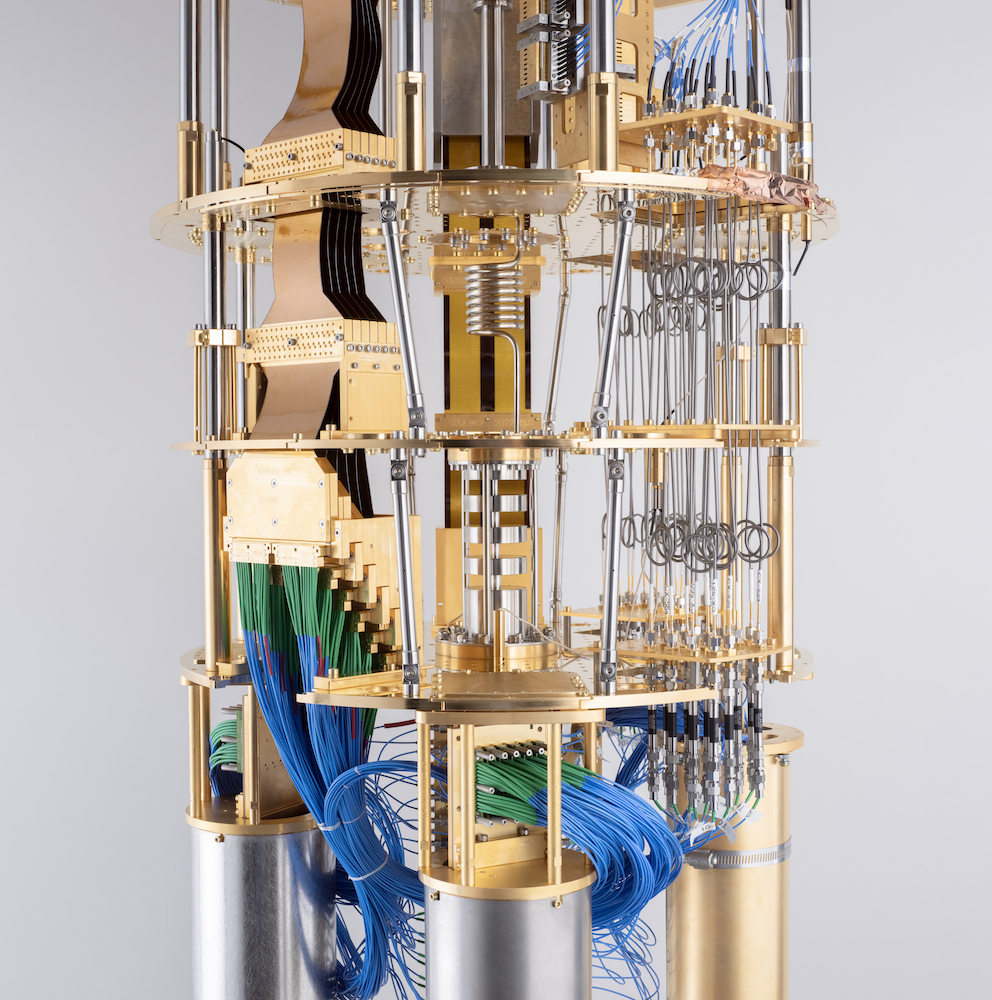
Today, IBM’s industry-leading quantum computers operate at “utility scale” - when a quantum computer is able to perform reliable computations at a scale beyond brute force classical computing methods that provide exact solutions to computational problems.
Previously, these problems were accessible only to classical approximation methods - usually problem-specific approximation methods carefully crafted to exploit the unique structures of a given problem.
This era of quantum utility means the quantum computers of today are valuable, useful tools researchers can use to explore meaningful scientific problems.
But the world is not quite up to quantum advantage, yet.
Think of quantum advantage as quantum computation that delivers a significant, practical benefit beyond either brute force or approximate classical computing methods, calculating solutions in a way that is cheaper, faster or more accurate than all known classical alternatives.
Researchers believe that quantum advantage will not occur as a single moment in time, but rather as an incremental journey - a growing collection of problems for which researchers first demonstrate practical relevance, and then quantum advantage.
IBM expects quantum advantage to be demonstrated within two years, especially in applications such as high energy physics, materials science, healthcare and life sciences, optimisation, and sustainability.
In the coming years, progress will continue to be made according to IBM’s established roadmap. This year, it is expected that hybrid classical and quantum computing will become more accessible through middleware that enables the integration of both technologies, with tools such as IBM’s Qiskit software.
Over the next three years, IBM’s goal is to present a viable path to error-correcting quantum computing, establishing all the necessary components for its implementation. And by 2029, it expects to deliver a fault-tolerant quantum computer that will help to unlock completely new computational territory for industries.
Regarding specific industries, IBM has also launched working groups focused on industries it believes will benefit most quickly:
Healthcare and life sciences: Led by organisations such as Cleveland Clinic and Moderna to explore applications of quantum chemistry and quantum machine learning to challenges such as accelerated molecular discovery and patient risk prediction models.
High energy physics: Comprised of groundbreaking research institutions such as CERN and DESY, which are working to identify the best-suited quantum calculations for areas such as identification and reconstruction algorithms for particle collision events, and the investigation of theoretical models for high energy physics.
Materials: Spearheaded by the teams at Bosch, The University of Chicago, Oak Ridge National Lab, ExxonMobil, and RIKEN, they aim to explore the best methods to build workflows for materials simulation.
Optimisation: Aimed at establishing collaboration across global institutions such as E.ON, Wells Fargo, and others to explore key questions that progress the identification of optimisation problems best suited for quantum advantage in sustainability and finance.
Sustainability: The most recently launched working group, this team, which includes PINQ², Université de Sherbrooke, Hydro-Québec, University of Luxembourg, and E.ON, aims to design quantum computing and hybrid solutions to address sustainability challenges in the fields of materials and energy.
Key challenges
One of the most important obstacles for the industry to overcome is the development of a skilled quantum workforce. The set of skills the quantum industry needs today is around quantum computational science.
In the near future, there will be a growing need for data scientists with quantum information science skills. At some point in the future, quantum will touch every industry, and everyone should have some basic understanding of how HPC, AI, and quantum computing can be used together.
Although collaborative networks between industry, academia and research have been established, further expansion of these ecosystems is required to foster innovation and ensure the applicability of quantum technology across multiple sectors.
An example of this is the IBM Quantum Network, which brings together more than 250 academic, research, startup and industry entities from around the world to share advances and help accelerate the adoption and benefits of quantum computing.

Quantum computing in financial services
Classical computers limit the potential of machine learning to solve specific financial services problems, whereas quantum computing promises higher-quality solutions.
Quantum for speed and accuracy: Financial services institutions are exploring quantum computing to enable calculations that are not possible with traditional computing technology.
Utility-scale systems: Today’s utility-scale quantum systems are already being used to test and develop financial services use cases in such applications as targeting and prediction, asset trading optimisation, and risk profiling; three areas that have been shown to have the highest potential.
The time is now: Engaging now is important, as financial institutions that adopt quantum computing early will be able to take advantage of the arbitrage potential that is impossible for those who remain solely on traditional computing.
Benefits of the Quantum Era for financial services:
Enhancing investment gains
Reducing capital requirements
Opening new investment opportunities
Improving the identification and management of risk and compliance
Front-office and back-office decisions on client management for “know your customer,” credit origination, and onboarding
Treasury management, trading and asset management
Quantum Safe cryptography
IBM’s mission is to bring useful quantum computing to the world and make the world quantum-safe. The good news is that quantum-safe cryptography standards and solutions exist, today.
As rapid progress is being made in this quantum era, accelerating industries’ quantum-safe cryptography transition and building crypto-agility is imperative. Organisations must modernise during this transformational time so they can quickly respond to risks and adapt their systems, applications, and platforms.
Indeed, the National Institute of Standards and Technology (NIST) is already publishing post-quantum cryptography standards to protect encrypted data from quantum-enabled threats. (In August 2024, two of the three NIST-published PQC algorithms were co-developed by IBM.)
IBM Quantum Computing & Quantum Safe knowledge: IBM Research has been a pioneer in both quantum computing and quantum-safe cryptography.
IBM put the first-ever quantum computer on the cloud in 2016 and has a global user base of more than 650,000. There are more than 250 organisations in the IBM Quantum Network and it has the largest deployed fleet of quantum computers, accessible over the cloud, and two IBM-developed algorithms were officially published among NIST’s post-quantum cryptography standards.
IBM Quantum Safe expertise: IBM’s quantum-safe consulting strategy entails working side by side with organisations, understanding and prioritising their needs, and then creating, tailoring, and scaling step-by-step solutions.
IBM Consulting Quantum Safe Transformation Services assist enterprises in adopting and maintaining a three-phase programme:
1. Raising quantum risk awareness and identifying priorities across the organisation;
2. Preparing an organisation’s roadmap for post-quantum cryptography migration;
3. Executing the migration and co-operating a Quantum Safe Center of Excellence for further resilience and agility.
IBM Quantum Safe technology: IBM has a technology ecosystem with multiple entry points, featuring built technologies to explore, advise, and remediate quantum risks. Its new software offering, Guardium Quantum Safe, leverages IBM’s leadership in quantum research as well as its leadership and expertise in data security.
This blueprint is based on the core values defined in Quantum Governance Principles: transparency, inclusiveness, accessibility, non-maleficence, equitability, accountability, and the common good.
Industry consortia: IBM is also working with numerous industries on quantum-safe consortia, which bring together industry associations, companies with expertise in post-quantum cryptography, and market leaders in specific sectors to develop ecosystem-wide cooperation, assets, and strategies.
In 2024, IBM announced the formation of the Emerging Payments Association Asia (EPAA) work group on post-quantum cryptography. With founding members EPAA, IBM, HSBC, AP+, and PayPal, the EPAA work group unites leading financial services providers across the global payments and banking landscape to drive awareness, controls, initiatives, and technical solutions.


Are you sure you want to delete this comment?
This action cannot be undone.